FAQ automation for SMEs: turn repeated website questions into sales and support follow-up
FAQ automation helps SMEs answer repeated website questions, capture leads, route support issues, and build a follow-up workflow before enquiries go cold.
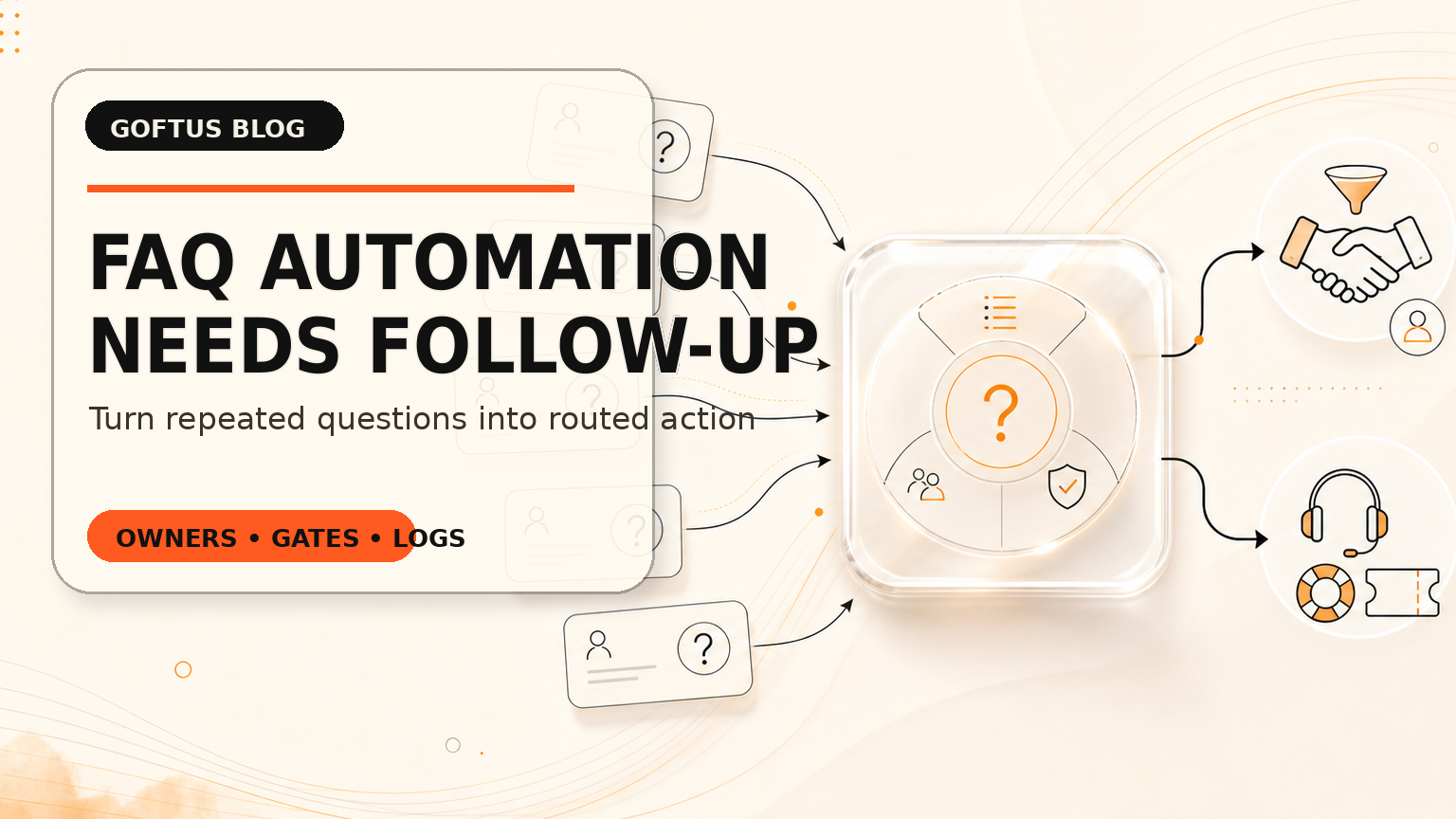
# FAQ automation for SMEs: turn repeated website questions into sales and support follow-up Meta description: FAQ automation helps SMEs answer repeated website questions, capture leads, route support issues, and build a
FAQ automation for SMEs: turn repeated website questions into sales and support follow-up
Meta description: FAQ automation helps SMEs answer repeated website questions, capture leads, route support issues, and build a follow-up workflow before enquiries go cold.
Quick answer
FAQ automation is the right daily SEO cluster for this GOFTUS run because no UTC 2026-08-21 blog post currently targets FAQ automation, AI FAQ automation, website FAQ chatbot, automated customer answers, or support FAQ automation. The business problem is practical: repeated website questions are not just content gaps. They are sales signals, support triage inputs, and follow-up tasks that often disappear in inboxes, chat widgets, and staff memory. A useful FAQ automation service answers common questions, captures the question that was asked, routes harder issues to the right owner, and sends the context into CRM or support tools. GOFTUS would connect that first customer-answer layer to /services#faq-automation, then expand it into wider workflow automation when the data shows where leads and support requests are leaking.
What this means for SMEs
The source signal for this post comes from the GOFTUS daily SEO FAQ output, which continues to show FAQ automation as an eligible 92-score product and blog keyword, plus Google News RSS results around customer service automation, AI FAQ automation, support deflection tools, and website chatbots. The RSS results surfaced Salesforce, G2, CMSWire, IBM, Trend Hunter, Sprout Social, and other customer-service automation coverage. Those are headline-level and market-context signals, not a claim that GOFTUS independently scraped every article body. Reddit search RSS returned malformed feed content in this unattended run, so Reddit is not used as a verified source for the article.
For UK, US, and EU SMEs, the important point is that customer questions usually arrive before the business has a clean workflow. A visitor asks whether a service fits their problem. A buyer asks about price, scope, timing, region, integrations, or proof. A customer asks about a ticket, invoice, booking, onboarding step, document, login, refund, or delivery issue. If the answer sits only in a static FAQ page, the business may answer the question but lose the signal. If the answer sits only in a chatbot, the business may collect messages but fail to route them.
Thirumurugan's view is that FAQ automation should be treated as the first support and sales operations layer, not as a cheap chatbot add-on. The workflow should start with the question itself. What was asked? Which page did it come from? Was the answer known? Did the visitor leave contact details? Was the issue sales, support, billing, onboarding, technical, or urgent? Did the system create a follow-up task? Did a human review unanswered or risky questions at the end of the day?
That is where GOFTUS differs from a normal FAQ plugin. A plugin may display answers. GOFTUS designs the workflow around the answer. Repeated questions become published FAQ items. Sales-ready questions become lead records. Support questions become tickets or triage notes. Sensitive answers, such as pricing, contracts, refunds, compliance, medical, legal, or finance topics, stay behind human review. Unknown questions are not hidden. They become a weekly improvement list.
SMEs should also avoid the trap of launching an AI FAQ layer without boundaries. If the website FAQ chatbot guesses, over-promises, invents a policy, or routes everything to the wrong inbox, the customer experience gets worse. The safer pattern is to define approved answers, escalation rules, CRM fields, support categories, owner alerts, and a review cadence before the bot goes live. Automation should shorten the time to a good answer, not replace responsibility for the answer.
The fastest useful build is narrow. Pick one service page or support journey. Gather the top questions staff answer manually. Write approved short answers. Route sales questions to the right owner, support issues to the right queue, and unanswered questions into a review list.
What SMEs should do next
Start with a one-page FAQ workflow map. List the trigger, the source page, the approved answer, the customer data captured, the escalation owner, the CRM or support destination, and the review date. Decide which answers the AI can provide immediately, which answers need a confidence check, and which answers should ask for contact details before a human replies.
Next, connect the workflow to GOFTUS /services#faq-automation. The goal is not to flood the site with generic questions. The goal is to turn real buyer and customer language into reusable answers, lead qualification, support routing, and evidence for improvement. If the business already uses HubSpot, Pipedrive, Airtable, Notion, Zendesk, Freshdesk, Intercom, Gmail, Sheets, n8n, Make, or Zapier, the FAQ layer should hand work into those systems cleanly instead of creating another place staff must check.
Finally, review the unanswered-question log every week. Those questions reveal missing service copy, unclear pricing, weak onboarding, confusing product pages, poor handoffs, and support issues that should be fixed upstream. The best FAQ automation does not just answer more questions. It teaches the business which questions deserve better workflows.
Competitor lens
Zapier, n8n, Relevance AI, Lindy, Gumloop, Bardeen, Make, and Stack AI can move data between tools or help teams build quick automations. Consultancies such as Faculty AI, Deeper Insights, Waracle, Brainpool AI, LeewayHertz, Markovate, SoluLab, BairesDev, Addepto, STX Next, Netguru, and 10Clouds can support broader AI or digital projects. Many of those options are useful.
The missing layer for SMEs is ownership of the customer-answer workflow. Tools automate tasks. GOFTUS automates the workflow around the task. That means GOFTUS looks at approved answers, escalation rules, CRM handoff, support triage, staff review, unanswered-question improvement, and monthly measurement. A business does not need another disconnected chatbot if it still loses leads after the answer. It needs a first-answer system that moves work to the right next step.
Summery for SMEs
Use FAQ automation as the entry wedge into practical AI workflow automation. Start with repeated questions, approved answers, lead capture, support routing, and unanswered-question review. Keep risky or unclear replies under human control. Connect the system to CRM, support, or follow-up tools so every useful question becomes action. GOFTUS can help SMEs build that through its FAQ automation service at /services#faq-automation, with the £100 Startup Kit diagnostic as a controlled first step for founders who want proof before a wider rollout.
FAQ
What is FAQ automation for a small business?
FAQ automation is a workflow that answers repeated website questions, captures useful context, and routes anything complex to the right person or system. It is more than a static FAQ page because the business can see what was asked, whether the answer helped, and which gaps need follow-up.
How is AI FAQ automation different from a chatbot?
A chatbot may hold a conversation. AI FAQ automation should run a controlled customer-answer workflow. It uses approved answers where possible, asks for context when needed, escalates risky or unknown questions, and sends useful sales or support information into CRM, support, or inbox workflows.
When should GOFTUS connect FAQ automation to CRM or support tools?
Connect it once the business has clear question categories and owners. Sales questions can create lead records, support questions can create tickets, and unanswered questions can create review tasks. GOFTUS starts with the smallest safe path, then expands once the team trusts the workflow.
Source notes
Sources used: GOFTUS daily SEO FAQ and Search Console output for the 92-score FAQ automation keyword; Google News RSS headline-level context for customer service automation, AI FAQ automation, website chatbots, and automated customer answers, including results from Salesforce, G2, CMSWire, IBM, Trend Hunter, and Sprout Social. Reddit RSS/search feeds returned malformed feed content during this run, so Reddit is not cited as verified evidence. The article treats market coverage as context and frames the final recommendation around GOFTUS workflow design.