FAQ Automation Is the First AI Support Win for SMEs in 2026
FAQ automation helps SMEs answer repeat questions, capture leads, route exceptions, and measure customer demand before buying bigger AI systems.
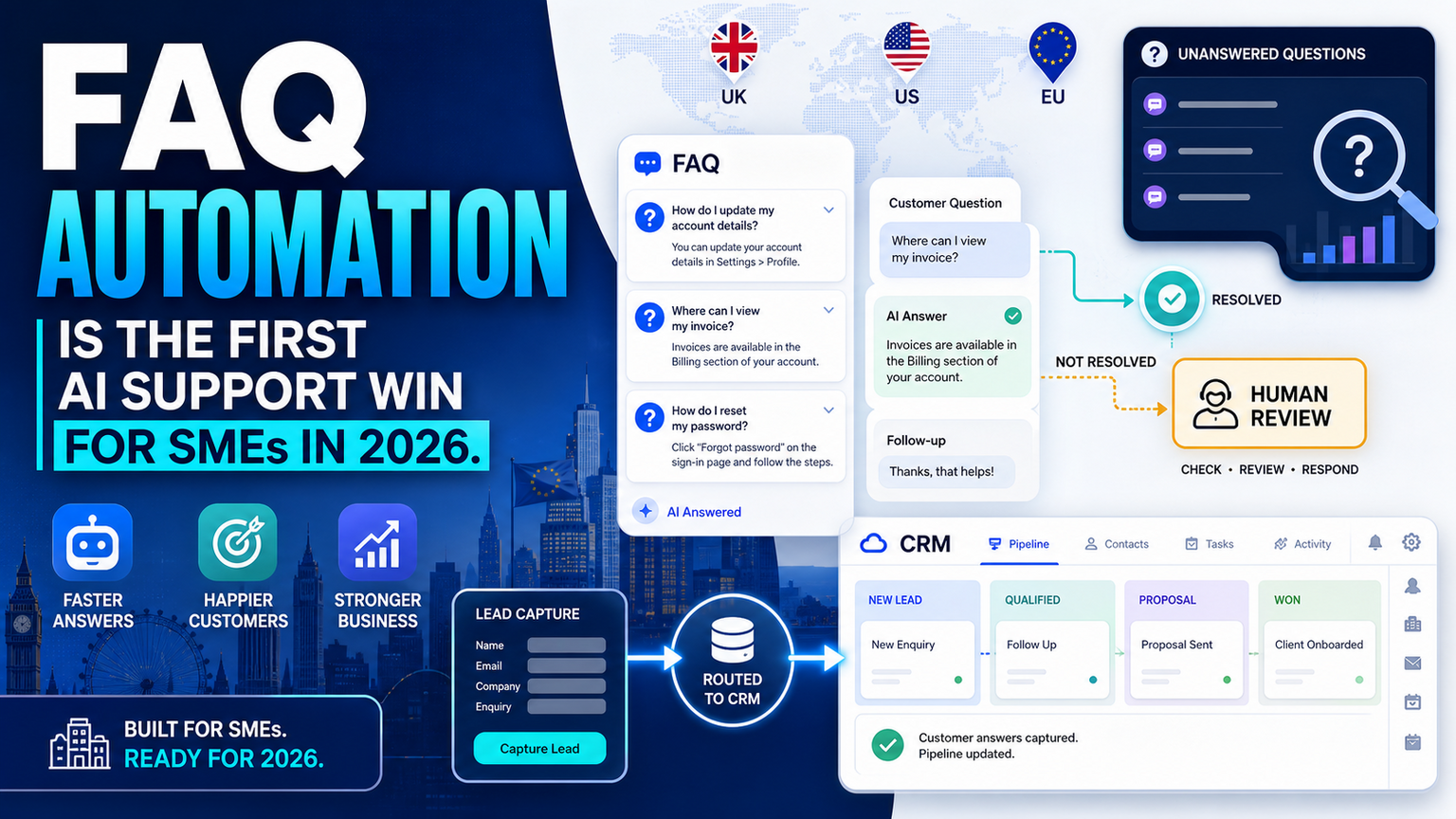
# Quick answer FAQ automation is the safest first AI support win for many UK, US, and European SMEs in 2026. It answers repeated customer questions, captures leads, routes complex issues to humans, updates CRM or suppor
Quick answer
FAQ automation is the safest first AI support win for many UK, US, and European SMEs in 2026. It answers repeated customer questions, captures leads, routes complex issues to humans, updates CRM or support tools, and shows which questions still need better content or process fixes.
The current market signal is clear enough for operators to act carefully. GOFTUS reads that as a workflow problem, not a chatbot shopping problem.
For most SMEs, the question is not whether an AI FAQ bot can reply. The question is whether the business knows what should be answered automatically, what should become a lead, what should be escalated, and what should be measured after launch. That is why the right entry point is FAQ automation service, not a disconnected widget.
Why this topic matters now
Customer support AI has moved from novelty to procurement shortlist. Another July 2026 result from World Business Outlook covered AI chatbot tools for banking support. Even where these are headline-level signals rather than full article-body reviews, the direction is useful for SMEs: support automation is becoming specific, vertical, and operational.
That matters because smaller teams feel the pain before they have the budget for a full contact centre platform. Staff answer the same delivery, pricing, booking, refund, onboarding, document, or service-area questions every week. The business loses time, misses leads, and stores customer knowledge across inboxes, spreadsheets, WhatsApp messages, and team memory.
FAQ automation fixes the first layer. A website FAQ chatbot can answer approved questions, capture lead details, route billing or complaint issues to the right person, and record unanswered questions so the team can improve pages, scripts, and internal knowledge.
What this means for SMEs
The business case is not that every customer should talk to AI. The business case is that every repeated question should have an owner, an approved answer, and a next step.
For a local service company, that might mean answering opening hours, prices from, areas covered, booking steps, and required documents. For a B2B agency, it might mean qualifying budget, timeline, industry, current tools, and support needs before a consultation. For an ecommerce or product business, it might mean returns, delivery, warranty, stock, invoices, and post-purchase guidance.
The workflow should usually start small:
1. Collect the top 30 to 80 repeated questions from email, website forms, call notes, WhatsApp, CRM, and sales chats.
2. Mark which questions can be answered automatically, which need lead capture, and which must go to a human.
3. Write short approved answers in plain language.
4. Connect the bot or FAQ assistant to the website and the correct follow-up destination.
5. Review unanswered questions every week for the first month, then monthly after that.
GOFTUS treats FAQ automation as the entry wedge into wider workflow automation. Once the question flow is working, the same structure can support CRM follow-up, booking reminders, document collection, reporting automation, internal knowledge assistants, and AI agents that help staff rather than replace judgement.
Thirumurugan's view
The mistake SMEs make is buying the visible tool first. A chatbot, helpdesk add-on, automation builder, or AI agent platform can be useful, but the value sits in the workflow around it. Who approves answers? Which questions are too risky for automation? What happens when the customer is angry, confused, or high value? Where does the lead go? Who reviews missed questions?
That is why GOFTUS builds the automation map before the widget. A good FAQ automation system should make the business calmer, not noisier. It should reduce repeated typing, but it should also improve the source of truth. If the same unanswered question appears ten times, the answer is not just to train the bot. The answer may be to update the service page, create a pricing explainer, add a booking step, change the CRM field, or give staff a better internal guide.
Competitor lens
The market gives SMEs plenty of options. UK consultancies such as Faculty AI, Deeper Insights, Waracle, and Brainpool AI can support larger AI programmes. US firms such as LeewayHertz, Markovate, SoluLab, and BairesDev can build custom systems. European teams such as Addepto, STX Next, Netguru, and 10Clouds bring strong software delivery. SaaS tools such as Zapier, n8n, Relevance AI, Lindy, Gumloop, Bardeen, Make, and Stack AI can automate individual tasks quickly.
Those options are useful. The gap for SMEs is ownership of the operating loop. Tools automate tasks. GOFTUS automates the workflow around the task.
For FAQ automation, that means GOFTUS is not just installing a chatbot. The work includes question discovery, answer governance, lead routing, CRM or support integration, human review rules, analytics on unanswered questions, and monthly improvement. That is the difference between a bot that replies and a support workflow that gets better.
What SMEs should do next
Start with a question audit, not software. Export the last month of customer questions from inboxes, forms, calls, WhatsApp, CRM, and sales chats. Tag each one as answer, qualify, route, or review.
Then launch a safe first scope: service availability, booking steps, pricing ranges, document requirements, opening hours, delivery expectations, and onboarding. Avoid legal, financial, security, complaint, or bespoke pricing advice unless there is a human review path.
If your team wants this built as a practical system, start with GOFTUS AI FAQ automation. If the support flow touches CRM, reporting, document intake, or follow-up, review GOFTUS services and AI agents. For quick questions, use /questions or book through /contact.
Summery for SMEs
FAQ automation is not a small side feature. For many SMEs, it is the first visible place where AI can save time, improve customer experience, and create cleaner workflow data. The winners will not be the businesses with the flashiest chatbot. They will be the businesses that know which answers are approved, which questions create leads, which issues need humans, and which repeated gaps should improve the whole operation.
FAQ
Is FAQ automation the same as a chatbot?
No. A chatbot is one interface. FAQ automation is the operating system around repeated questions: approved answers, lead capture, routing, human review, CRM or helpdesk updates, and unanswered-question measurement.
Can small businesses use FAQ automation without risking wrong answers?
Yes, if they launch with approved low-risk questions first and keep clear escalation rules. GOFTUS usually starts with repeated operational questions, then adds review workflows before anything sensitive or bespoke.
Where should an SME start?
Start with a one-month question audit. Then build a small FAQ automation service flow that answers repeat questions, captures leads, routes complex issues, and reviews unanswered questions weekly.
Source notes
Reddit small-business searches returned rate limits during this unattended run, so the article uses the news and buyer-query signal rather than claiming a confirmed Reddit discussion. X was unavailable because xurl was not installed in the cron environment.