FAQ automation for SMEs: capture customer questions before follow-up slips
FAQ automation helps SMEs capture repeated questions, answer faster, route follow-up, and improve sales or support workflows before leads slip.
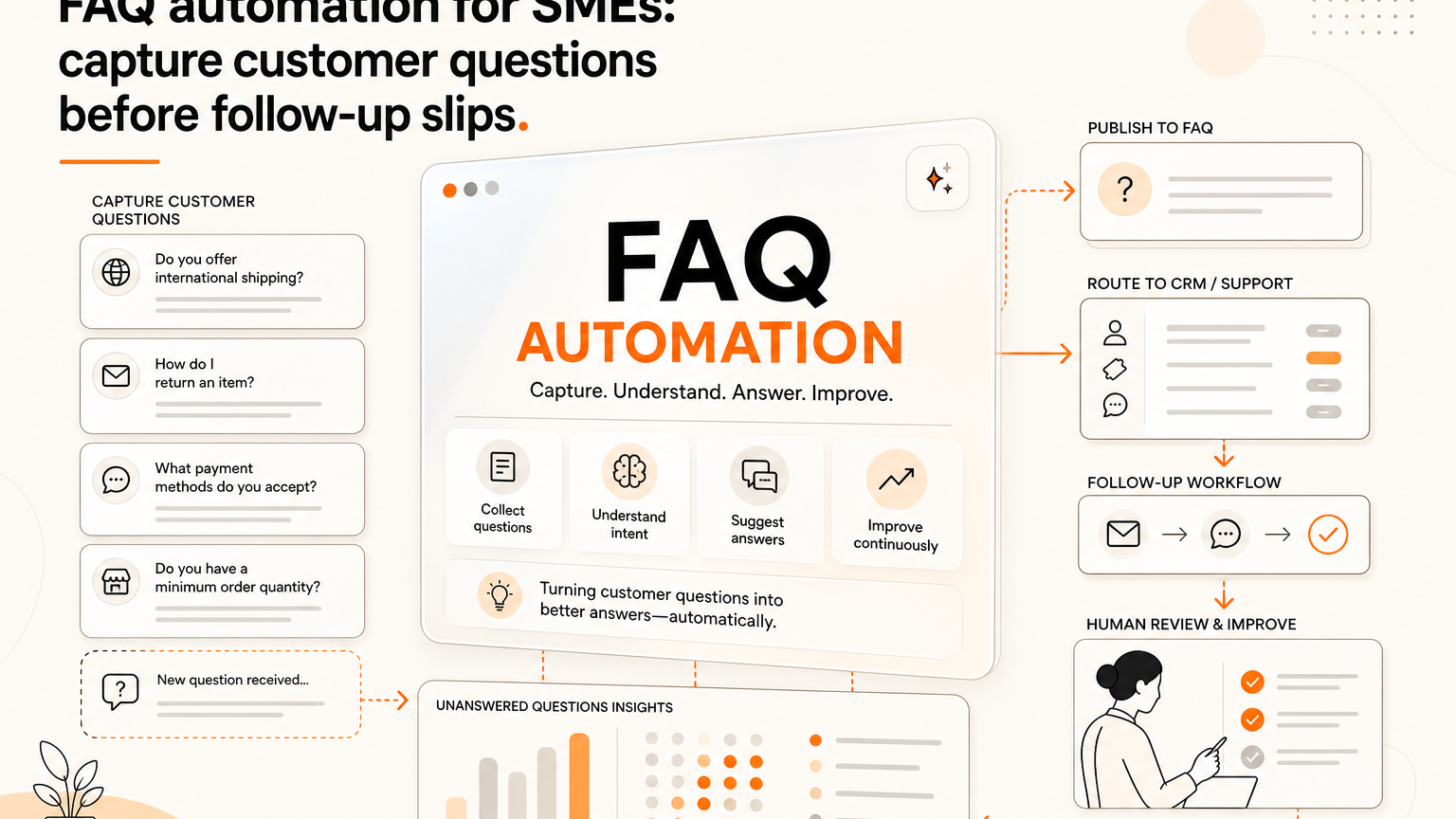
# Quick answer FAQ automation should be the first layer of customer-answer workflow for many SMEs, not just a longer help page. When a buyer asks about price, delivery, onboarding, integrations, refunds, support hours,
Quick answer
FAQ automation should be the first layer of customer-answer workflow for many SMEs, not just a longer help page. When a buyer asks about price, delivery, onboarding, integrations, refunds, support hours, or next steps, the business needs three things at once: a clear answer, a captured signal, and a route for follow-up. The source trigger for this post is today's FAQ automation cluster requirement, supported by Google News RSS results around customer service automation from Salesforce, IBM, Sprout Social, G2, and Small Business and Entrepreneurship Council, plus Reddit small-business and operator context showing how much day-to-day service quality still depends on staff training, handoff, and follow-through.
For a UK, US, or EU SME, the searchable problem is simple: repeated website questions are often the earliest buying signal, but they are lost when the answer lives only in someone's inbox, chat transcript, or memory. GOFTUS treats FAQ automation service as a workflow wedge. It answers common questions, captures intent, routes complex cases to sales or support, updates CRM notes, and shows which questions still need a human answer.
What this means for SMEs
Most businesses do not need another generic chatbot before they know which questions customers are actually asking. They need a controlled answer layer. A website FAQ chatbot can collect the question, match it to an approved answer, ask one or two qualifying follow-ups, and send the right next action to the right person. That is very different from letting an AI assistant improvise from a pile of old pages.
The practical win is not that every question is automated. The win is that the same question stops being handled ten different ways. A prospect asking about delivery, onboarding, compatibility, or support should get a consistent answer. If the question suggests buying intent, it should create a lead or task. If the question suggests risk, a complaint, or a custom requirement, it should move to a human with context attached.
This is why AI FAQ automation matters as an entry point into wider workflow automation. It is small enough to launch quickly, but close enough to revenue and support quality to prove value. Once repeated questions are captured, GOFTUS can connect the same pattern to CRM follow-up, customer support automation, document automation, reporting automation, or agentic workflows.
What SMEs should do next
Start by collecting the last 50 to 100 real questions from website chat, email, sales calls, contact forms, WhatsApp, support tickets, and founder notes. Group them into buying questions, support questions, policy questions, technical questions, and questions that reveal confusion on the website. Do not start with a large knowledge-base migration. Start with the questions that already slow down staff or cause leads to go cold.
Next, mark each answer as approved, draft, or human-only. Approved answers can be shown directly. Draft answers can be suggested to a staff member for review. Human-only answers should collect details and route the case instead of pretending to solve it. This protects the business from unsafe automation while still reducing repeat work.
Then define routing. A pricing or demo question can create a CRM task. A support issue can open a ticket. A policy question can point to a document. An unanswered question can become a weekly improvement item. GOFTUS normally designs this as capture, answer, qualify, route, review, and improve, not as a standalone bot widget.
Finally, measure missed questions. The most useful dashboard is not vanity usage. It is unanswered questions, questions that led to follow-up, questions that need a better page, and answers that staff keep editing. Those signals tell an SME where the customer journey is unclear.
Competitor lens
SaaS tools and automation platforms can help. Zapier, n8n, Make, Lindy, Bardeen, Gumloop, Relevance AI, and Stack AI can move data between forms, chats, CRMs, and support tools. Agencies and consultancies such as Faculty AI, Deeper Insights, Waracle, Brainpool AI, LeewayHertz, Markovate, SoluLab, BairesDev, Addepto, STX Next, Netguru, and 10Clouds can also build useful AI and workflow systems.
The gap is usually ownership of the workflow around the answer. Tools automate tasks. GOFTUS automates the workflow around the task. That means deciding what AI can answer, what needs approval, where the lead goes next, how staff correct answers, how exceptions are logged, and how the system improves every month.
For SMEs, that difference matters. A chatbot that answers quickly but fails to route a high-intent buyer is still leaking revenue. A workflow that captures the question, gives an approved answer, asks for the right details, and assigns follow-up is much more valuable than a widget that looks impressive for the first week.
Summery for SMEs
FAQ automation is not just a support convenience. It is a practical way to turn customer questions into workflow data. If a business already receives repeated questions, the first automation project should not be a broad AI transformation. It should be an answer-and-routing layer that protects quality and creates follow-up.
Thirumurugan's view is that FAQ automation works best when it starts with real customer language. The system should answer what is safe, capture what is unclear, and route what matters. That gives SMEs a controlled path from simple automated customer answers into CRM automation, customer support automation, reporting, and AI agents.
The soft CTA is straightforward: if repeated questions are slowing sales or support, use GOFTUS to map the first 30 questions, build the approved answer layer, and connect it to the workflow that actually owns follow-up. The FAQ automation service is the natural starting point, with wider automation available through GOFTUS services when the answer layer proves where the bottlenecks are.
FAQ
Is FAQ automation the same as a chatbot?
No. A chatbot is an interface. FAQ automation is the workflow behind approved answers, question capture, routing, review, and improvement.
Where should an SME start?
Start with repeated customer questions from chat, email, forms, and sales notes. Turn those into approved answers before adding wider AI automation.
When should a human review the answer?
Use human review for pricing exceptions, complaints, regulated claims, custom technical requirements, account changes, and anything the business would not want AI to decide alone.
How does this connect to CRM?
A useful FAQ layer does not stop at answering. It should create or update the lead, tag the intent, assign follow-up, and record unanswered questions for improvement.
Source notes: Reddit and small-business operator signals are treated as social context, not verified proof. Google News RSS was used for headline-level cross-checking on customer service automation and AI customer support resources, including visible results from Salesforce, IBM, Sprout Social, G2, and Small Business and Entrepreneurship Council. Direct article claims were not scraped beyond reachable RSS headlines in this unattended run.