FAQ Automation for SMEs: Capture Buying Questions Before They Become Lost Follow Ups
FAQ automation helps SMEs capture buying questions, route follow up, and turn repeated website answers into sales and support workflows before leads go cold.
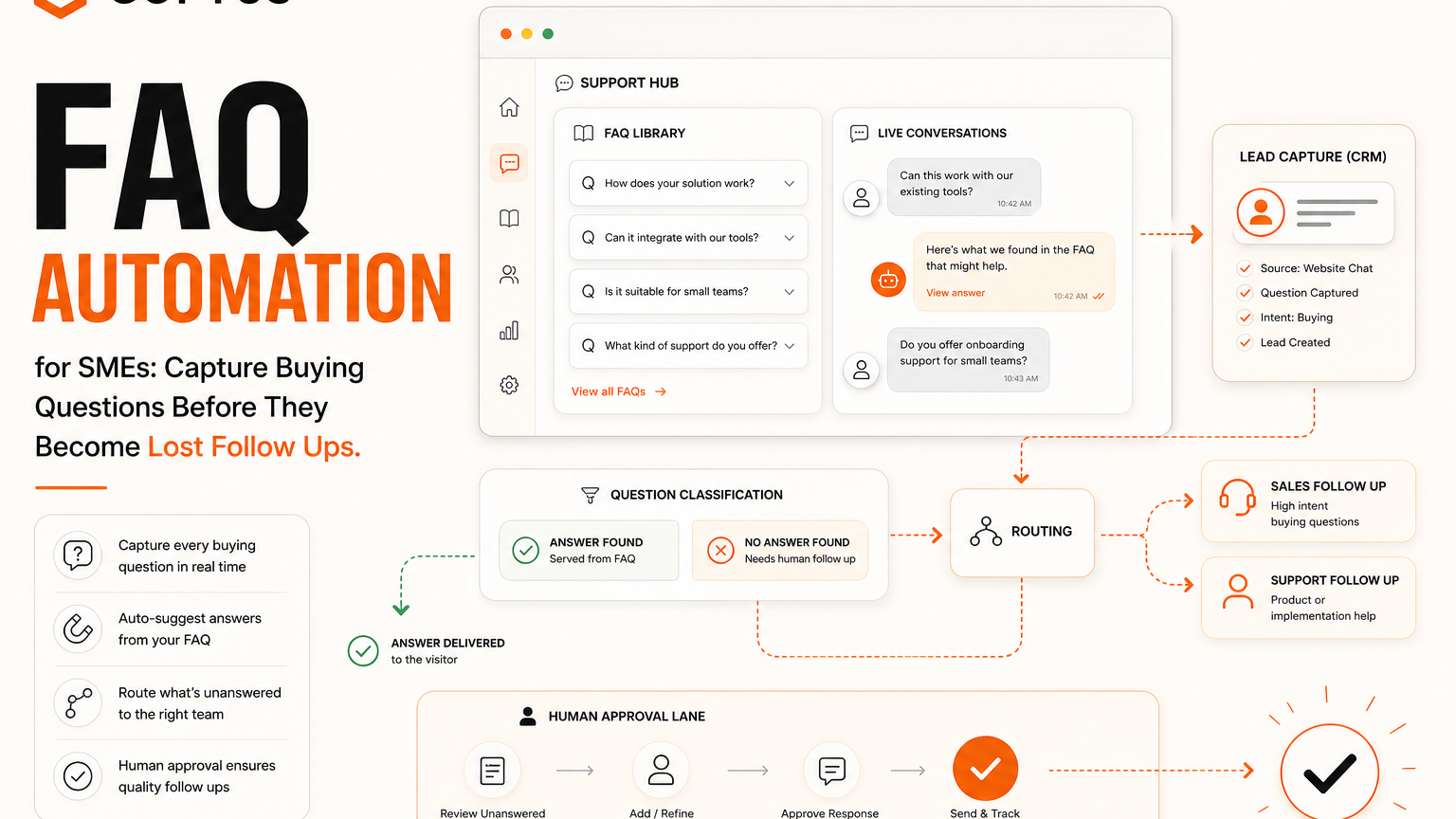
# Quick answer FAQ automation should do more than answer repeated website questions. For SMEs in the UK, US, and Europe, the useful version captures the question, checks whether an approved answer exists, asks for missi
Quick answer
FAQ automation should do more than answer repeated website questions. For SMEs in the UK, US, and Europe, the useful version captures the question, checks whether an approved answer exists, asks for missing context when needed, routes buying intent to sales or support, and records what the team still needs to improve. That is why today's GOFTUS post targets faq automation as a workflow problem, not a chatbot feature.
The source signal is a 100-score r/Entrepreneur discussion in the GOFTUS Reddit intelligence feed where the operator argued that growth problems often begin after a customer says yes. It is social heat, not verified market data. Google News RSS also showed current customer-service automation context from Salesforce, Bitdefender, Sprout Social, G2, Hootsuite, IBM, and other support technology publishers. Together they point to the same practical lesson: more demand exposes weak follow up unless the business has a clear answer-and-routing layer.
For GOFTUS, the first layer is an FAQ automation service that turns repeated questions into governed customer-answer workflows.
What this means for SMEs
Most small businesses already have the raw material for FAQ automation. It is in inbox replies, WhatsApp messages, sales calls, helpdesk tickets, website chats, proposal notes, and the owner's memory. The gap is not usually content. The gap is ownership. Nobody has decided which answers are approved, which questions should trigger sales follow up, which need support triage, and which should become signals for improving the offer.
A basic website FAQ page can reduce a little noise, but it does not tell the team what happened next. A simple chatbot can answer easy questions, but it may hide unanswered questions inside transcripts. A workflow-first FAQ automation setup does four jobs at once. It gives customers fast approved answers. It captures buying questions while intent is fresh. It routes complex questions to the right person. It creates a learning loop so the answer library improves every month.
That matters when lead generation is working. More enquiries can create more admin, slower responses, and more owner interruptions. FAQ automation protects the team by making the first answer consistent and the next step visible. A pricing question might go to sales with the page, product, source, and exact wording attached. An onboarding question might go to support. A risk or compliance question might wait for human review before any answer is sent.
Hajikreena's view
Hajikreena's view is that FAQ automation is the safest entry wedge into wider AI automation because it starts with knowledge the business already understands. You are not asking an agent to take over finance, CRM, browser actions, or customer accounts on day one. You are asking it to handle repeated questions with approved answers and clear escalation rules.
The best projects start with a question audit. Which ten questions do customers ask every week? Which five questions usually mean buying intent? Which answers are sensitive enough to require approval? Which answers change often because pricing, delivery, stock, onboarding, or policy changes? Which unanswered questions should create a CRM task rather than disappear in chat history?
Once those rules are clear, GOFTUS can connect FAQ automation into forms, chat, CRM, helpdesk, email, Slack, Teams, Airtable, Notion, HubSpot, Pipedrive, n8n, Make, Zapier, or a custom backend. The tool choice comes after the workflow design. That is the difference between a widget and an operating system for customer answers.
Competitor lens
UK firms such as Faculty AI, Deeper Insights, Waracle, and Brainpool AI can be useful for analytics, AI projects, or broader digital delivery. US firms such as LeewayHertz, Markovate, SoluLab, and BairesDev can build custom systems. European teams such as Addepto, STX Next, Netguru, and 10Clouds can support data and software delivery. SaaS tools such as Zapier, n8n, Relevance AI, Lindy, Gumloop, Bardeen, Make, and Stack AI can automate tasks quickly.
GOFTUS does not position against those options by pretending tools are bad. Tools automate tasks. GOFTUS automates the workflow around the task. For FAQ automation, that means answer ownership, approval paths, CRM or support handoff, unanswered-question reporting, and monthly improvement. A chatbot alone may respond. A GOFTUS workflow shows who owns the follow up, what was promised, what answer was used, and what still needs human judgment.
That is especially important for SMEs because the cost of missed context is personal. A late reply can lose a lead. A wrong answer can create support debt. A hidden question can teach the business nothing. The goal is not to make the website sound clever. The goal is to keep customer intent moving.
What SMEs should do next
Start with a two-week capture sprint. Export recent website chat, contact form, inbox, sales, and support questions. Group them into buying questions, onboarding questions, delivery questions, pricing questions, support questions, and risk questions. Mark each question as approved answer, needs human review, or needs routing. Do not automate anything until the owner of each category is clear.
Then design the first workflow. A visitor asks a question. FAQ automation checks the approved library. If the answer is safe, it replies and logs the event. If the question shows buying intent, it creates or updates a CRM lead. If no approved answer exists, it asks for context, routes the issue, and adds the question to a review queue. Each week, the business reviews unanswered questions and improves the library.
GOFTUS can help SMEs build this first customer-answer layer through /services#faq-automation, then extend it into CRM automation, support triage, reporting automation, document workflows, and AI agents when the business is ready.
Summery for SMEs
FAQ automation is not just a cheaper support widget. It is a way to protect customer intent before follow up slips. The social signal from business owners is that growth often breaks the process after people say yes. The news context is that customer-service automation tools keep expanding. The practical answer is to start small: approved FAQs, routed unanswered questions, CRM handoff, support ownership, and review loops.
If your team is answering the same website questions every week, start with GOFTUS AI FAQ automation. It gives customers faster answers while giving staff a clearer queue for the questions that still need care.
FAQ
Is FAQ automation the same as a website chatbot?
No. A chatbot is only one possible interface. FAQ automation is the workflow behind the answer: approved content, lead capture, routing, CRM or support updates, review queues, and reporting on unanswered questions.
What should SMEs automate first?
Start with repeated buying and onboarding questions. Those questions are usually safe enough to standardise, valuable enough to track, and common enough to reduce owner interruptions quickly.
When should a human approve the answer?
Use human approval for pricing exceptions, legal or compliance topics, complaints, refunds, custom delivery questions, account-specific details, or anything that could create a promise the business cannot keep.
Source notes: Reddit signal from the GOFTUS Composio intelligence run on 2026-08-14, especially r/Entrepreneur discussion about problems after customers say yes. Google News RSS cross-checks for FAQ automation, AI customer service automation, and website FAQ chatbot topics surfaced Salesforce, Bitdefender, Sprout Social, IBM, G2, Hootsuite, Trend Hunter, and AIMultiple headlines. These sources are used as context signals, not as fabricated statistics or direct performance claims.