DeepSeek's AI Chip Push Shows Why SMEs Need Automation Portability
DeepSeek AI chip headlines show why SMEs need portable automation workflows, not one-vendor AI systems.
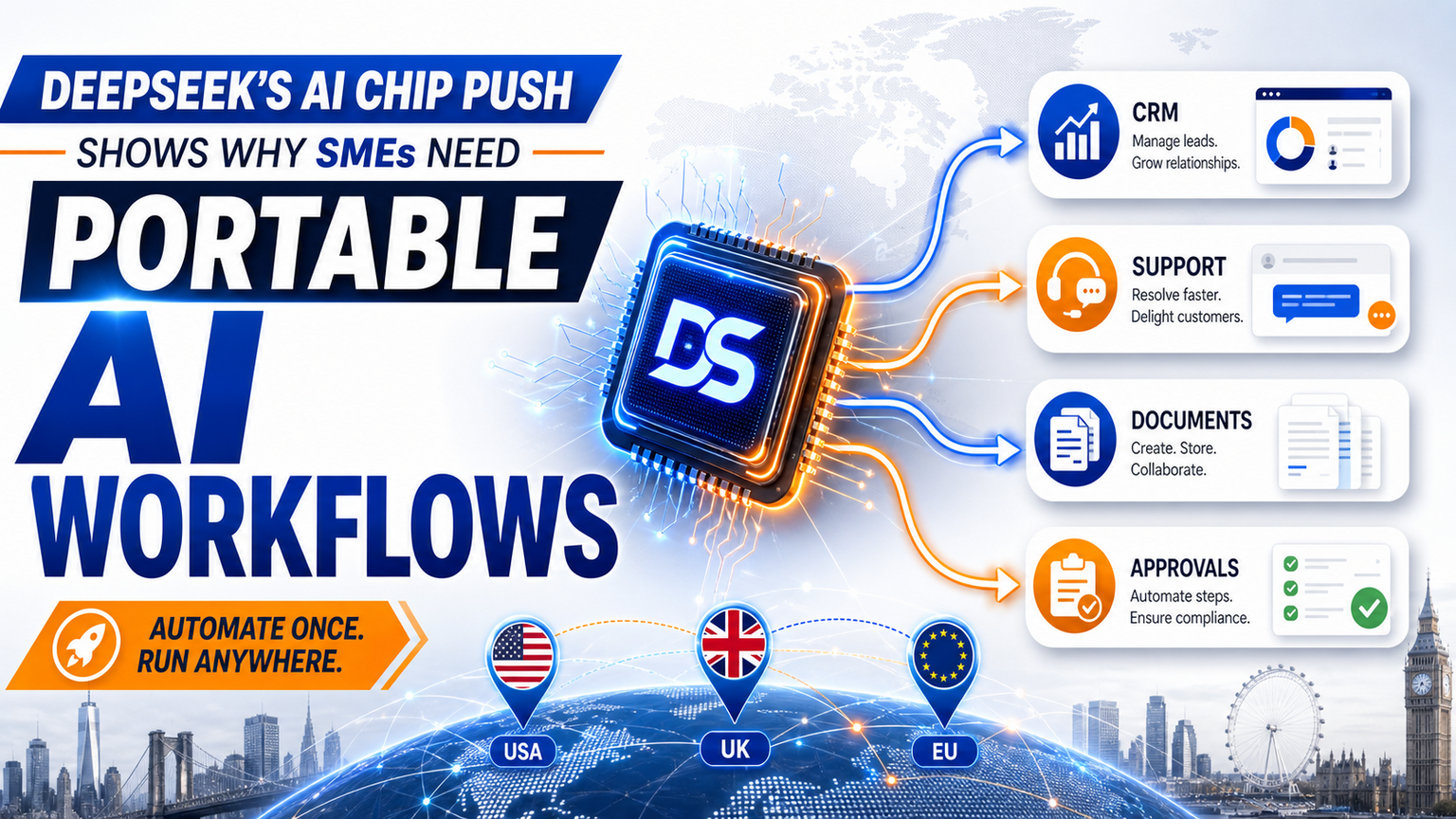
# DeepSeek's AI Chip Push Shows Why SMEs Need Automation Portability Meta description: DeepSeek AI chip headlines show why SMEs need portable automation workflows, not one-vendor AI systems, across support, CRM and docu
DeepSeek's AI Chip Push Shows Why SMEs Need Automation Portability
Meta description: DeepSeek AI chip headlines show why SMEs need portable automation workflows, not one-vendor AI systems, across support, CRM and document operations.
Quick answer
The same theme appeared as a fresh r/LocalLLaMA hot RSS discussion on 12 July, where the community framed it as another signal that AI infrastructure is becoming more fragmented, competitive and political.
For UK, US and EU SMEs, the immediate lesson is not to guess which chip, lab or model will win. The practical lesson is to build automation that can move when pricing, latency, access, compliance or vendor availability changes. A workflow that depends on one AI provider is fragile. A workflow with clear inputs, approval rules, logging, fallbacks and integration points can swap the AI layer without rebuilding the business process.
That is why GOFTUS treats AI procurement as workflow architecture, not just tool selection. Whether a business uses OpenAI, Anthropic, DeepSeek, Mistral, Microsoft, Google, local models or a mix of them, the durable asset should be the workflow around the model.
What this means for SMEs
DeepSeek reportedly working on its own AI chip matters because it points to a wider pattern. Frontier AI is no longer just a software subscription market. It is becoming an infrastructure market with chips, cloud capacity, export controls, regional regulation, model pricing, open weights, proprietary APIs and vendor ecosystems all changing at once.
A small business does not need to follow every chip announcement. It does need to avoid building brittle automations that break when a provider changes prices, terms, rate limits or capabilities. This is especially important for support triage, CRM follow-up, document processing, internal knowledge assistants and reporting workflows.
Imagine a company builds a customer support process directly inside one AI SaaS tool. It answers FAQs, drafts replies and routes exceptions. That may work in the first month. But if the model becomes slower, costlier, unavailable in a region, or unsuitable for a regulated workflow, the business has to rebuild under pressure.
A better pattern is to separate the workflow from the model. Keep customer data in the CRM or support desk. Keep policies and knowledge in controlled documents. Keep human approval rules visible. Use an automation layer to call the right model for each step, record what happened and route exceptions to a person. Then the business can change providers without changing how staff work.
This is the difference between buying AI and operationalising AI. Buying AI is signing up for a model, chatbot or agent platform. Operationalising AI is designing the path from trigger to action, approval, update, measurement and improvement.
Hajikreena's view on the signal
The DeepSeek chip signal is a reminder that AI supply chains are becoming strategic. Businesses may soon choose AI systems not only by answer quality, but also by cost control, data location, vendor resilience, latency, procurement risk and policy comfort.
For an SME, this should not create panic. It should create a checklist. Which workflows are already using AI? Which ones would stop if a provider changed? Which steps require human approval? Which outputs should be logged? Which provider could act as a fallback? Which tasks should use a cheaper model, and which tasks need a stronger one?
GOFTUS would not tell an SME to choose a single winner in the AI chip race. We would help the team design support, sales, document and reporting workflows so the AI component can be replaced, compared or improved. That keeps the business in control while the market changes around it.
Competitor lens
The competitive market is crowded. UK consultancies such as Faculty AI, Deeper Insights, Waracle and Brainpool AI can support advanced AI programmes. US teams such as LeewayHertz, Markovate, SoluLab and BairesDev can build custom systems. European firms such as Addepto, STX Next, Netguru and 10Clouds can help with data and engineering delivery. SaaS tools including Zapier, n8n, Relevance AI, Lindy, Gumloop, Bardeen, Make and Stack AI can automate useful tasks quickly.
Those options can be valuable. The gap for many SMEs is that a tool or consultancy engagement can still leave the operating workflow unclear. Who reviews the AI output? What happens when confidence is low? Where is the customer record updated? How are mistakes found? How does the workflow improve next month?
Tools automate tasks. GOFTUS automates the workflow around the task.
That means GOFTUS focuses on the durable layer: process mapping, CRM integration, support routing, document controls, approval gates, monitoring, exception logs and monthly improvement. If a business later changes from one AI provider to another, the workflow remains understandable.
What SMEs should do next
Start with one workflow that already creates friction. Good candidates include repeated customer questions, quote follow-ups, invoice document handling, lead qualification, internal policy search, compliance reminders and weekly reporting.
Then map it in plain language. What starts the workflow? What information is needed? Which system holds the source of truth? What should AI draft or classify? What must a person approve? What data should be written back to the CRM, ticketing tool, spreadsheet or document store? What should be measured every month?
For support-heavy teams, GOFTUS can start with FAQ automation and expand it into lead capture, support triage and CRM updates. For broader agentic workflows, see AI agents. For a practical service overview, visit GOFTUS services, or use contact to request a diagnostic.
The goal is not to chase the newest AI infrastructure story. The goal is to make sure the next infrastructure shift does not force the business to rebuild its operations from scratch.
Summery for SMEs
DeepSeek's reported AI chip push is a business portability signal. It suggests the AI market will keep changing across hardware, models, costs and regions. SMEs should avoid locking critical operations into one vendor-shaped workflow. Build the process first, keep approvals and logs visible, and make the model layer replaceable.
FAQ
Should a small business care about DeepSeek building AI chips?
Yes, but only at the workflow level. The point is not that every SME should track semiconductor strategy. The point is that AI costs, speed and availability can change when vendors control more of the stack. SMEs should build automations that can change model provider without disrupting support, CRM, document or reporting work.
How can GOFTUS make AI automation portable?
GOFTUS maps the workflow around the AI step. That includes triggers, data sources, prompt rules, approval gates, integrations, fallback providers, logging and monthly review. The business then owns the process, while the AI model can be changed or compared when needed.
Which internal link should operators use first?
If the business is support-heavy, start with FAQ automation. If the issue is broader operational delegation, review AI agents or services. The best first project is usually a repeated workflow with clear inputs, clear owners and measurable time savings.
Source notes
Direct Reuters access returned HTTP 401 in this environment, so this is cited as a headline-level cross-check, not a full article scrape.
Brand framing: GOFTUS interprets the signal through SME workflow portability, provider fallback and practical automation ownership.