Customer Support Automation for SMEs: Voice Agents Need Interruption Rules Before They Answer Calls
Customer support automation works better when AI voice agents have interruption rules, review gates, CRM handoff, and human escalation paths.
# Quick answer Customer support automation is moving from chat widgets into live voice conversations, but SMEs should not let an AI voice agent answer calls until interruption handling is designed as a workflow. A fresh
Quick answer
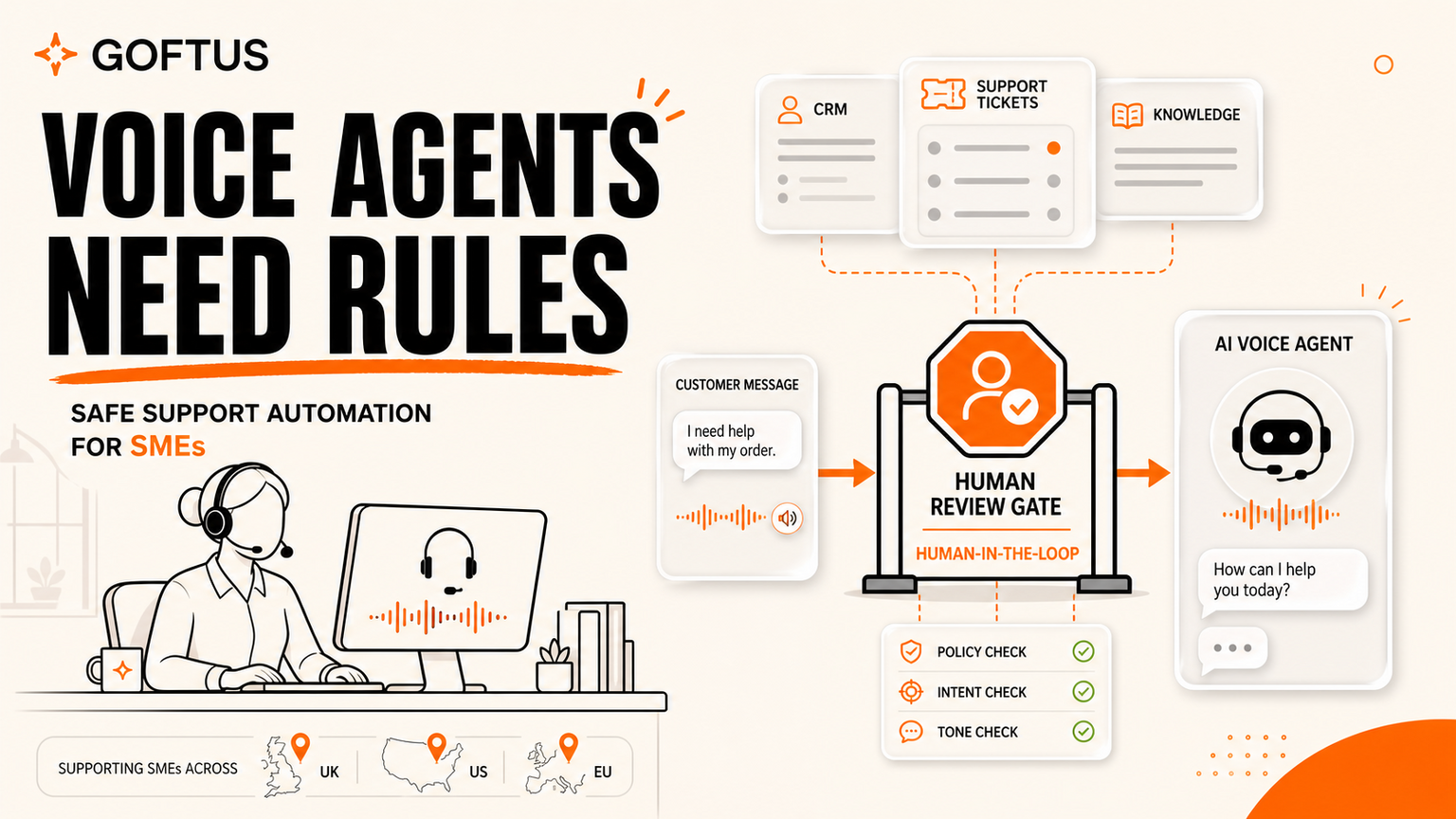
Customer support automation is moving from chat widgets into live voice conversations, but SMEs should not let an AI voice agent answer calls until interruption handling is designed as a workflow. A fresh r/artificial discussion asked how well AI voice agents deal with customers who interrupt, change their mind, or correct themselves mid sentence. That is a social signal, not proof of product performance. The useful business lesson is clear: voice automation needs rules for turn taking, escalation, CRM updates, call notes, and human review before it becomes customer facing.
For GOFTUS, the right starting point is not buying the loudest voice AI tool. It is mapping the call journey and deciding what the agent can observe, prepare, ask, log, and route. See https://goftus.com/services for the wider workflow automation approach and https://goftus.com/agents when the work involves AI agents that act across systems.
What this means for SMEs
The Reddit signal came from an operator asking whether AI voice agents can handle people who constantly interrupt. Anyone who has answered sales or support calls knows why this matters. Customers rarely follow a neat demo script. They start answering early, say "wait actually", ask two questions at once, complain about the previous step, or give new details after the answer has already begun.
Google News RSS also showed current coverage around enterprise voice AI and contact center agents, including Microsoft Dynamics 365 Contact Center voice-agent items, CX Today coverage of real-time voice agents, TechCrunch coverage of voice AI startups, and other customer-service AI stories. Some direct pages may be access limited, so GOFTUS treats those listings as headline-level cross-checks rather than scraped article claims.
For a UK, US, or European SME, the problem is practical. A voice agent that sounds smooth but misunderstands interruptions can create more work than it saves. It may log the wrong intent, promise the wrong next step, continue talking when the customer has corrected the issue, or fail to escalate when frustration is obvious. The result is not just a poor call. It is messy CRM data, repeated support work, and a team that stops trusting automation.
GOFTUS would design customer support automation around lanes. The first lane is observe: transcribe, classify, and suggest the next step without taking action. The second lane is prepare: draft a reply, create a support summary, or fill CRM fields for review. The third lane is approve: ask a human before refunds, complaints, cancellations, legal claims, or sensitive account changes. The final lane is act: only complete narrow, reversible, low-risk actions once the business has tested them.
Interruption rules belong in that design. The agent needs stop phrases, pause rules, confidence thresholds, escalation triggers, and a way to reopen intent when the customer changes direction. It should also keep a clean audit trail: what the customer asked, what the AI understood, what was suggested, who approved the action, and what happened in CRM or the support desk afterward.
What SMEs should do next
Start with one repeated call type, not every conversation. Good candidates include appointment questions, order status, basic onboarding, booking changes, lead qualification, or common support triage. Write down the safe answer, the unsafe answer, the handoff rule, and the system update required after the call.
Then test real interruption patterns. Ask staff to interrupt, correct themselves, change topics, speak over the agent, and ask for a manager. Measure whether the workflow routes the call correctly, not whether the voice sounds impressive. If the call summary is wrong or the CRM field is uncertain, the automation should mark it for review instead of pretending to be certain.
Connect the result to existing tools. A useful voice workflow should create a support ticket, update CRM notes, tag unanswered questions, route urgent issues, and show managers what customers are asking most often. That is where GOFTUS can help: tool setup, workflow design, escalation paths, monitoring, and monthly improvement.
Competitor lens
Faculty AI, Deeper Insights, Waracle, Brainpool AI, LeewayHertz, Markovate, SoluLab, BairesDev, Addepto, STX Next, Netguru, and 10Clouds can all be useful partners for AI projects. SaaS tools such as Zapier, n8n, Relevance AI, Lindy, Gumloop, Bardeen, Make, and Stack AI can also automate parts of the process.
The gap appears after the demo. Tools automate tasks. GOFTUS automates the workflow around the task. For voice support, that means call boundaries, human approval, CRM handoff, support routing, exception review, audit evidence, and improvement cycles. The business does not need another isolated AI voice feature. It needs a controlled customer support automation system that staff can trust.
Summery for SMEs
Voice agents are becoming easier to test, but customer support automation should be judged by workflow outcomes. Can the system recognise when a customer interrupts? Can it stop safely? Can it hand off difficult calls? Can it update CRM accurately? Can managers review what happened? If those answers are unclear, keep the AI in observe or prepare mode until the controls are ready.
For GOFTUS clients, the practical next step is a small diagnostic: choose one support call type, define the approval gates, connect the CRM or helpdesk, and measure the exceptions. That creates a safer route to AI voice automation than letting a new tool speak to customers without rules.
FAQ
Should SMEs replace support staff with AI voice agents? No. Start by using AI to prepare call notes, route simple requests, and surface repeated questions. Move to direct call handling only after interruption, escalation, and review rules are tested.
Where should this connect inside GOFTUS? For most teams, start with https://goftus.com/services. If the voice agent must act across tools, also review https://goftus.com/agents.
What is the buyer problem? The buyer problem is customer support automation that reduces repeated work without losing control of live customer conversations.
Source notes
Social signal: r/artificial discussion, "How well do AI voice agents handle people who constantly interrupt?", captured in GOFTUS Reddit intelligence for 2026-08-14. Reddit is treated as operator sentiment, not verified product evidence.
Cross-check: Google News RSS results for AI voice agents and contact center automation showed current items from Microsoft, CX Today, TechCrunch, Salesforce, and related business publications. These were used as headline-level context where direct pages were not fully retrieved.
GOFTUS framing: customer support automation, AI agents, approval gates, CRM/support handoff, and workflow monitoring for SMEs.