Customer support AI guardrails for SMEs: let AI help without trapping customers
Customer support AI guardrails help SMEs use ChatGPT-style assistants for faster answers while keeping human handoff, CRM notes, and review logs in place.
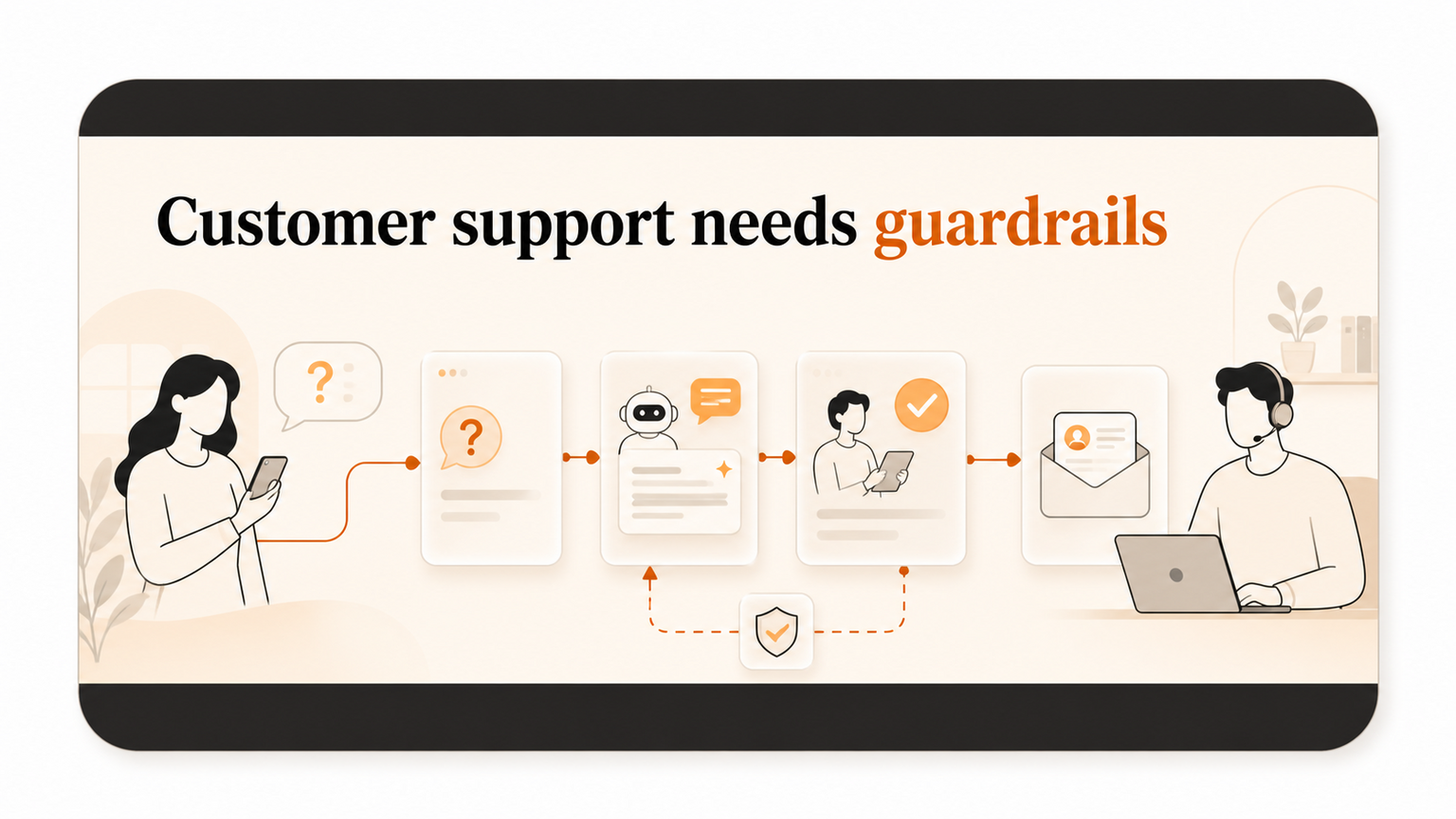
# Quick answer Customer support AI guardrails let SMEs use AI for faster replies without trapping customers inside a bot loop. The safe pattern is simple: AI can observe, draft, classify, and suggest the next step, but
Quick answer
Customer support AI guardrails let SMEs use AI for faster replies without trapping customers inside a bot loop. The safe pattern is simple: AI can observe, draft, classify, and suggest the next step, but a human owner must be available when the customer asks for help, the answer is uncertain, money is involved, or the workflow touches CRM, support, documents, refunds, orders, or live web portals. GOFTUS builds these guardrails around the tools a team already uses, so ChatGPT-style assistants become a controlled support workflow instead of another disconnected experiment.
What this means for SMEs
The 2026-08-22 GOFTUS daily SEO run made customer support automation a priority again. It showed 100 score demand for ChatGPT and AI tools, plus 96 to 95 score demand for OpenAI and AI generator workflows. The recommended angle was not simply to buy another tool. It was to connect AI tools to approvals, owners, and ROI controls for SMEs.
The same day, GOFTUS Reddit keyword intelligence surfaced a 100 score social signal from r/ArtificialInteligence about a retailer using an AI phone assistant that allegedly would not route a simple stock question to a human. Reddit is a social signal, not proof of the company process. Still, the frustration is useful because it shows the buyer problem clearly. People do not reject AI because it answers first. They reject AI when it blocks the next useful step.
Google News RSS cross checks for AI customer service and contact-center automation show the broader market moving toward more AI-assisted support. That makes the guardrail layer more important. When vendors promote automation speed, SMEs need to ask what happens when the answer is incomplete, when the customer wants a person, or when a promise needs to be recorded in the CRM.
A support AI workflow should have four lanes. First, observe: the system reads approved FAQs, product notes, CRM history, order status, and support policies. Second, prepare: it drafts the answer, classifies urgency, and suggests a route. Third, approve or hand off: a named person reviews sensitive replies and takes over when confidence is low. Fourth, act and log: the approved reply is sent, the CRM or support ticket is updated, and exceptions are saved for improvement.
This is different from a generic chatbot. A generic bot tries to keep the conversation inside the bot. A governed workflow lets AI reduce repeated work while preserving a clear escape route. For example, AI can answer opening-hours questions immediately, prepare a refund summary for staff, or draft a follow-up email after a missed call. But it should not refuse a human handoff when the customer is stuck, angry, ready to buy, or asking about a detail that affects price, availability, legal terms, safety, or delivery.
Summery for SMEs
For SMEs, the goal is not to make support feel fully automated. The goal is to make support faster, more consistent, and easier to audit. Start with one high-volume support question. Write the approved answer. Decide which words or conditions trigger human review. Connect the workflow to CRM or the helpdesk. Then review the exceptions every month.
This is where GOFTUS differs from a standalone SaaS chatbot or a consultant who only delivers a prompt library. SaaS tools can be useful for chat, voice, routing, and knowledge lookup. Consultants can help map ideas. GOFTUS focuses on workflow ownership: the approved sources, the handoff rule, the review lane, the CRM update, the action log, and the monthly improvement loop. That is the difference between AI that answers and AI that becomes part of operations.
A practical first project could be a customer question triage flow. Website questions enter a single queue. AI classifies them as sales, support, finance, or urgent. It drafts a response using approved source material. Low-risk answers can be sent after a quick review. Higher-risk cases are assigned to a person with the customer context already summarized. Every reply is logged so the business can see which questions repeat, which answers fail, and where a new FAQ or workflow is needed.
The same structure works for phone notes, shared inboxes, website chat, and support forms. The guardrail is not a blocker. It is the operating system for deciding when AI can help and when a person must step in.
Competitor lens
Many AI support vendors sell deflection. That can reduce tickets, but deflection is the wrong measure if customers cannot buy, complain, confirm details, or reach a person when the answer is weak. SMEs should measure resolution, handoff quality, follow-up speed, and whether CRM records are accurate after the conversation.
GOFTUS positions customer support AI guardrails around business outcomes. We define the approved knowledge base, connect the inbox or phone notes, create human-in-the-loop approval points, and log the final action. If the AI answer is good, the team moves faster. If the AI answer is risky, the workflow escalates before trust is damaged.
FAQ
What should a customer support AI guardrail do first?
Start with handoff rules. Decide when the assistant must stop drafting and route to a person. Common triggers include low confidence, pricing questions, angry customers, account changes, refunds, delivery promises, private data, and repeated customer requests for a human. Once those rules exist, the AI can safely draft and classify around them.
How does this connect to GOFTUS services?
GOFTUS builds support automation as a workflow, not only a chatbot. We connect approved FAQs, CRM notes, support tickets, review steps, and monthly reporting. See /services for the broader automation service path, or use /agents when the workflow includes AI agents that prepare actions across tools.
Why not just buy chatbot software?
Chatbot software can be useful, but it usually needs workflow design around it. Without approved sources, handoff rules, CRM logging, review steps, and exception reporting, the tool may answer quickly while creating hidden follow-up work for staff.
Source notes
Primary SEO input: GOFTUS daily SEO FAQ run on 2026-08-22. High-score Trends keywords included AI tools at 100, ChatGPT at 100, OpenAI at 96, and AI generator workflow terms above 90.
Social signal: GOFTUS Reddit keyword intelligence on 2026-08-22 listed a 100 score r/ArtificialInteligence discussion about an AI phone assistant and lack of human access. Treated as operator/social heat, not verified company fact.
Cross-check: Google News RSS searches for AI customer service and contact-center automation showed current market coverage around AI-assisted support, used as headline-level context.