Creatio's AI Studio Shows Why No-Code Automation Still Needs Workflow Owners
Creatio's AI Studio news shows why SMEs need workflow owners, approvals, exception routing and CRM updates around no-code AI automation.
# Creatio's AI Studio Shows Why No-Code Automation Still Needs Workflow Owners Meta description: Creatio's AI Studio news shows SMEs why no-code AI automation still needs workflow owners, approvals, exception routing, C
Creatio's AI Studio Shows Why No-Code Automation Still Needs Workflow Owners
Meta description: Creatio's AI Studio news shows SMEs why no-code AI automation still needs workflow owners, approvals, exception routing, CRM updates and monitoring.
SiliconANGLE reported on 15 July 2026 that Creatio has introduced a major update to its customer relationship management and workflow platform, including AI Studio and conversational development features for building, deploying and governing artificial intelligence agents. The headline is not just another no-code software update. It is a signal that the next wave of automation will let more business users describe workflows in natural language, then expect systems to turn those descriptions into actions.
That sounds useful for UK, US and EU SMEs. Sales teams want faster lead qualification. Support teams want repeated questions answered without waiting for a manager. Finance teams want fewer spreadsheet handoffs. Operations teams want tasks routed to the right person before a customer notices the delay. But the risk is also clear. If a team can create automations faster, it can also create messy automations faster.
Bharatvaj's view: conversational workflow building is powerful only when someone owns the process around it. GOFTUS helps SMEs turn AI automation into controlled operating systems: approved inputs, clear handoffs, CRM updates, exception routing, human review, reporting and monthly improvement. If you are exploring no-code AI or agentic workflows, start with the workflow, not the tool. See GOFTUS AI automation services and AI agents for the practical build path.
What this means for SMEs
No-code platforms have always promised speed. The newer promise is that a business user can type what they want and let AI build the first draft of the workflow. That can reduce friction, especially for teams that do not have internal engineers. A founder, sales lead or operations manager can describe a lead routing process, a support triage process or a document intake process without writing code.
The problem is that the business process still has to survive real life. What happens when a lead is incomplete? Who checks an AI-generated summary before it reaches the CRM? Which customer questions should be answered automatically, and which should be routed to a human? What is the fallback when the system cannot classify the request? Where are errors logged? Who reviews the workflow after the first month?
Those questions matter more than the builder interface. SMEs do not fail with automation because they lacked buttons. They fail because the automation did not match how people, customers, systems and exceptions actually move through the company.
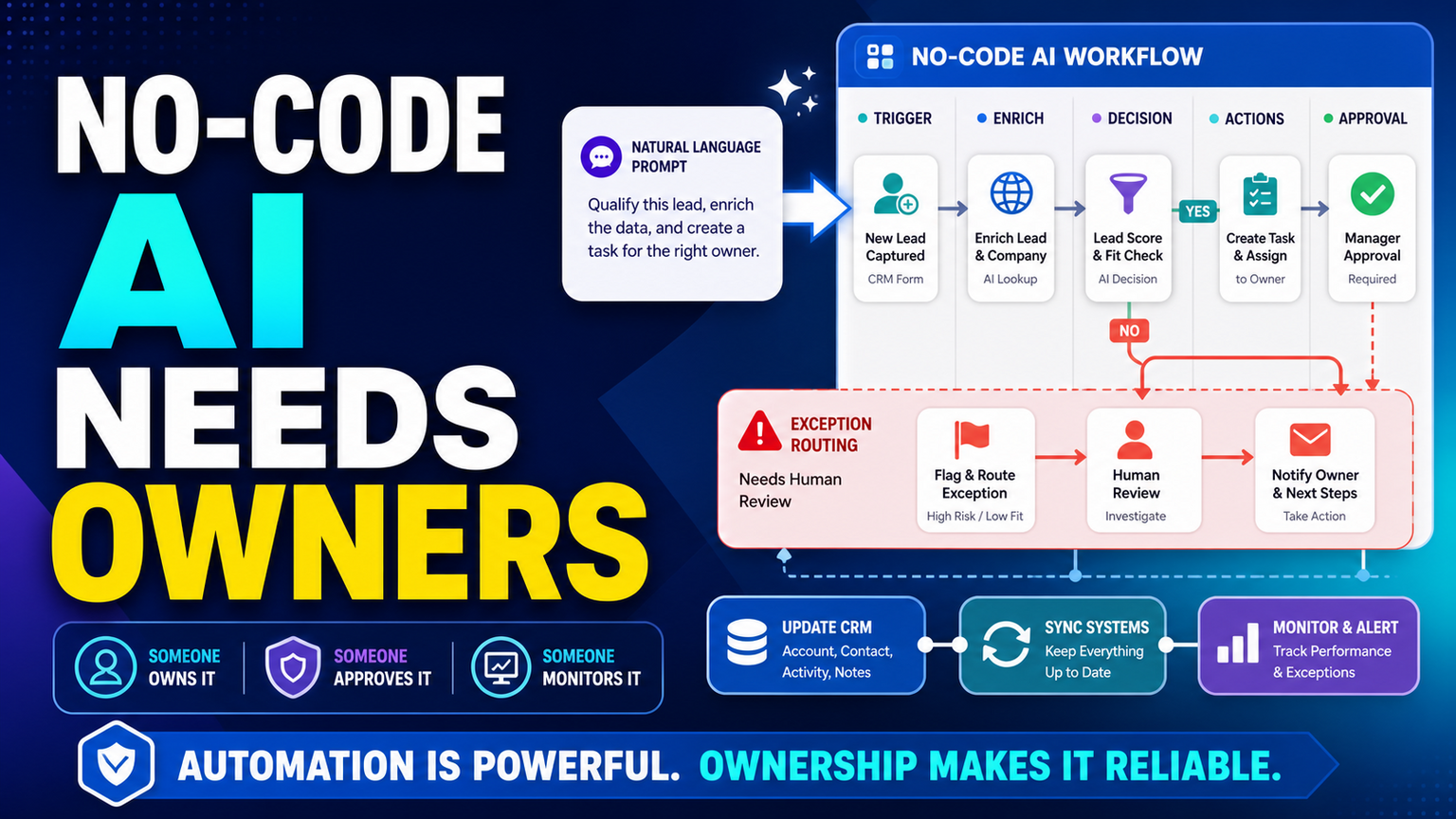
For example, a natural language prompt might create a workflow that qualifies a lead, enriches company data and creates a task. A working business system also needs ownership: who accepts the lead, what data is required, what happens if enrichment fails, which CRM fields are updated, who receives the exception, and which report shows whether the process improved response time.
The market around AI automation is crowded. UK firms such as Faculty AI, Deeper Insights, Waracle and Brainpool AI can help enterprises with AI strategy and delivery. US firms such as LeewayHertz, Markovate, SoluLab and BairesDev often position around custom software and agent development. European teams such as Addepto, STX Next, Netguru and 10Clouds can support data, software and AI builds. SaaS tools including Zapier, n8n, Relevance AI, Lindy, Gumloop, Bardeen, Make and Stack AI can move tasks between apps quickly.
Those options can all be useful. The gap for many SMEs is not access to another builder. The gap is workflow ownership. Tools automate tasks. GOFTUS automates the workflow around the task.
That means GOFTUS looks at the full loop: intake, decision rules, system access, approvals, human review, CRM or support updates, exception handling, reporting and improvement. A no-code AI builder might create the first workflow draft. GOFTUS helps decide whether that workflow is safe, measurable and useful inside a real business.
What operators should do next
Start with one workflow that already creates visible friction. Good candidates include new lead qualification, quote follow-up, support triage, FAQ routing, invoice intake, document review, meeting action capture or customer onboarding. Write down the trigger, the desired outcome and the current failure points.
Then define the owner. Every AI workflow needs a person responsible for its rules, source data, exceptions and monthly review. Without an owner, automation becomes invisible risk. With an owner, the business can improve the workflow instead of blaming the tool.
Next, map the handoffs. A strong SME workflow should answer five questions before it goes live:
1. What information starts the workflow?
2. Which systems must be updated?
3. Which actions can AI complete automatically?
4. Which actions need human review?
5. What report proves the workflow is working?
This is where GOFTUS usually creates value. We connect tools like n8n, CRM platforms, support inboxes, documents, website forms and AI agents into a governed process. The goal is not to make the business look more technical. The goal is to reduce missed follow-ups, repeated admin, slow customer responses and unclear ownership.
X was unavailable because the xurl CLI was not installed in this cron environment.
Creatio's AI Studio update points to a wider shift: business users will be able to describe more automations in plain language. That is good news for SMEs, but it does not remove the need for process design. The winning teams will not be the ones with the most AI workflows. They will be the ones with clear owners, approval gates, exception routing, CRM updates and monitoring.
GOFTUS can help you choose the right first workflow, build the automation, connect the systems and review performance after launch. If you want a practical diagnostic before buying more tools, start with GOFTUS services or contact GOFTUS.
Should SMEs use no-code AI workflow builders?
Yes, if the workflow is narrow, owned and measurable. No-code AI builders can help teams move faster, but they should not be treated as a replacement for process design. Start with one painful workflow, define the owner, add exception handling and track whether customer or team outcomes improve.
What is the risk of letting business users build AI automations?
The risk is not that business users build automations. The risk is that nobody reviews the workflow after it starts touching customers, CRM data or internal decisions. SMEs should set approval rules, data boundaries, escalation paths and monthly review before expanding automation across the company.
How can GOFTUS help with no-code AI automation?
GOFTUS helps SMEs turn tool ideas into working systems. That includes workflow mapping, AI agent design, CRM updates, n8n automation, document processing, support triage, reporting and review loops. The aim is simple: automate repeatable work while keeping humans in control of exceptions and business judgment.