Claude Sonnet 5 and AI Agent Costs: The SME Workflow Automation Lesson
Anthropic's Sonnet 5 launch shows why SMEs need cost controls, review gates, and workflow design before scaling AI agents.
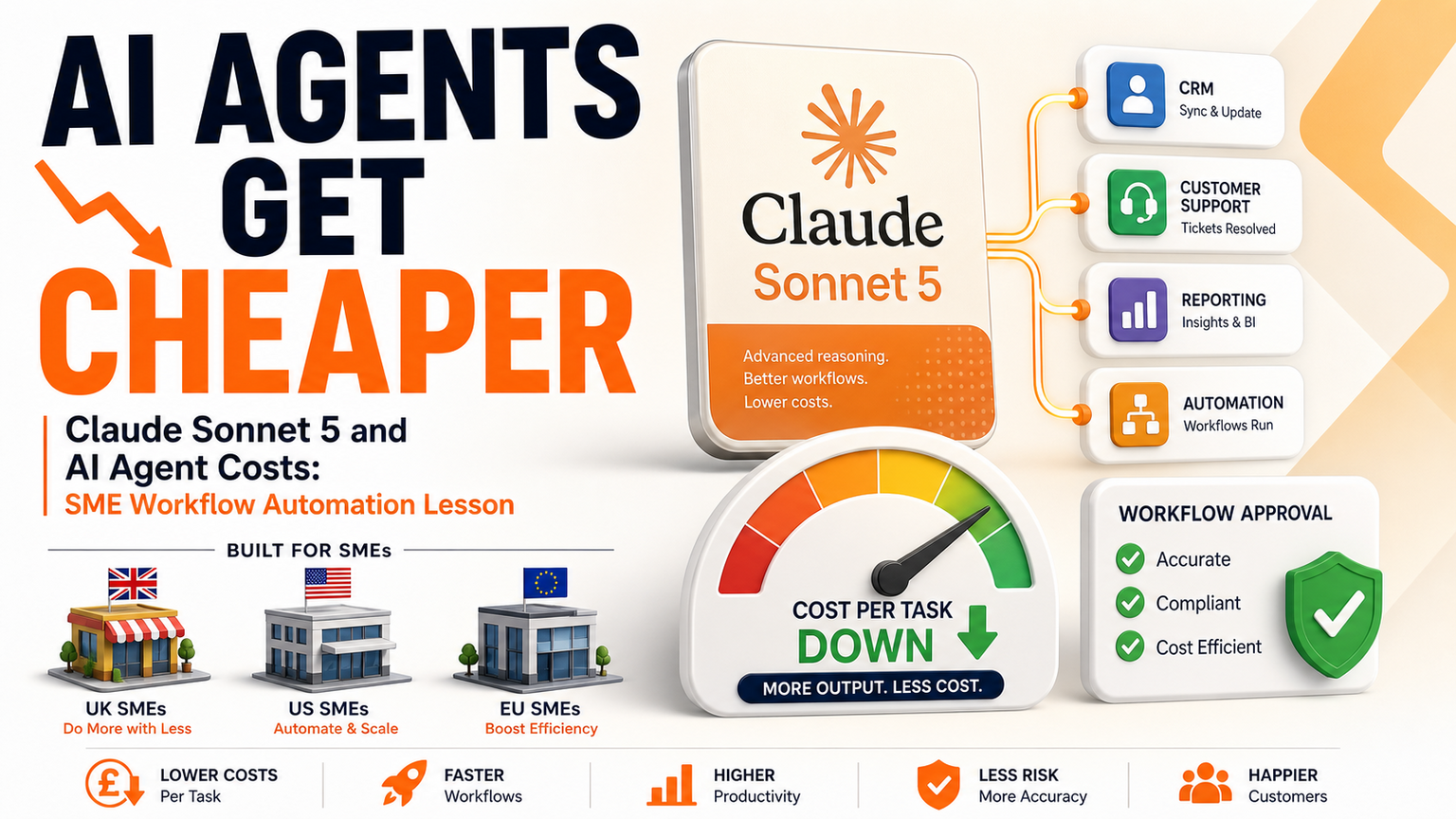
Anthropic has introduced Claude Sonnet 5 as its most agentic Sonnet model yet, with stronger reasoning, tool use, coding, and professional work capability. The business lesson for SMEs is not only that a new model is more capable. Bharatvaj's view is that agentic AI is becoming affordable enough to move from experiments into everyday operations, which means cost controls and review gates need to be designed before usage spreads across teams. A hot r/Anthropic RSS thread showed users discussing whether to downgrade or cancel when a model access change arrives. That is not enterprise procurement data, but it is a useful signal: AI users are now making practical decisions around price, limits, and reliability, not just model excitement.
What this means for SMEs
Sonnet 5 matters because Anthropic is positioning it around agentic work: planning, browser and terminal tool use, coding, knowledge work, and autonomous execution. Anthropic says it is available across Claude plans, Claude Code, and the Claude Platform, with introductory API pricing before a higher standard price after August 31, 2026.
For an SME, this creates an opportunity and a risk. The opportunity is clear: more workflows can be automated at a reasonable cost. Sales follow-up, support triage, document processing, reporting, inbox routing, internal knowledge search, and CRM updates can all benefit from agents that can plan and use tools.
The risk is that better model economics can make weak workflows scale faster. If teams connect an agent to a CRM, helpdesk, spreadsheet, or inbox without rules, the business may get more activity but not more control.
Before scaling agentic AI, SMEs should define:
Which workflows are allowed to use autonomous steps.
Which systems the agent can read from or write to.
Where a human must approve customer-facing, financial, legal, HR, or high-value sales actions.
How usage cost is tracked by workflow, not only by user.
What happens when the agent is uncertain, blocked, or wrong.
Which monthly metrics prove the automation is improving the business.
A better model can reduce friction, but it does not replace operating design. The SME advantage comes from pairing capable AI with clear workflow boundaries.
Global SaaS competitors such as Zapier, n8n, Relevance AI, Lindy, Gumloop, Bardeen, Make, and Stack AI will keep making agent workflows easier to assemble. US competitors such as LeewayHertz, Markovate, SoluLab, and BairesDev often publish broad AI agent and industry automation guides. UK and European consultancies such as Faculty AI, Deeper Insights, Waracle, Brainpool AI, Addepto, STX Next, Netguru, and 10Clouds often frame the same shift around enterprise AI, safety, PoCs, RAG, production readiness, and AI cost.
That content is useful, and the tools can be useful too. The gap for many SMEs is the operating layer.
Tools automate tasks. GOFTUS automates the workflow around the task.
A workflow builder may send a lead email. GOFTUS asks whether the lead source is valid, whether the CRM field is complete, whether the response needs approval, whether the follow-up sequence should pause after a complaint, whether the owner gets notified, and whether the automation improved conversion after one month.
For UK, US, and European SMEs, the relevance is direct: agentic AI cost is falling, but data protection, customer promises, audit trails, and vendor dependency still need ownership.
| Question | Practical answer |
|---|---|
| What happened? | Anthropic introduced Claude Sonnet 5, describing it as its most agentic Sonnet model yet for coding, tool use, and professional work. |
| Why does it matter for SMEs? | More capable lower-cost agents can move AI automation from pilots into daily sales, support, admin, and reporting workflows. |
| What is the risk? | Teams may scale agents before setting permissions, review rules, cost tracking, exception handling, and quality monitoring. |
| What should SMEs automate first? | Start with bounded workflows such as support triage, CRM follow-up, document intake, internal knowledge lookup, or weekly reporting. |
| What is the GOFTUS angle? | Build the full workflow around the agent so speed, cost, quality, review, and accountability improve together. |
Should SMEs switch workflows to Claude Sonnet 5 immediately?
Not blindly. SMEs should test one bounded workflow first, compare cost and quality against the current process, and add approval rules before expanding to customer-facing or finance-related work.
What should an SME measure when using AI agents?
Measure workflow outcomes, not only token spend. Useful metrics include time saved, response quality, rework, missed follow-ups, ticket backlog, reporting delay, approval exceptions, and monthly cost per completed workflow.
How can GOFTUS help with agentic AI adoption?
GOFTUS designs practical AI automation for CRM follow-up, support triage, reporting automation, document processing, internal knowledge assistants, and agentic workflows with review and monitoring built in.
If your business is considering Claude, OpenAI, Microsoft Copilot, or agent workflow tools, GOFTUS can map the workflow, choose the right automation points, integrate your systems, add human review, and improve the system monthly.
CTA: Book a GOFTUS AI workflow review to turn agentic AI capability into a controlled, measurable business process.
Official source: Anthropic news page, "Introducing Claude Sonnet 5", published June 30, 2026.