Claude AI workflow automation needs approval gates before non developers launch agents
Claude AI is helping non developers build agents, but SMEs need approval gates, browser boundaries, logs, and owners before workflows act.
# Quick answer Claude AI workflow automation is no longer only a developer story. The latest GOFTUS daily SEO run ranked `claude ai` at 94 and recommended Claude AI workflow automation with human approval gates. The same
Quick answer
Claude AI workflow automation is no longer only a developer story. The latest GOFTUS daily SEO run ranked `claude ai` at 94 and recommended Claude AI workflow automation with human approval gates. The same GOFTUS Reddit intelligence run found a 100 score r/ClaudeAI signal from an operator who described building a job-search product with Claude, including employer-page automation and a non-technical founder contribution. That Reddit post is a social signal, not an independently verified business case, but it shows the buying question clearly: if non developers can now build useful AI agents, what keeps those agents safe when they touch real workflows?
For SMEs, the answer is approval design. Claude, ChatGPT, Gemini, no-code builders, browser agents, and consultants can all help create drafts, research leads, fill forms, summarize documents, or route customer questions. GOFTUS focuses on the operating layer around that work: who requested the action, which data was allowed, what the agent prepared, who approved it, where it acted, and what log proves the decision later.
What this means for SMEs
The news context supports that shift. Google News RSS surfaced Anthropic's `Introducing Claude for Small Business` item, plus SiliconANGLE coverage of Claude for small-business automation workflows and TechInformed coverage on what businesses must fix before letting AI agents act. Those sources point in the same direction: AI assistants are moving from chat and drafting into repeatable business workflows.
That matters because non developers are often closest to the work. A sales coordinator understands the follow-up steps that keep leads warm. A support lead knows which customer questions need a human response. An operations manager sees which spreadsheet updates create delays. A founder knows which quotes, contracts, and approvals must never be changed without review. When those people can describe a workflow to Claude or connect a no-code agent, automation becomes much faster to prototype.
Speed is useful, but it also changes the risk. A non developer can create a workflow that looks harmless in a demo and still causes damage in production. The agent may submit a form before a human checks it. It may update CRM fields using weak source data. It may draft a refund message without policy context. It may scrape a portal that requires login boundaries. It may use a customer file in a place where that data should not go. None of those failures require bad intent. They happen when the workflow lacks owners, stop rules, and review lanes.
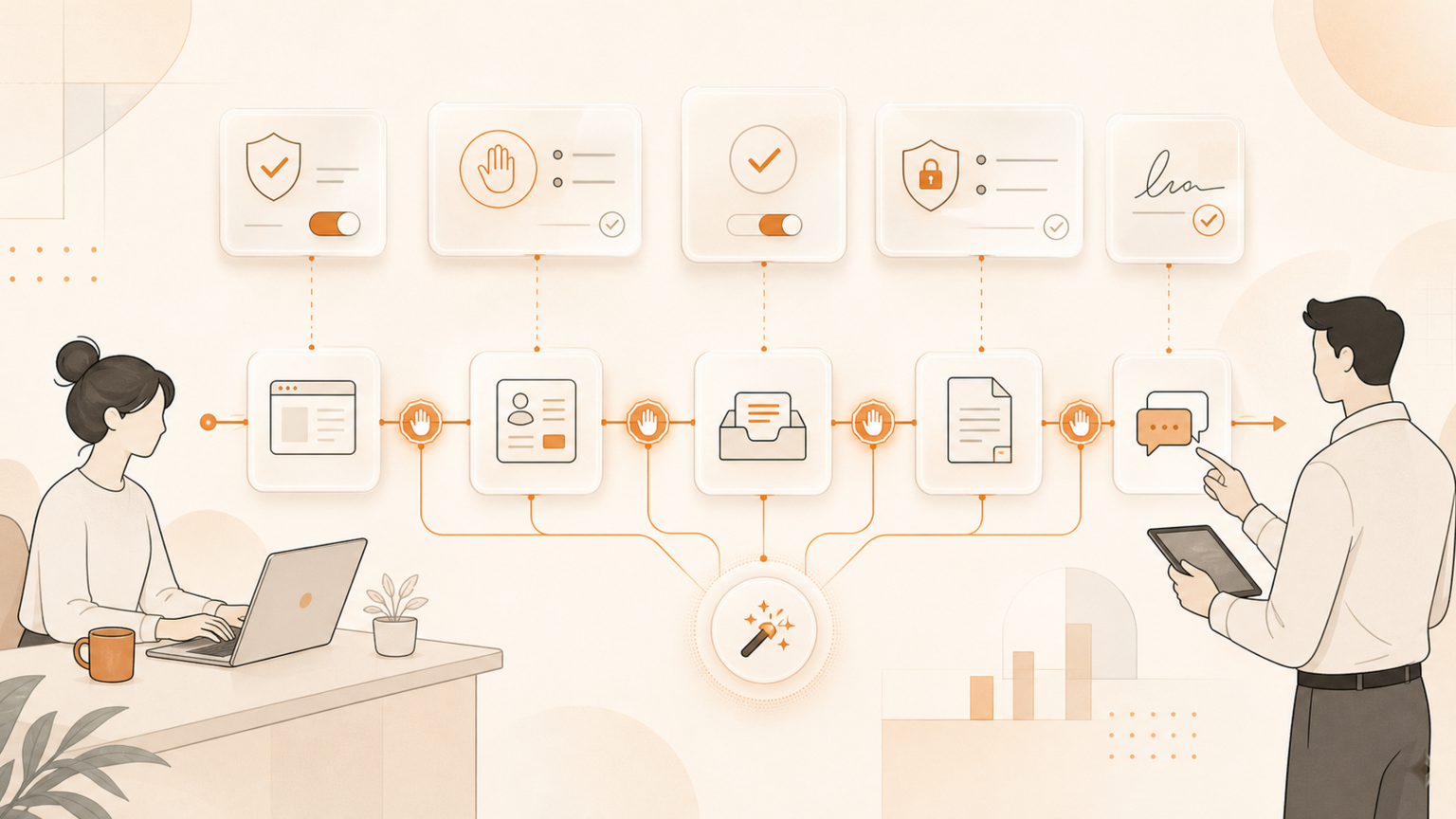
The practical SME response is to separate prepare from act. In the prepare lane, Claude can research, summarize, classify, compare, draft, and suggest. In the approve lane, a named owner reviews the prepared output against the business rule. In the act lane, the system completes the approved step, such as updating CRM, sending a support response, creating a document, scheduling a follow-up, or opening a browser task. In the review lane, the business checks exceptions and improves the workflow monthly.
This is also where browser work needs special care. Many agent demos involve reading employer pages, supplier portals, support systems, billing pages, or web forms. A browser with AI controls should not be allowed to click, submit, buy, cancel, change records, download sensitive files, or send messages without a clear approval rule. GOFTUS would define allowed domains, login boundaries, data fields, human approvals, screenshots or action logs, and fallback steps before any browser agent is trusted.
Competitor lens
Many competitors sell this as a tool choice: pick the best model, the best agent builder, the best browser automation platform, or the best consultant. Those choices matter, but they are not the whole system. A strong SaaS tool can still be risky if anyone can connect it to customer data without approval. A skilled consultant can still leave the business with fragile handoffs if no owner reviews exceptions. A no-code platform can still create shadow automation if workflows are not documented.
GOFTUS frames Claude AI workflow automation as a business operating system problem. The service starts with the workflow map, not the tool menu. We identify the trigger, source data, AI step, human approval point, action boundary, exception queue, and audit log. Then we connect the right tools around that design. That can include Claude, OpenAI, Gemini, CRM, support software, spreadsheets, documents, n8n, Make, Zapier, browser-control tooling, and reporting.
The advantage is practical. Staff can still use AI creatively, but risky steps pause. Managers can see what changed. Founders can approve customer-facing actions without reading every draft manually. Support teams can move faster without trapping customers in bad automation. Sales teams can follow up with better context without letting an agent promise terms the business has not approved.
What competitors are missing
The missing piece is usually the handoff from prototype to production. A prompt that helps one employee is not the same as a workflow the company can trust. Production needs permissions, templates, source-of-truth rules, escalation paths, and a record of outcomes. It also needs a simple way to retire or revise an agent when the model changes, the policy changes, or the business process changes.
GOFTUS would start with green, amber, and red lanes. Green tasks are safe preparation tasks, such as summarizing notes or drafting a first reply. Amber tasks affect customer communication, CRM, support, finance, or documents and require approval. Red tasks involve money movement, legal claims, sensitive data, login changes, public submissions, or irreversible actions and must stop until a human owner approves or redesigns the process.
Summery for SMEs
Claude AI can help non developers build useful workflows, but the business should not confuse a working demo with a controlled process. The first question is not whether Claude can do the task. The first question is whether the task has a named owner, a reliable source of truth, a human approval point, a browser or system boundary, and a log.
A safe rollout starts small. Choose one recurring workflow, such as lead follow-up, support triage, document review, or internal reporting. Let AI prepare the work. Make a person approve customer-facing or system-changing actions. Record the decision. Review exceptions every month. GOFTUS can build that operating layer through /agents and /services so non-developer AI adoption becomes useful without becoming shadow automation.
FAQ
What should non developers automate first with Claude AI? Start with preparation work such as summarizing support tickets, drafting follow-ups, classifying leads, or preparing document checklists. Keep sending, submitting, deleting, buying, or changing records behind approval.
Where should approval gates sit? Put approval between AI preparation and business action. If the output reaches a customer, updates CRM, changes a document, opens a portal, or affects money, a named owner should approve first.
How does GOFTUS help? GOFTUS maps the workflow, defines green and amber actions, connects the tools, adds review queues, and keeps logs so SMEs can use Claude AI without losing control of customer work.
Can this connect to browser agents? Yes, but only with boundaries. Allowed domains, login rules, read-only steps, screenshots, approval prompts, and action logs should be defined before an AI browser workflow acts.
Source notes
Daily SEO input: the 2026-08-24 GOFTUS daily SEO FAQ run ranked `claude ai` at 94 and recommended Claude AI workflow automation with human approval gates. Social signal: the 2026-08-24 GOFTUS Reddit intelligence run scored an r/ClaudeAI post about building a job-search product with Claude at 100; it is used as operator sentiment, not as a verified business outcome. News cross-check: Google News RSS surfaced Anthropic's `Introducing Claude for Small Business`, SiliconANGLE coverage of Claude small-business automation workflows, and TechInformed coverage on fixing businesses before letting AI agents act. Direct article retrieval was not required beyond RSS/headline-level cross-checking for this cron run.