Claude AI workflow automation: make coding agents ask before they act
Claude AI workflow automation: make coding agents ask before they act with GOFTUS owners, approval gates, evidence logs, and practical SME workflow ROI.
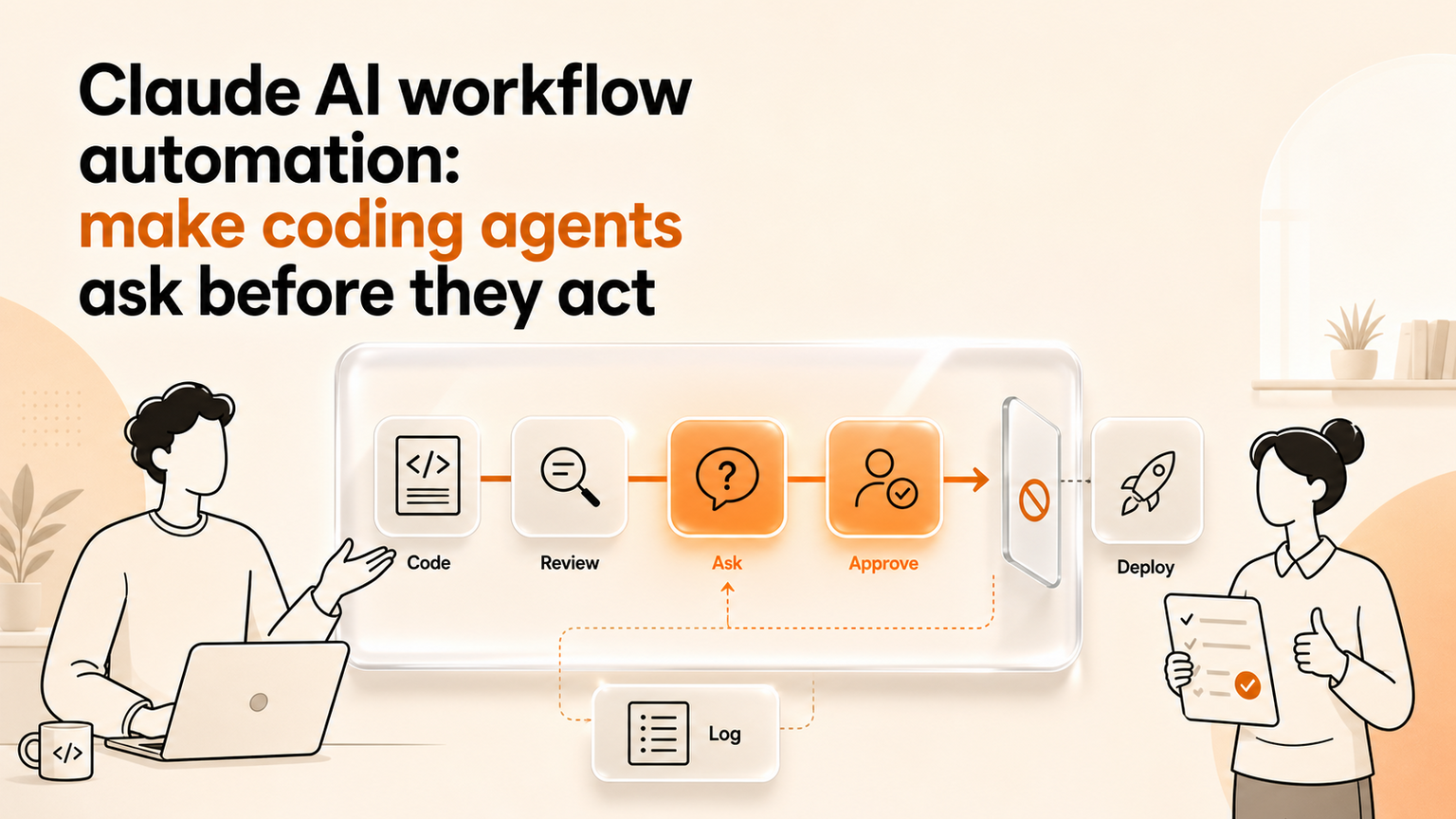
# Claude AI workflow automation: make coding agents ask before they act Meta description: Claude AI workflow automation: make coding agents ask before they act with GOFTUS workflow owners, approval gates, logs, and prac
Claude AI workflow automation: make coding agents ask before they act
Meta description: Claude AI workflow automation: make coding agents ask before they act with GOFTUS workflow owners, approval gates, logs, and practical ROI controls.
Quick answer
Claude AI workflow automation with human approval gates is the evergreen business problem behind today's Reddit signal. r/ClaudeAI: Hot take that Claude Code should ask more questions before touching code; r/ClaudeAI also surfaced concern over commercial incentives. Reddit is used as operator sentiment only. The useful takeaway for SMEs is not to copy forum reactions. It is to decide where AI may observe, prepare, recommend, or act inside a governed workflow. GOFTUS would map the owner, action boundary, approval point, fallback route, and evidence log before connecting the tool to /agents.
What this means for SMEs
A coding assistant that moves too quickly can create the same problem as a junior employee with production access: good intent, incomplete context, and a change that nobody reviewed. SMEs need the productivity without turning every model upgrade into an uncontrolled deployment risk.
The first 100 words of any AI plan should include the keyword and the business lane: Claude AI workflow automation with human approval gates. That lane might cover support triage, sales follow-up, marketing review, IT incident routing, document checks, browser actions, or reporting. The mistake is treating the AI model or SaaS product as the strategy. The strategy is the repeatable work path that turns a signal into a safer and faster outcome.
A controlled GOFTUS workflow normally starts with observation. The AI can read a ticket, summarize a thread, classify a lead, compare a draft with a policy, or prepare a next-step recommendation. Observation saves time without giving the system authority. The next lane is preparation. The AI can fill a CRM note, draft a customer reply, propose a checklist, or stage a browser form. Preparation is useful because staff review a nearly finished action instead of starting from an empty page.
Approval is where the workflow becomes business-safe. A human should approve anything that affects a customer promise, financial record, security setting, legal/compliance wording, brand claim, or external portal. The approval screen should show the source data, the proposed action, the risk level, and the reason the AI chose that path. If the reviewer rejects the action, the system should capture why, route the exception, and improve the rule for next time.
Action should be the narrowest lane. Some actions can happen automatically after enough evidence: adding a tag, creating a task, sending a reminder, or updating a low-risk internal status. Other actions should stay human-controlled: sending a sensitive reply, changing customer data, submitting a web form, adjusting an ad claim, or deploying code. The point is not to slow the team down. The point is to put speed behind the steps where the risk is understood.
ROI should be measured in plain operating terms. How many copy-paste steps disappeared? How many follow-ups were saved before they went cold? How many tickets were routed with enough context? How many draft assets were rejected before they reached customers? How many exceptions were visible to a manager? Those measures are more useful for SMEs than a generic promise about AI transformation.
The internal path matters too. If the workflow needs agents that can prepare actions, GOFTUS connects the design to /agents. If the workflow is a broader operations, CRM, support, or marketing system, GOFTUS connects it to /services. If buyers are still researching, companion answers on /questions support the same claude ai cluster and route them back to the right service page. That keeps SEO traffic tied to a business outcome instead of a disconnected blog post.
Source reliability should stay explicit. Reddit is a useful place to detect operator anxiety and fast-changing questions, but it is not a source of verified product facts. For this post, GOFTUS used the Reddit signal as social heat and Google News RSS or accessible headline-level sources as a cross-check. Where direct pages were blocked or not needed, the article treats the cross-check as context rather than claiming full article extraction.
Competitor lens
SaaS tools, automation builders, and consultants can all help. n8n, Zapier, Make, OpenAI, Claude, Gemini, image tools, video tools, and code tools each solve part of the problem. The gap appears when the business has five useful tools and no owner for the complete workflow. A tool can generate output, but it will not automatically define approval rights, exception handling, audit logs, monthly review, or the handoff between sales, support, IT, marketing, and finance.
GOFTUS competes by owning that full path. The work is not just prompt writing or connector setup. It is process design, integration, monitoring, review, and continuous improvement. That is why a managed workflow can beat a DIY stack when the SME needs dependable output rather than another experiment. The buyer still gets useful SaaS tools, but the business owns the operating system around them.
Summery for SMEs
Treat this AI model/tool chatter signal as a workflow design prompt. Pick one process, tie it to /agents, decide what AI may observe or prepare, require approval before risky action, log the result, and review exceptions monthly. That is how Claude AI workflow automation with human approval gates becomes useful business infrastructure instead of another tool conversation.
FAQ
What should an SME do first after seeing this signal?
Choose one repeatable workflow where claude ai can reduce delay or rework. Map the trigger, owner, data source, AI preparation step, approval point, exception route, and success measure before buying more tools or connecting agents.
When should AI be allowed to act automatically?
Only after the team has tested the workflow, defined low-risk actions, and made the log visible. Customer-facing, financial, security, compliance, deployment, or browser-submit actions should remain approved by a person until the risk pattern is well understood.
How does GOFTUS turn this into ROI?
GOFTUS connects the workflow to /agents, removes repeated manual steps, adds review gates, and tracks evidence such as faster routing, fewer missed follow-ups, cleaner handoffs, and fewer rejected outputs. The result is measurable operating improvement, not just AI usage.
Source notes
Reddit/social signal: r/ClaudeAI: Hot take that Claude Code should ask more questions before touching code; r/ClaudeAI also surfaced concern over commercial incentives. Reddit is used as operator sentiment only. Cross-check: Google News RSS query 'Claude Code approval gates AI coding agent enterprise controls' surfaced Balancing speed and safety: A control framework for AI coding agents - Amazon Web Services (AWS) (Amazon Web Services (AWS)); Devin AI vs Claude Code vs Cursor: $20 to $500 Gap [2026] - tech-insider.org (tech-insider.org). Source labelling is headline-level where direct article extraction was unavailable.