Claude AI Builds Need Customer Handoff Rules Before SaaS Teams Scale
Claude AI workflow automation with human approval gates turns today's Reddit signal into practical GOFTUS workflow controls, approvals, logs, and ROI logic
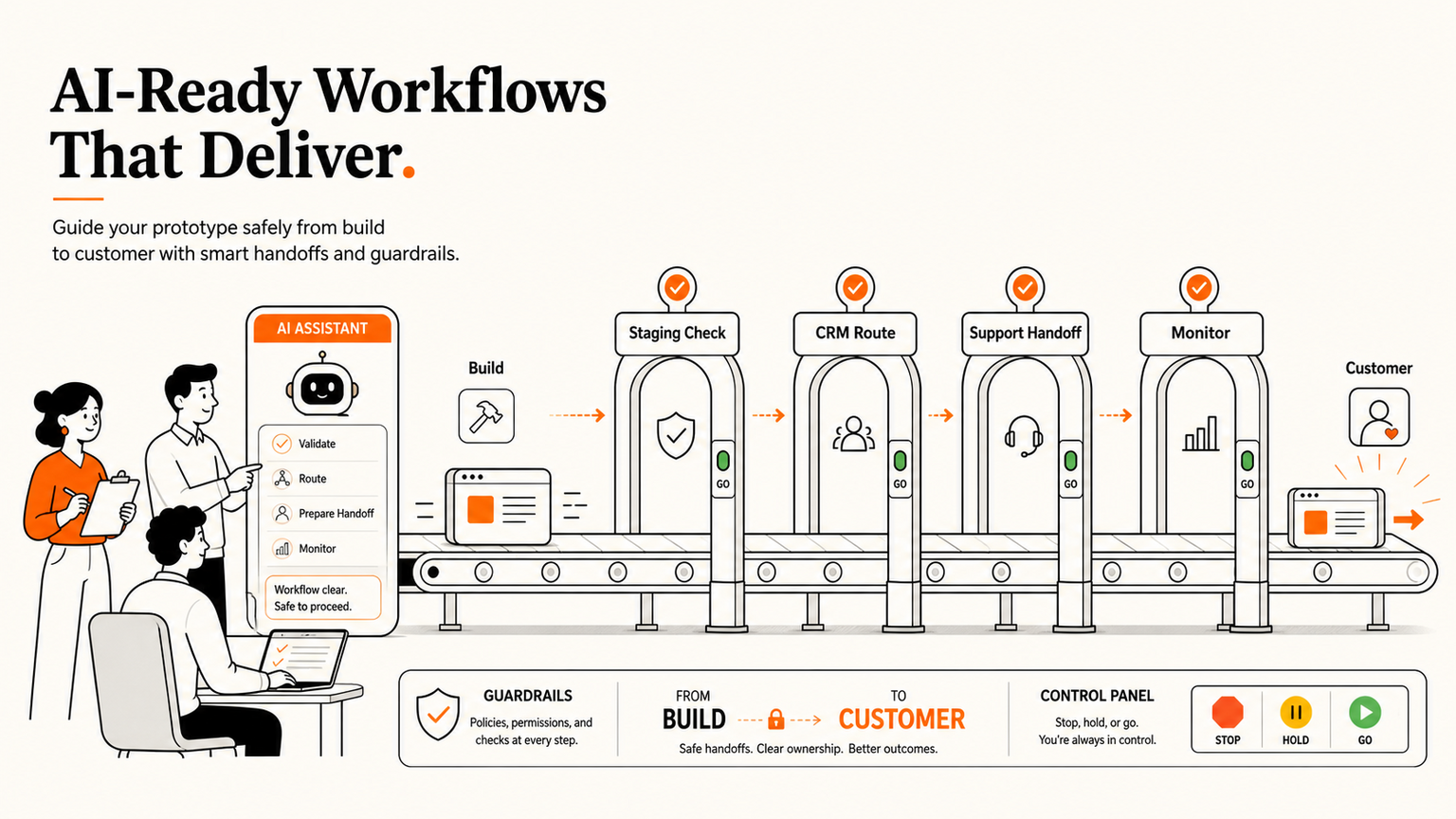
# Quick answer Claude AI workflow automation with human approval gates is the SEO target behind this Reddit-signal post. Claude AI Builds Need Customer Handoff Rules Before SaaS Teams Scale because SaaS and Claude build
Quick answer
Claude AI workflow automation with human approval gates is the SEO target behind this Reddit-signal post. Claude AI Builds Need Customer Handoff Rules Before SaaS Teams Scale because SaaS and Claude builder discussions show how quickly AI can help create prototypes while customer discovery, support, changelogs, and handoff rules lag behind. Reddit is useful as social heat, not verified fact. The GOFTUS lesson is to convert the signal into a business workflow with a named owner, approval path, cost or risk boundary, evidence log, and monthly review.
For this signal, GOFTUS would implement Claude AI workflow automation with scoped build briefs, customer validation checkpoints, staging tests, support handoff, CRM notes, owner approval, and post-launch monitoring. That keeps AI useful without turning every new model, assistant, or automation demo into an uncontrolled business process. The first 100 words of this article include the buyer keyword, the business pain, and the operating lesson: SMEs need workflows that let AI prepare work while people decide when the work becomes a customer, finance, support, document, browser, code, or marketing action.
What this means for SMEs
The Reddit signal came from r/SaaS, where discussion around "I finally got my first paying customer after 8 months" showed operator interest, friction, or concern. The cross-check is current news context from Jakob Nielsen on UX: "Redesigning Workflows for AI - Jakob Nielsen on UX". If the direct page was unavailable, this is RSS or headline-level context rather than a claim that the full article was independently scraped. Together, the sources point to the same operating issue: AI tool access is expanding faster than workflow ownership.
For a smaller business, the hard part is not asking AI to draft something. The hard part is deciding what happens next. A staff member can ask a model to write a customer reply, summarize a call, generate a campaign asset, review code, classify a support ticket, or prepare a browser task. Without a workflow, every output becomes a one-off judgement call. One person approves too much. Another person bypasses review because the answer looks confident. A manager cannot see what changed. A customer sees the result before anyone checks the source.
GOFTUS translates the signal into an operating design. First, define the trigger. That might be a new lead, support question, campaign request, code change, document upload, invoice exception, or website task. Second, define what AI is allowed to observe and prepare. Third, define the approval gate. Customer-facing messages, public claims, CRM changes, finance actions, security remediation, code deployment, and browser submissions should not happen silently. Fourth, create an exception route so failed steps become visible work instead of hidden technical debt.
This is where measurable ROI becomes possible. Count the time currently spent finding context, copying information, chasing a reply, rewriting the same answer, checking work, or fixing missed handoffs. Then compare that with the time spent reviewing prepared work and clearing exceptions. The goal is founders move faster without shipping unsupported AI-built workflows to customers. That is more practical than promising transformation or arguing about which model is smartest this week.
A useful first build should be narrow. Pick one queue, one owner, one system of record, and one approval step. If the workflow touches support, start with triage and suggested replies. If it touches sales, start with lead qualification and follow-up. If it touches documents, start with intake and review. If it touches marketing, start with claim checks and brand approval. If it touches browsers, start with observe and prepare modes before allowing any submit, purchase, account-change, or public-posting step.
The competitor trap is to buy a SaaS add-on or hire a consultant and assume the operating loop is solved. Tools and consultants can be useful. They do not automatically own integrations, permissions, fallback routes, exception queues, staff training, reporting, or improvement after launch. GOFTUS is stronger where the work crosses tools and needs an owner after the first demo.
Summery for SMEs
Treat this signal as a workflow question before treating it as a software question. Start with the task that already costs time or creates missed follow-up. Put AI in the prepare lane first. Add approval gates for risky actions. Log what was approved, rejected, changed, and escalated. Review the workflow monthly so the team can improve prompts, data sources, handoffs, and stop rules. For implementation support, see https://goftus.com/services and the supporting Q&A hub at https://goftus.com/questions.
Competitor lens
A normal SaaS pitch says the answer is another tool. A normal consulting pitch says the answer is a strategy deck. Both can help, but an AI-enabled process needs daily ownership. GOFTUS positions the work at the operating layer: trigger, system of truth, allowed AI preparation, approval owner, action boundary, audit evidence, exception route, and monthly improvement. That is how SMEs move from tool experiments to controlled automation across sales, support, documents, reporting, marketing, security, and browser workflows.
FAQ
What should SMEs automate first? Start with a repeated handoff where demand is visible and the risk is manageable: follow-up, support triage, document intake, FAQ routing, reporting preparation, or CRM updates.
Where should humans stay in the loop? Keep human review before customer messages, public marketing claims, finance actions, legal content, security remediation, code deployment, CRM changes, and browser actions.
How does GOFTUS measure ROI? Measure avoided admin time, faster response time, fewer missed follow-ups, fewer failed steps, cleaner review, and better owner visibility.
Source notes
Reddit/social signal: r/SaaS discussion titled "I finally got my first paying customer after 8 months". Source mode from GOFTUS Reddit intelligence, score 100, comments 170. Reddit is treated as operator sentiment only.
News cross-check: Google News RSS query "Claude AI SaaS startup customer handoff workflow automation 2026" surfaced Jakob Nielsen on UX headline "Redesigning Workflows for AI - Jakob Nielsen on UX" dated Thu, 09 Apr 2026 07:00:00 GMT. This is headline/RSS-level context unless the article is directly accessible.
SEO source: GOFTUS daily SEO FAQ output used keyword "claude ai" with Trends score 94 and mapped angle "Claude AI workflow automation with human approval gates".