China's humanoid robot games show strategy needs operating controls
China robot games show a strategy signal, but SMEs still need workflow owners, permission limits, review gates, fallbacks and logs.
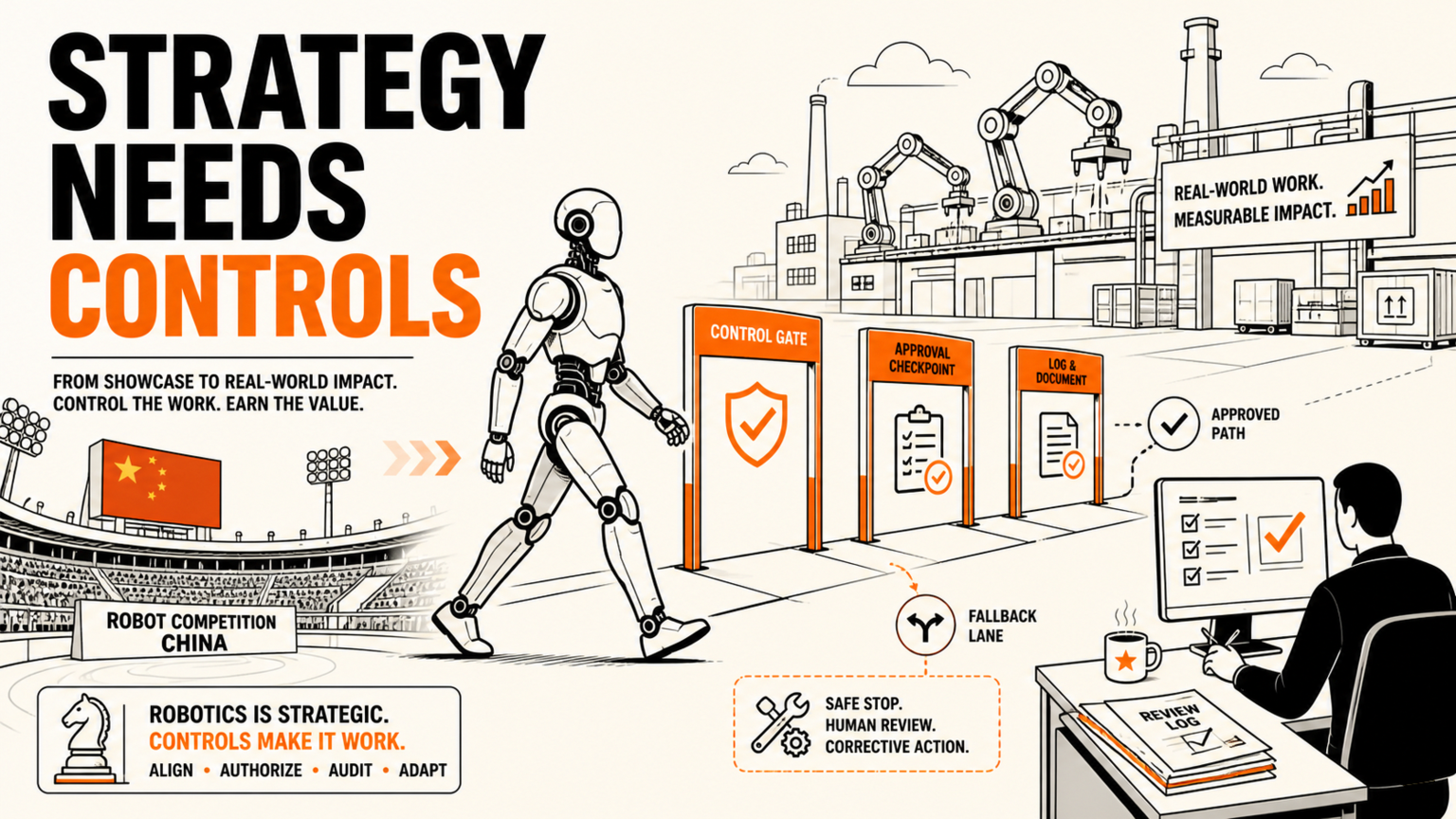
# Quick answer China's humanoid robot games are not only a sports story. They are also a strategy signal. Public competitions create attention, pressure vendors to improve hardware and software, and give policymakers, in
Quick answer
China's humanoid robot games are not only a sports story. They are also a strategy signal. Public competitions create attention, pressure vendors to improve hardware and software, and give policymakers, investors and operators a shared picture of where the technology is heading. But for SMEs, the business lesson is not "copy the spectacle." The lesson is to build operating controls before adopting any robot or AI agent that can affect real work.
GOFTUS reads the China robotics strategy news as a reminder that useful automation is never only about the model, the motor or the market race. It depends on workflow owners, limited permissions, approval gates, exception routes, human review, fallback capacity, and logs that show whether operations actually improved.
What this means for SMEs
China's robotics push matters because it turns humanoid robots into a visible national and commercial priority. News coverage around the Beijing games, robot makers and industrial readiness points to a race to convert hype into useful work. That does not mean every company should rush to buy humanoid robots. It means every company should prepare a better automation governance layer now.
The first preparation step is workflow inventory. List the tasks that are repetitive, physical, risky, document-heavy, browser-heavy, support-heavy, or coordination-heavy. Then ask which of those tasks would benefit from an assistant, which require human judgment, and which should remain manual. The same exercise works for robots, AI agents, CRM automation, document automation and reporting automation.
The second step is permission design. A humanoid robot in a factory, shop, office or warehouse can have physical permission. A software agent can have browser, document, CRM, support or finance permission. Both need explicit limits. The workflow should say what the system may see, what it may prepare, what it may change, and when it must stop. A strategic technology race does not remove the need for those limits. It makes them more important.
The third step is evidence. Leaders should not approve automation because a vendor demo looks advanced. They should approve a controlled pilot because logs show a task can be completed with fewer delays, fewer errors, safer handoffs, and better customer or employee outcomes. Evidence should include failures too. If a robot cannot complete a task, or an AI agent cannot verify an instruction, the exception record is not embarrassment. It is the data needed to improve the workflow.
The fourth step is fallback capacity. New automation often fails at the edge: unusual customer requests, unexpected object placement, incomplete records, downtime, policy changes, staffing constraints, or safety events. SMEs need manual fallback lanes, alternate tools, supervisor review and customer communication rules. Without those lanes, a strategic technology becomes a single point of failure.
GOFTUS helps by designing that operating layer. Instead of treating robotics, AI agents, FAQ automation, CRM automation and browser automation as separate experiments, the business can use one control pattern: observe, prepare, approve, act, review. That pattern keeps innovation moving while preventing tools from making uncontrolled changes.
What competitors are missing
Some vendors will sell the robot. Some platforms will sell automation connectors. Some consultants will sell a roadmap. All three can be useful. The missing piece is often workflow ownership after the first demo. Who approves the next use case? Who watches exceptions? Who decides when a robot, agent or script can touch a customer record? Who compares outcomes month by month?
GOFTUS focuses on that ownership gap. If China and other markets accelerate humanoid robotics, SMEs will face more options, not fewer. The winners will not be the companies that chase every new machine. They will be the companies that can safely absorb new capability into controlled operations.
Summery for SMEs
The Beijing humanoid robot games and China's broader robotics push should be treated as a strategy signal, not a workplace guarantee. The technology race is real enough to watch, but the adoption path for SMEs still runs through operating controls. Build workflow ownership, permission boundaries, approval gates, exception handling, fallback routes and logs now, so future robot or AI-agent capability can be tested without putting customers, staff, records or reputation at unnecessary risk.
FAQ
Does China's robotics strategy mean SMEs need humanoid robots soon?
Not necessarily. It means SMEs should understand where automation capability is moving and prepare governance for physical and software agents before adoption pressure arrives.
What should a business prepare first?
Prepare the workflow layer: task inventory, permissions, approvals, exception paths, fallback teams and monthly review metrics.
Why does GOFTUS connect robots with AI agents?
Both can move from suggestion to action. When a system can act in the world, in a browser, or inside business software, it needs boundaries, review and logs.
Source notes
Google News RSS for World Humanoid Robot Games surfaced The Atlantic scenes coverage, BBC coverage of robot boxing, football and sprinting, DW coverage of the robot race, and Nikkei context on robot supply chains. This run used RSS headlines and links as source discovery where direct publisher pages were blocked or inconsistent.
Google News RSS for humanoid robot Olympics surfaced New York Times, Gizmodo, Al Jazeera, Business Insider and Mashable links about sprint records, robot failures and the Beijing games. The article treats those as news signals, not proof of workplace deployment.
Google News RSS for Beijing humanoid robot games surfaced Tech Xplore, BBC, DW and South China Morning Post links about sprinting, tennis, football and records at the games.
Google News RSS for humanoid robot reliability surfaced Robot Report, MotorTrend, Devdiscourse and analyst-warning headlines about dexterity, industrial readiness and hype versus reality.
Google News RSS for China robotics strategy surfaced Reuters, Yahoo, Investing.com and diginomica links about Chinese robot makers trying to convert humanoid hype into useful work and the broader strategic showcase.