How SMEs use ChatGPT workflow automation without losing control
ChatGPT workflow automation helps SMEs in support and operations when approvals, logs, data rules, and owners are designed before everyday team use.
# How SMEs use ChatGPT workflow automation without losing control ## Quick answer ChatGPT workflow automation is one of the highest scoring GOFTUS daily SEO inputs today. The keyword is not just a tool name. For UK, US
How SMEs use ChatGPT workflow automation without losing control
Quick answer
ChatGPT workflow automation is one of the highest scoring GOFTUS daily SEO inputs today. The keyword is not just a tool name. For UK, US, and EU SMEs, it points to a practical question: how can a business use ChatGPT inside customer support and operations without losing control of approvals, customer data, CRM notes, or staff accountability?
The fresh social signal came from r/ChatGPT and r/ClaudeAI discussions where operators described AI-generated tickets, AI-reviewed work, and staff being asked to make sense of systems that were partly created by AI. That is social sentiment, not verified news. The news cross-check is headline-level Google News RSS, which listed OpenAI coverage on ChatGPT Work and business use cases, including the 18 August 2026 OpenAI headline about how NVIDIA scales expertise with ChatGPT Work. OpenAI pages were not directly readable from this cron environment, so this post uses the RSS headline as context rather than claiming full article-body verification.
GOFTUS sees the same pattern in smaller companies. The risk is not that ChatGPT drafts a reply, writes a note, or summarizes a ticket. The risk is that the workflow around the answer is missing. A safe starting point is a narrow AI automation workflow with named owners, review rules, source checks, and a clear handoff back into the tools the team already uses.
What this means for SMEs
ChatGPT can help with repeated support questions, sales notes, internal documentation, meeting summaries, proposal drafts, and operational checklists. Those tasks are useful because they sit close to daily work. They are also risky because they touch customer promises, staff decisions, and business records.
A small business does not need a giant AI programme to use ChatGPT well. It needs a workflow boundary. The boundary should answer five questions before staff scale usage. What source material can ChatGPT use? What output is allowed to leave the business? Which actions need human approval? Which systems can be updated? What evidence proves the workflow saved time or improved quality?
Without those rules, ChatGPT becomes another informal tool. One person uses it for support, another for CRM notes, another for policy drafts, and no one can see where information came from. This creates shadow workflows that are difficult to audit. With rules, ChatGPT becomes a controlled assistant inside the operating model.
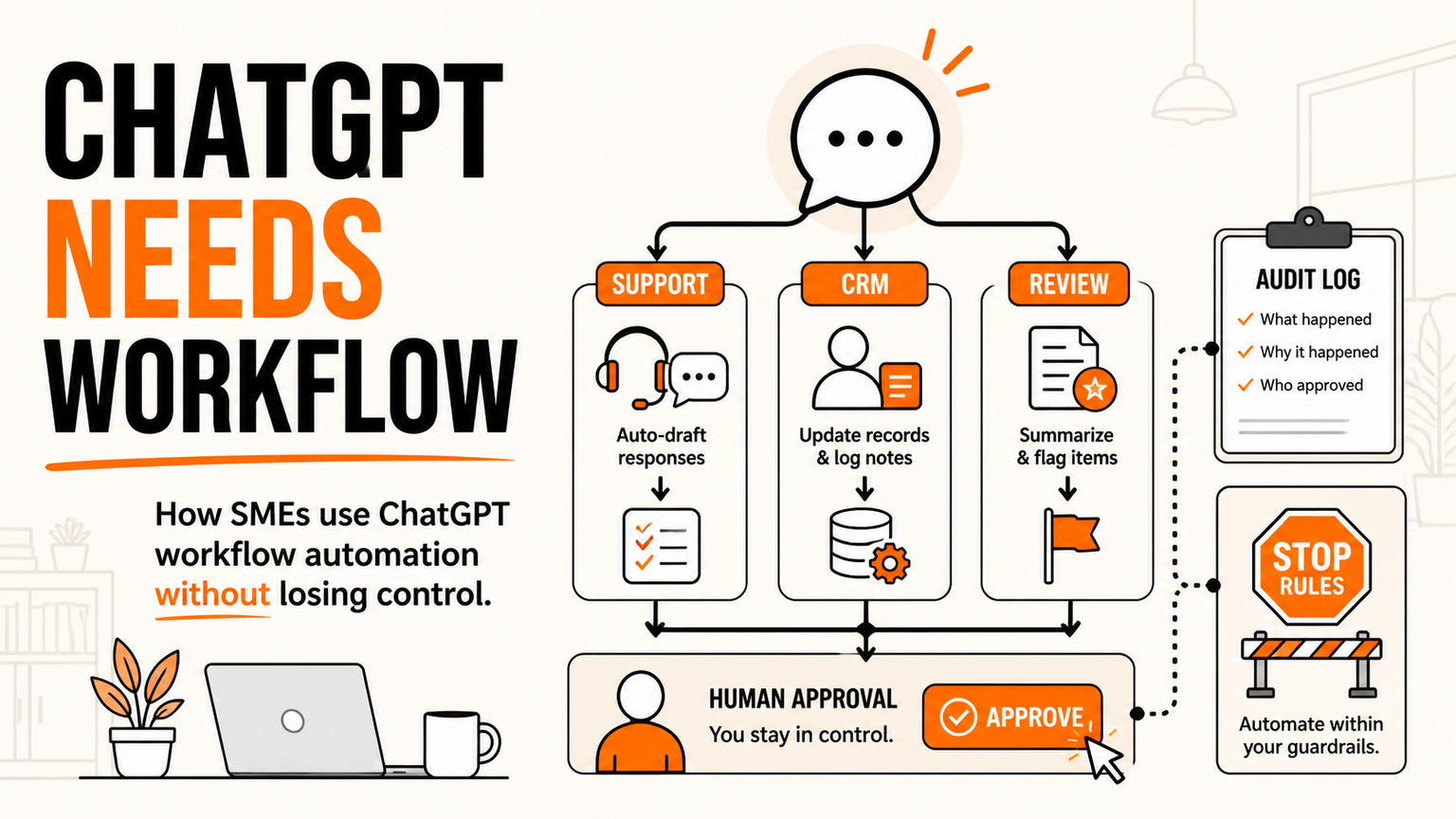
A simple support workflow might look like this: ChatGPT drafts a reply from approved FAQs and past tickets, a support owner reviews the answer, the final response is sent through the helpdesk, the CRM is updated with a short summary, and unanswered questions are routed into a weekly improvement list. The business gets speed, but it keeps judgement and evidence.
Bharatvaj's view
Bharatvaj's view is that ChatGPT workflow automation should be designed around responsibility, not novelty. If AI creates a ticket, someone still owns the ticket. If AI summarizes a call, someone still checks the source. If AI updates a CRM field, someone still needs to know why the update happened.
That is why GOFTUS separates prepare steps from act steps. Prepare steps include drafting, classifying, extracting, summarizing, and suggesting. Act steps include sending, updating, deleting, escalating, submitting, refunding, ordering, or changing records. ChatGPT is usually safe to test in prepare lanes first. It should only move into act lanes when there are approval gates, logs, fallback routes, and clear stop rules.
For SMEs, this protects the team from two common problems. The first is overtrust, where staff assume the AI answer is correct because it sounds polished. The second is tool sprawl, where every department creates a different AI habit. A workflow owner can prevent both by defining the approved inputs, output checks, escalation points, and review cadence.
Competitor lens
SaaS tools such as Zapier, n8n, Relevance AI, Lindy, Gumloop, Bardeen, Make, and Stack AI can connect ChatGPT to useful automations. Larger consultants such as Faculty AI, Deeper Insights, Waracle, Brainpool AI, LeewayHertz, Markovate, SoluLab, BairesDev, Addepto, STX Next, Netguru, and 10Clouds can also support strategy and delivery.
The gap for many SMEs is not access to tools. It is workflow ownership. Tools automate tasks. GOFTUS automates the workflow around the task. That means the trigger, approval, exception route, CRM or support handoff, audit trail, and improvement loop are designed together.
This is especially important for customer-facing work. A chatbot that answers quickly but uses old information can create more work. A CRM automation that updates the wrong status can confuse sales. A document assistant that drafts policy from the wrong source can create compliance anxiety. The workflow around ChatGPT must make the safe path easier than the risky path.
What SMEs should do next
Start with one workflow where ChatGPT can remove repeated work without making final decisions alone. Good candidates include support reply drafts, inbound lead qualification notes, meeting summary clean-up, customer FAQ improvement, internal knowledge search, and weekly reporting commentary.
Then write a one-page operating rule. List the allowed source documents, the human reviewer, the system of record, the handoff destination, and the exceptions that must stop the automation. Add a short audit log that records what happened, why it happened, and who approved it. Review the workflow monthly, not just when something breaks.
GOFTUS can help turn this into a practical build: discovery, workflow design, automation, CRM or helpdesk integration, QA checks, and improvement reporting. If the team wants a smaller first step, the £100 Startup Kit diagnostic can identify the best first ChatGPT workflow before software spend grows.
Summery for SMEs
ChatGPT workflow automation is useful when it is attached to a business process, not scattered across individual habits. The opportunity is faster support, cleaner CRM notes, better internal documentation, and less repeated admin. The control layer is approved sources, review gates, audit logs, escalation rules, and measured outcomes.
For GOFTUS, the right question is not whether SMEs should use ChatGPT. The right question is which workflow should ChatGPT support first, who owns the result, and what happens before AI output reaches a customer, record, or browser-based action.
FAQ
Can ChatGPT workflow automation replace support staff?
No. The safer starting point is to let ChatGPT draft, classify, and summarize while staff approve customer-facing responses. This reduces repeated work without removing judgement.
What should SMEs automate first with ChatGPT?
Start with a narrow repeated workflow: support replies, lead notes, FAQ updates, call summaries, or internal knowledge search. Avoid high-risk actions until review and logs are stable.
How does GOFTUS help with ChatGPT workflow automation?
GOFTUS maps the workflow, adds approval gates, connects existing tools, measures outcomes, and improves the process after launch. The goal is practical operating control, not generic AI adoption.
Source notes
Daily SEO input: GOFTUS 2026-08-19 Search Console and Trends run. Keyword used: chatgpt, score 100, mapped angle: ChatGPT workflow automation for customer support and operations.
Social signal: r/ChatGPT and r/ClaudeAI operator discussions about AI-generated tickets and AI-reviewed work. Treated as social sentiment only.
News cross-check: Google News RSS surfaced OpenAI coverage on ChatGPT Work and business usage, including the headline How NVIDIA scales expertise with ChatGPT Work. Direct OpenAI pages returned HTTP 403 in this environment, so this is headline-level context.
X signal: xurl is installed but has no registered app, so X was not used as a source in this unattended run.