ChatGPT workflow automation for SMEs: turn AI conversations into controlled customer operations
ChatGPT workflow automation helps SMEs turn staff AI conversations into approved customer operations with owners, CRM handoffs, logs, and review.
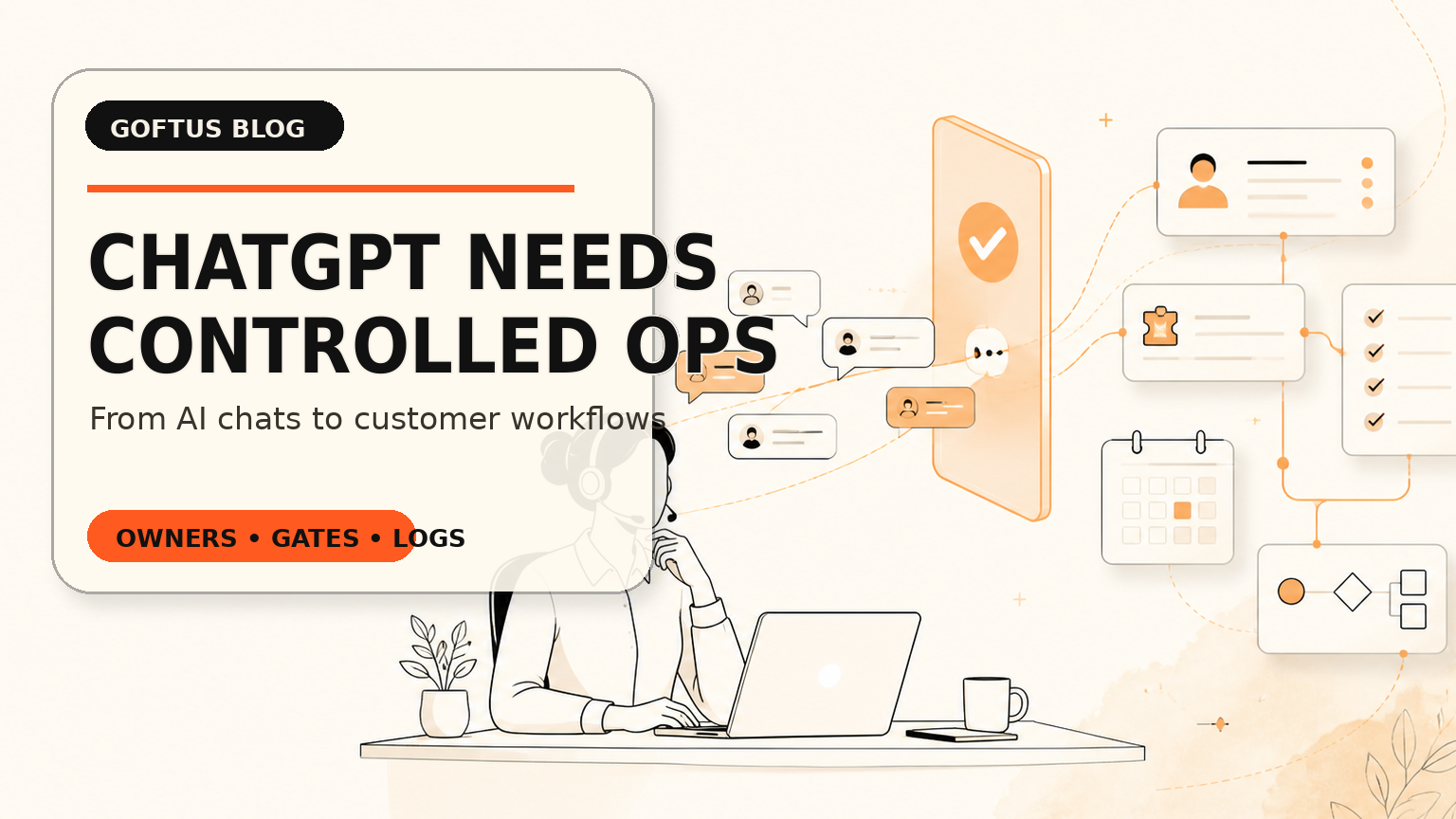
# ChatGPT workflow automation for SMEs: turn AI conversations into controlled customer operations Meta description: ChatGPT workflow automation helps SMEs turn staff AI conversations into approved customer operations wi
ChatGPT workflow automation for SMEs: turn AI conversations into controlled customer operations
Meta description: ChatGPT workflow automation helps SMEs turn staff AI conversations into approved customer operations with owners, CRM handoffs, logs, and review.
Quick answer
ChatGPT workflow automation is the practical next step for SMEs that already use ChatGPT in customer support, sales, operations, documents, or internal knowledge work. The fresh signal is not that every AI conversation is reliable. The signal is that staff and clients are already bringing AI-generated notes, scope changes, support replies, and operating ideas into real workflows. A recent r/webdev discussion described a non-technical client using AI to produce large technical documents and shifting requirements, while a r/sysadmin discussion asked how to move beyond simply asking an LLM questions. Those are social signals, not verified news facts, but they match what many UK, US, and EU operators are feeling: ChatGPT is now inside the business whether the workflow is ready or not.
What this means for SMEs
The daily SEO input for this run put `chatgpt` at a 100 Trends score and mapped it to ChatGPT workflow automation for customer support and operations. That is the buyer problem this post targets. A small business does not need another loose chat window. It needs a controlled path from question to answer, from answer to task, and from task to review.
OpenAI-related Google News RSS results this week also pointed to enterprise use of ChatGPT Work, OpenAI and IBM activity around secure enterprise deployment, and customer conversation examples such as Cars24 using OpenAI. Those RSS items are used here as headline-level market context. The pattern is clear enough without inventing statistics: businesses are trying to use ChatGPT closer to customer work, but the operational value depends on the handoff around the model.
The risk for SMEs is that ChatGPT becomes a second inbox with no owner. A support teammate asks it to draft an answer. A salesperson uses it to rewrite a follow-up. A manager asks it to summarize call notes. A founder asks it to turn a customer complaint into a process change. Each one may be useful, but none of them becomes business automation unless the output is routed, approved, logged, and improved.
Bharatvaj's view is that ChatGPT workflow automation should begin with the moment after the answer is drafted. Who checks the answer? Which source did it rely on? Does it update CRM, create a support note, prepare a document, trigger a follow-up, or ask a human to review a risky claim? If those steps are not designed, staff will either copy and paste blindly or abandon the tool when it creates extra work.
GOFTUS would start by choosing one customer operation, not every use case. Good first candidates include triaging website enquiries, drafting support replies, converting call notes into CRM tasks, preparing onboarding emails, summarizing long client documents, or turning repeated questions into a searchable knowledge base. The workflow can use ChatGPT to prepare the answer, but the workflow around it decides what happens next.
What SMEs should do next
First, separate safe preparation from risky action. ChatGPT can classify a message, draft a reply, summarize a document, extract intent, or prepare a CRM note. Sending a refund message, changing a contract, updating a payment record, publishing a policy answer, or committing to delivery dates should stay behind approval.
Second, define owners. A support workflow needs a support owner. A sales workflow needs a sales owner. A document workflow needs a reviewer who understands the source material. This is where many tool-led automation projects fail. They connect apps, but they do not assign responsibility for the exception path.
Third, log the handoff. The useful record is not only the prompt and answer. It is the customer question, source page, generated draft, approving person, final message, CRM update, support ticket, and unresolved issue. That record lets an SME improve the workflow every week instead of trusting a black box.
Fourth, use GOFTUS services when the process touches revenue, customer experience, or operational risk. GOFTUS can design the customer-operation workflow, connect it to CRM or support tools, and build review lanes around ChatGPT rather than leaving staff to manage copy-paste work manually. See /services for the practical automation path.
Fifth, add browser controls if ChatGPT or an agent will touch web portals. A browser-based action should have login boundaries, allowed pages, approval before submit, screenshots or logs, and stop rules. That is where the related query `browser with ai controls` fits naturally.
Competitor lens
Tools like Zapier, n8n, Make, Lindy, Bardeen, Gumloop, Relevance AI, and Stack AI can be useful for connecting steps. Consultants such as Faculty AI, Deeper Insights, Waracle, Brainpool AI, LeewayHertz, Markovate, SoluLab, BairesDev, Addepto, STX Next, Netguru, and 10Clouds can help with larger AI programmes. The gap for many SMEs is not tool access. It is workflow ownership.
Tools automate tasks. GOFTUS automates the workflow around the task. That means the trigger, source data, approval lane, owner, exception route, CRM or support handoff, audit log, and monthly improvement loop are designed together. ChatGPT is powerful, but the business outcome comes from the operating system around it.
Summery for SMEs
ChatGPT workflow automation should not mean giving every staff member a blank chat box and hoping customer operations improve. It should mean choosing one repeated business process, letting AI prepare the useful draft or classification, then routing the result through owners, approvals, logs, and follow-up systems.
For a UK, US, or EU SME, the best starting point is usually a customer-facing workflow: enquiry triage, support reply drafting, CRM follow-up, onboarding notes, document summaries, or repeated question capture. If the workflow proves useful, expand it into reporting, knowledge management, and browser-based actions with approval gates. GOFTUS can help turn that first controlled workflow into a repeatable automation system through /services and, where agents act in web tools, through /agents.
FAQ
What is ChatGPT workflow automation?
It is the process of turning ChatGPT outputs into controlled business steps: classify, draft, review, approve, update, log, and improve.
Should SMEs let ChatGPT answer customers directly?
Not for risky or policy-sensitive answers. Let it prepare drafts and route them to humans until the approved answer set is proven.
Where should GOFTUS start?
Start with one customer operation where repeated questions, follow-ups, CRM updates, or support notes are already consuming staff time.
How does this connect to browser with AI controls?
If an AI agent opens portals, submits forms, or changes records in a browser, the workflow needs approved actions, login boundaries, logs, and stop rules.
Source notes
Daily SEO FAQ output, 2026-08-20: `chatgpt` scored 100 and was mapped to ChatGPT workflow automation for customer support and operations.
Reddit/Composio social signal, 2026-08-21: r/webdev discussion on clients using AI for communication and r/sysadmin discussion on AI use cases beyond asking LLM questions. These are treated as operator sentiment, not verified fact claims.
Google News RSS cross-checks: OpenAI ChatGPT Work and OpenAI enterprise deployment headlines, including OpenAI/NVIDIA and IBM/OpenAI results. These are headline-level source cross-checks where direct article retrieval was not required for the operational lesson.