ChatGPT Governance for SMEs: Turn Staff AI Habits Into Approved Workflows
ChatGPT governance helps SMEs turn staff AI habits into approved workflows with review gates, logs, and safe CRM, support, document, and browser actions.
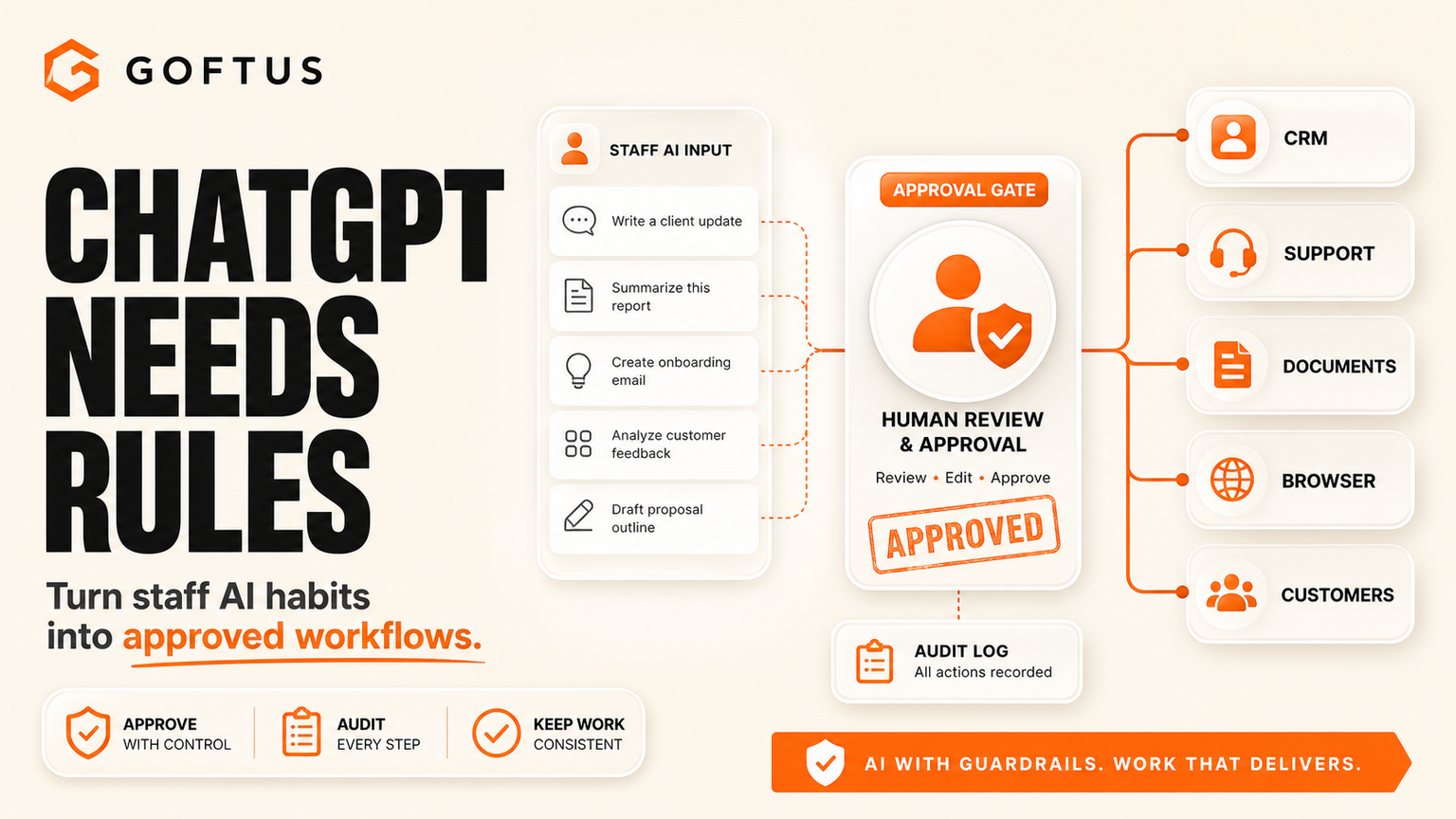
# Quick answer ChatGPT governance matters because staff already use AI for small, surprising tasks before the business has agreed where those tasks are safe. The social signal this run came from r/ChatGPT, where operato
Quick answer
ChatGPT governance matters because staff already use AI for small, surprising tasks before the business has agreed where those tasks are safe. The social signal this run came from r/ChatGPT, where operators were swapping unusual but useful ways they use ChatGPT. Reddit is not treated as proof that any one workflow works for every company. It is useful heat: people are moving AI from chat into everyday work.
For SMEs in the UK, US, and Europe, the searchable problem is simple. How do you keep the benefits of staff AI habits without letting unapproved drafts, data, browser actions, CRM updates, or customer messages leak into live operations? GOFTUS would answer that with a practical ChatGPT governance workflow: permitted use cases, data boundaries, review gates, audit logs, and a clear route from idea to approved action. If you need this mapped to your own operations, start with /services.
What this means for SMEs
The Google News cross-check for this topic surfaced OpenAI's enterprise theme, "From assistance to execution: How enterprises put AI to work", plus current coverage about shadow AI and enterprise AI governance. Those sources point in the same direction as the Reddit signal: AI is no longer only a writing assistant. It is becoming a daily operating layer around finance, sales, support, documents, research, coding, reporting, and customer communication.
That shift creates a gap for smaller businesses. Most teams do not need a huge AI policy document before they can make progress. They need a short operating workflow that says what staff can try, what must stay out of prompts, which outputs require human review, and which actions are never allowed without approval. A designer asking ChatGPT to turn customer notes into a landing-page outline is different from a support agent sending an AI-written refund response. A salesperson asking for follow-up ideas is different from an agent updating a CRM stage. A founder summarising meeting notes is different from an AI browser tool logging into a supplier portal.
This is where GOFTUS positions ChatGPT governance as workflow design, not legal theatre. The first layer is intake. Capture the tasks people already use AI for, especially the embarrassing or unofficial ones, because those often reveal real workflow pain. The second layer is classification. Sort tasks into observe, prepare, approve, and act lanes. AI can observe a document, prepare a draft, suggest a next step, or complete an action only when the lane allows it. The third layer is system connection. If the output touches CRM, support, documents, reporting, finance, or browser-based portals, it needs an owner, a review step, and a log.
What SMEs should do next
Start with one department rather than the whole company. Ask staff for ten AI use cases they already trust. Remove anything involving sensitive customer data, passwords, regulated decisions, private employee information, or direct payments until rules are written. Keep the safe cases and attach owners to them. For example, marketing can use AI to prepare campaign variants, but a person approves claims before publication. Support can use AI to summarise tickets, but a person approves refunds and complaint replies. Sales can use AI to draft follow-up, but CRM updates need confirmation.
Then build a lightweight approval workflow around the highest-value case. The workflow should show the original input, the AI output, the proposed action, the reviewer, the decision, and the final result. If browser automation is involved, define login boundaries and stop rules before the agent touches live pages. This is where /agents can help: GOFTUS designs AI agents that prepare work, wait for human approval, and record what happened instead of acting invisibly.
The measurement should be operational. Do not only count AI messages or licences. Count repeated drafts removed, response time improved, missed follow-ups reduced, documents processed, exceptions caught, and approvals completed. ChatGPT governance becomes valuable when it protects the business while making useful AI habits easier to repeat.
Summery for SMEs
Hajikreena's view is that the funny or surprising ChatGPT use case is often the clue, not the strategy. If staff keep using AI for a task, the business should not shame it or ignore it. It should decide whether the task belongs in an approved workflow. The workflow can be simple: safe inputs, prepared output, human review, controlled system action, and a log.
This is especially important for SMEs because they rarely have spare managers to babysit every tool. A clear ChatGPT governance workflow lets the team use AI without turning every decision into a meeting. It also gives owners a way to improve the system monthly. If a draft is always approved, automate more of the preparation. If a task is often rejected, improve the prompt, data source, or boundary. If an action is risky, keep it in the approval lane.
Competitor lens
Faculty AI, Deeper Insights, Waracle, Brainpool AI, LeewayHertz, Markovate, SoluLab, BairesDev, Addepto, STX Next, Netguru, and 10Clouds can all help organisations with AI strategy, software delivery, or specialised data work. SaaS tools such as Zapier, n8n, Relevance AI, Lindy, Gumloop, Bardeen, Make, and Stack AI can also automate useful tasks.
The difference is the operating layer. Tools automate tasks. GOFTUS automates the workflow around the task. For ChatGPT governance, that means choosing the use case, defining what AI can see, adding approval gates before customer or system impact, connecting the right CRM or support tools, logging decisions, and improving the workflow after real use. That is the part most SMEs need before another tool subscription.
FAQ
What is the first step in ChatGPT governance for an SME?
List the ways staff already use AI, then classify each one by risk and business value. Start with safe drafting, summarising, research, internal notes, and support preparation before allowing live customer or system actions.
When should ChatGPT output need approval?
Require approval when output changes a CRM record, sends a customer message, updates a document of record, touches finance, uses sensitive data, or drives browser-based actions in live systems.
Where should GOFTUS fit?
GOFTUS can turn informal AI use into workflow rules, approval queues, logs, and connected automations across /services and /agents, so the team gets speed without losing control.
Source notes
Social signal: r/ChatGPT discussion titled “What’s one thing you use ChatGPT for that sounds ridiculous - until people actually try it?” captured in the GOFTUS Reddit intelligence run on 2026-08-15. Treated as social heat, not verified fact.
News cross-check: Google News RSS results for ChatGPT enterprise governance surfaced OpenAI's “From assistance to execution: How enterprises put AI to work” and current articles on shadow AI and enterprise AI governance. These were used as headline-level context.
Optional X signal: xurl was installed but had no registered apps in this cron environment, so X was skipped and not treated as a blocker.