California’s Claude Deal: The SME Workflow Governance Lesson
California’s Claude rollout shows SMEs why AI adoption needs workflow guardrails, approvals, monitoring, and monthly improvement.
# Quick answer California announced a partnership that will make Anthropic Claude available to state agencies, cities, and counties, with discounted access, workforce training, expert workflow input, and public-sector u
Quick answer
California announced a partnership that will make Anthropic Claude available to state agencies, cities, and counties, with discounted access, workforce training, expert workflow input, and public-sector use cases such as document drafting, summarisation, customer service, cyber defence, and internal workflows.
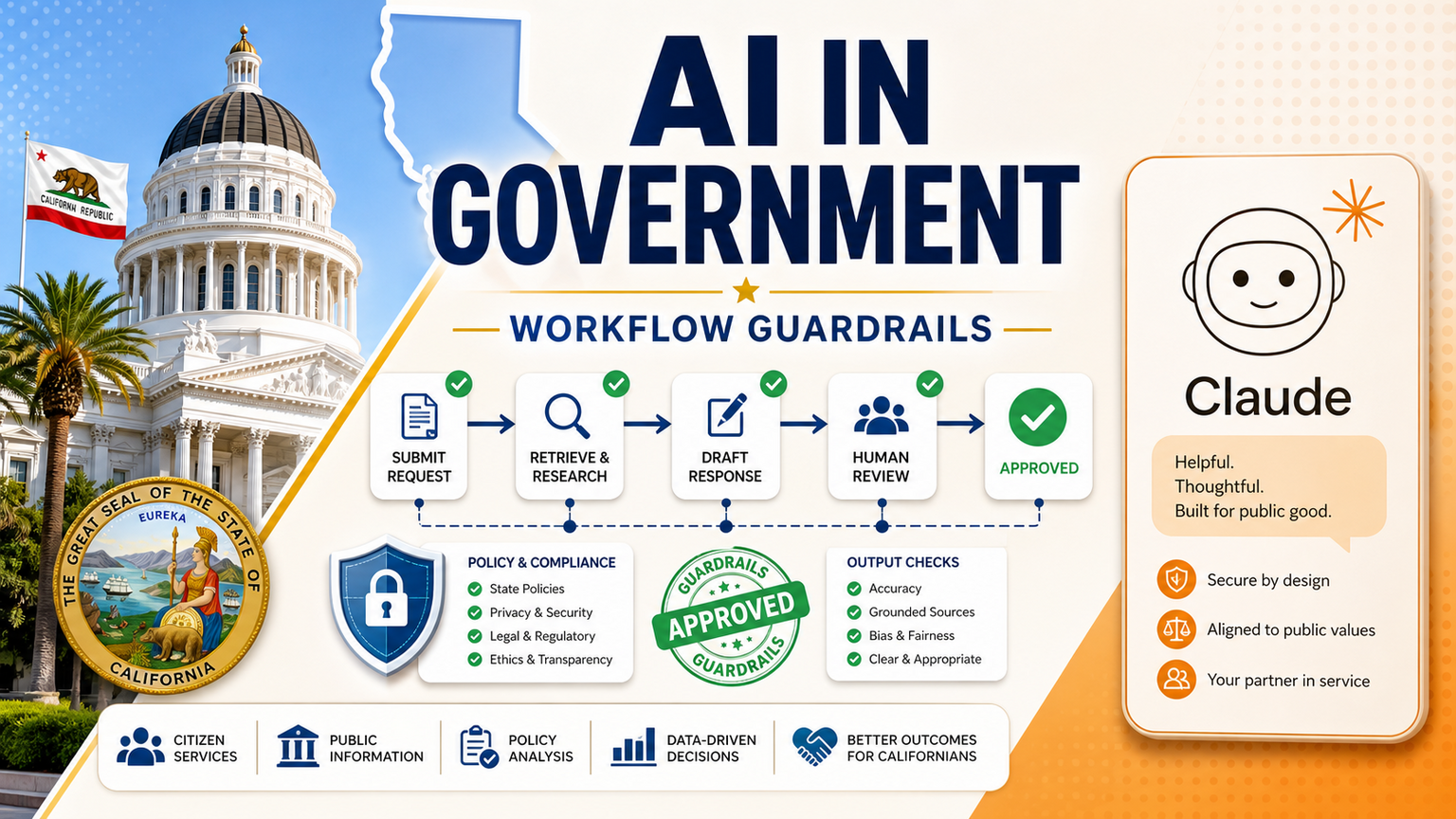
Thirumurugan's view is that the business lesson is not only about government AI. It is about how any SME should introduce AI into real work. Give the model a bounded job, connect it to the right systems, add human review, monitor outcomes, and improve the workflow every month.
What this means for SMEs
The official California announcement says Claude is the first AI productivity tool that will be available to all state agencies through the California Department of Technology's Statewide Information Technology Shared Services portal. It also says the agreement gives agencies and local governments discounted access, free workforce training, and technical assistance from Anthropic developers.
The useful detail for business owners is the shape of the rollout. California is not presenting AI as a loose chatbot experiment. The announcement talks about workflow input, transparent pricing around business use cases, workforce training, cyber defence, customer service, document summaries, and better internal processes.
That matters for SMEs in the US, UK, and Europe because the same pattern applies at a smaller scale. AI succeeds when it sits inside an operating workflow, not when it is left as a separate tab that staff may or may not use correctly.
For an SME, the practical version looks like this:
Pick one workflow, such as support triage, CRM follow-up, document intake, invoice checking, internal search, reporting, or sales admin.
Define what the AI can read, draft, classify, update, or send.
Add approval gates for customer, financial, legal, HR, medical, cybersecurity, or regulated decisions.
Train staff on when to trust the assistant, when to edit it, and when to escalate.
Keep logs of prompts, sources, outputs, reviewers, and final actions.
Review accuracy, time saved, cost, exceptions, and customer impact every month.
The California signal is public-sector news, but the SME takeaway is operational. AI adoption should start with workflow design before tool rollout.
Competitor lens
Global SaaS competitors such as Zapier, n8n, Relevance AI, Lindy, Gumloop, Bardeen, Make, and Stack AI help teams build automations and agents faster. US competitors such as LeewayHertz, Markovate, SoluLab, and BairesDev often publish AI agent guides and industry-specific automation pages. UK and European competitors such as Faculty AI, Deeper Insights, Waracle, Brainpool AI, Addepto, STX Next, Netguru, and 10Clouds often frame similar topics around AI safety, production AI, RAG, sovereign cloud, public-sector AI, and enterprise transformation.
Those tools and consultants can be useful. The missing layer for many SMEs is the operating wrapper around the tool.
Tools automate tasks. GOFTUS automates the workflow around the task.
A workflow builder can send a support email to an AI model. GOFTUS designs the intake rule, data access boundary, source-checking step, approval queue, CRM update, fallback path, dashboard, and monthly improvement process. A consultant can advise on AI strategy. GOFTUS turns the chosen workflow into a measurable operating system.
Because this is US public-sector news, the regional relevance is clear: American organisations are seeing AI move from pilots into shared service portals, procurement routes, and employee training. UK and European SMEs should read it as an early warning that governance, procurement, data protection, and human accountability will matter just as much as model choice.
Summery for SMEs
| SME question | Practical answer | GOFTUS workflow layer |
|---|---|---|
| What happened? | California announced a partnership to make Anthropic Claude available to state agencies and local governments. | Translate AI access into a controlled internal workflow. |
| Why does it matter? | The rollout includes training, technical assistance, workflow input, and use-case pricing. | Start with process design, not a loose chatbot launch. |
| What should SMEs copy? | Bounded use cases, workforce enablement, cyber controls, and transparent ownership. | Add permissions, review gates, logs, and improvement loops. |
| Where should SMEs start? | Support triage, CRM follow-up, document processing, reporting, or internal knowledge search. | Build one measurable workflow before scaling. |
| What should leaders measure? | Time saved, quality, exceptions, review overrides, cost, risk, and customer impact. | Review the automation monthly and improve it. |
FAQ
Is the California Claude partnership relevant to small businesses?
Yes. SMEs may not need a government-scale portal, but they do need the same discipline: approved tools, clear use cases, staff training, data boundaries, human review, and visible outcomes.
Should SMEs wait for perfect AI regulation before automating workflows?
No. SMEs can start safely with bounded, low-risk workflows while adding approval gates, logging, privacy controls, and monthly reviews. Waiting for perfect rules often delays useful operational improvements.
How can GOFTUS help turn AI access into a working process?
GOFTUS maps the workflow, connects the systems, defines permissions and review steps, builds AI agents or automations, monitors the results, and improves the system each month so the business gets measurable outcomes.
Practical GOFTUS CTA
If your team is testing Claude, ChatGPT, Microsoft Copilot, Gemini, Zapier, n8n, Make, or another AI workflow tool, GOFTUS can help turn the experiment into a governed workflow. Start with one process, add the right controls, measure the outcome, and improve it every month.
Sources and source notes
Main source: Governor of California official announcement, "Governor Newsom announces a first-of-its-kind partnership, providing Anthropic tools to state agencies and improving services for Californians", published June 29, 2026. It is used here as a social discussion signal about adoption friction, not as confirmation of the California partnership. Other Reddit feeds returned 429 rate limits.
X signal: xurl was not available in this cron runtime, so X was not used.