Audit logs for AI workflows: how growth companies keep IT under control
How growing SMEs use audit logs, approval gates, and handoffs to keep AI workflows safe as IT requests, support, and automation scale up safely.
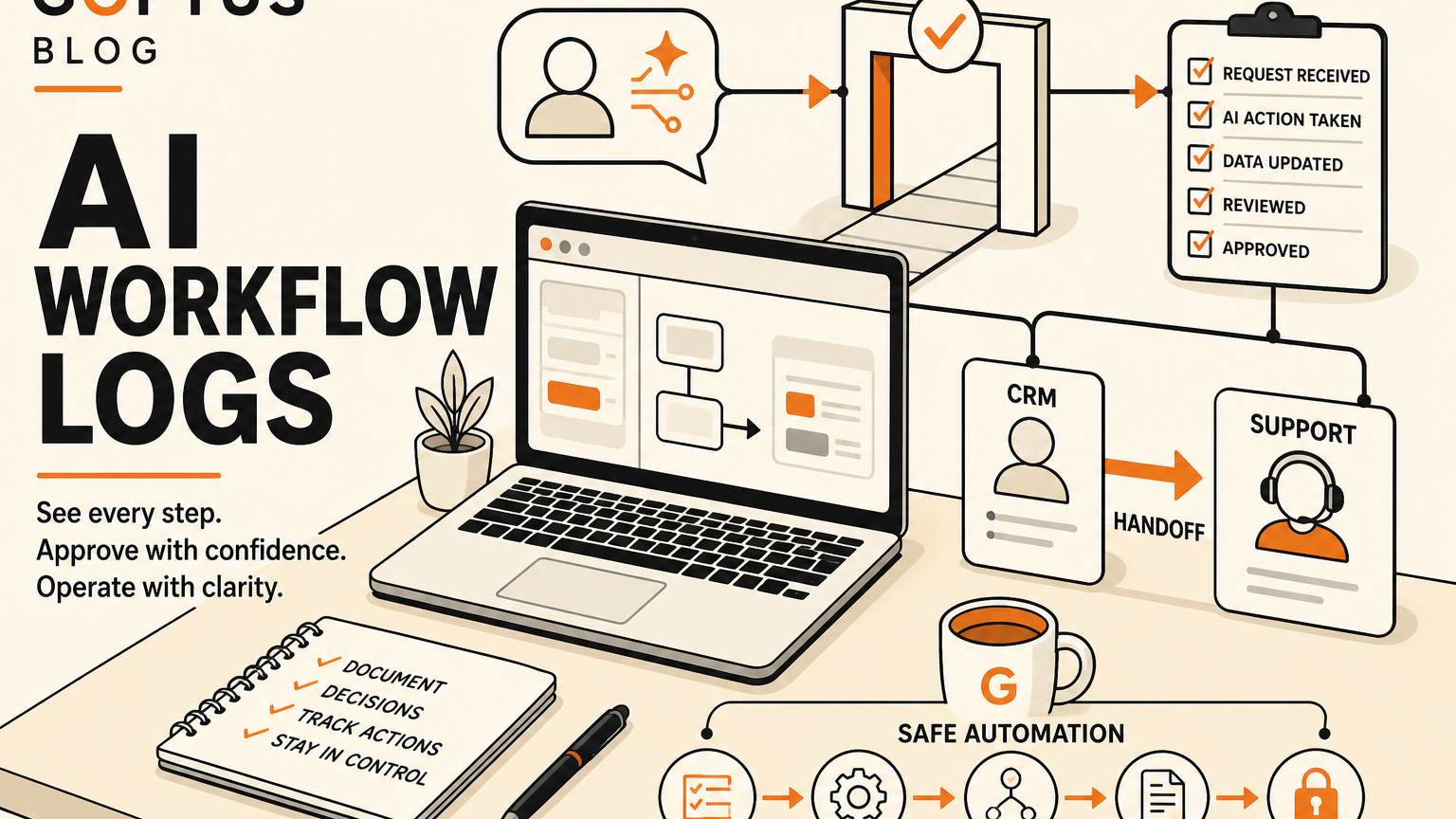
# Audit logs for AI workflows: how growth companies keep IT under control ## Quick answer A 20-person growth company does not need enterprise theatre to use AI safely. It needs visible workflow controls: who asked for w
Audit logs for AI workflows: how growth companies keep IT under control
Quick answer
A 20-person growth company does not need enterprise theatre to use AI safely. It needs visible workflow controls: who asked for work, what AI prepared, who approved it, what changed, and where exceptions went next. That is why audit logs matter before a company adds more bots, copilots, browser agents, or SaaS automations.
The signal for this post is a Reddit sysadmin discussion asking how a 20-person growth company should think about IT. Reddit is social heat, not verified company evidence, but the question shows a common SME moment: the business has grown beyond informal fixes, yet is not ready for a heavy internal IT department. At the same time, Google News RSS is surfacing fresh small-business AI agent and automation-tool coverage, including Hostinger coverage of AI agent builder tools and Wix Symphony coverage for small businesses.
For GOFTUS, the buyer query behind this is audit logs. Not logs as a technical afterthought, but logs as the proof layer for AI workflow automation across sales, support, documents, reporting, and browser-based work. If your team cannot see what happened, you cannot improve it, trust it, or hand it to a busy manager with confidence.
What this means for SMEs
Small teams often add software in the order pain appears. First comes a CRM. Then a helpdesk. Then a shared drive. Then a form tool. Then Zapier, Make, n8n, or a browser automation. Now staff ask for ChatGPT, Claude, AI note takers, AI email drafting, and agents that can act in web apps.
That stack can work, but only if the workflow has a record. A useful audit log should answer five practical questions. What triggered the workflow? What information did the AI use? What action did it recommend or prepare? Who approved the action? What changed in the destination system?
Without that record, a 20-person company gets the worst version of automation: work happens faster, but nobody can explain it. A sales follow-up is sent without context. A support ticket is closed too early. A supplier record changes without a clear owner. A report goes to leadership without the failed AI step marked. When mistakes happen, the team blames the tool instead of fixing the workflow.
Hajikreena's view is that audit logs should be designed around business moments, not around developer consoles. The owner, ops lead, or support manager should be able to open a plain timeline and see requests, approvals, outputs, exceptions, and next steps. The log should show enough detail to rebuild the decision without exposing unnecessary private data to every user.
Where AI workflow audit logs help first
Start with workflows where AI touches customer, revenue, compliance, or operational trust. These are where small failures create expensive confusion.
Sales follow-up is a good first case. AI can draft replies, summarize call notes, score urgency, and update CRM fields. The log should show the source message, suggested next step, approved message, CRM update, and any skipped field. GOFTUS links this work to /services because the value is not just faster emails. The value is a visible and repeatable follow-up path.
Support triage is another strong candidate. AI can classify an issue, suggest an answer, prepare a refund note, or route an escalation. The log should show whether AI only prepared the response or actually updated a ticket. If a browser agent opens a customer portal, the business also needs login boundaries and human-approved browser actions through /agents.
Document and reporting workflows need the same treatment. AI can extract details from PDFs, compare contracts, summarize dashboards, or prepare weekly reports. The log should mark source files, reviewer approval, exceptions, and the final destination, so the team can find the weak step instead of rechecking everything manually.
Competitor lens
Faculty AI, Deeper Insights, Waracle, Brainpool AI, LeewayHertz, Markovate, SoluLab, BairesDev, Addepto, STX Next, Netguru, and 10Clouds can all be useful partners for AI strategy, builds, and engineering delivery. SaaS tools such as Zapier, n8n, Lindy, Gumloop, Bardeen, Make, and Stack AI can also automate important tasks quickly.
The gap appears after the first demo. Tools automate tasks. GOFTUS automates the workflow around the task. That means defining the trigger, approval gate, exception route, audit log, owner, review cadence, and improvement loop before the automation is treated as production.
For a growing SME, this difference matters. A SaaS connector can move data from a form into a CRM. A consultant can build an AI assistant. GOFTUS asks what happens when the form is incomplete, the AI is uncertain, the CRM conflicts with existing data, a browser login is needed, or a manager wants the weekly review. That is where audit logs become an operating control rather than a technical feature.
What SMEs should do next
Pick one workflow where AI or automation already touches real work. Do not start by buying another tool. Start by drawing the path from request to result.
List the trigger, systems involved, AI-prepared steps, approval points, and minimum audit record: source, draft or decision, approver, action taken, destination, exception, and timestamp. Review the log weekly until the workflow is stable.
Keep the first version narrow. A good early automation might only prepare CRM updates and wait for approval, classify support tickets without closing them, or draft browser actions but require a human click before submission. Narrow controls are easier to trust, improve, and explain.
If your business is at the 10 to 50 person stage, set staff rules too. Who can create automations? Who can connect new tools? Which systems are off limits? What must be logged? Which failures require a human owner? These questions are not bureaucracy. They protect speed.
GOFTUS can help turn that map into a working system across /services, with AI agents and browser controls available through /agents where the workflow needs safe action in web tools.
Summery for SMEs
The Reddit sysadmin signal is not proof that every growth company has the same IT problem. It is a reminder that small teams reach a point where informal fixes stop scaling. AI makes that point arrive faster because staff can create drafts, automations, and agents before the business has agreed on control.
Audit logs give the company a practical middle ground. The team can still move quickly, but every important AI-supported action has a trail. Owners can see what changed, managers can review exceptions, and the business can improve the workflow instead of arguing about whether AI is trustworthy.
The best first move is one visible workflow with a clear trigger, approval gate, handoff, and log. Once that works, the same pattern can extend into sales, support, documents, reports, and controlled browser actions.
FAQ
Do small companies really need audit logs for AI workflows?
Yes, when AI influences customer messages, CRM updates, support decisions, finance checks, documents, or browser actions. A simple log should show what happened, who approved it, and what changed.
Should audit logs slow the team down?
No. A good audit log reduces repeated checking because evidence is captured once and risky steps are visible.
Where should a business start?
Start with one repeated workflow that already causes confusion, such as sales follow-up, support triage, reporting, or document handling. Map the trigger, approval point, exception route, and system update before adding more AI tools.
Source notes
Social signal: Reddit r/sysadmin discussion, "How should a 20-person growth company think about IT?" captured in GOFTUS Reddit intelligence on 2026-08-17. Treated as operator sentiment, not verified news.
News cross-check: Google News RSS returned current small-business AI tooling context, including Hostinger coverage of AI agent builder tools on 2026-08-17 and Wix Symphony small-business AI platform coverage from 2026-08-11. RSS was used as headline-level context.