Anthropic's Hard Questions Push Shows Why SMEs Need AI Accountability Workflows
Anthropic's public AI questions push is a reminder that SMEs need clear AI accountability workflows before agents scale.
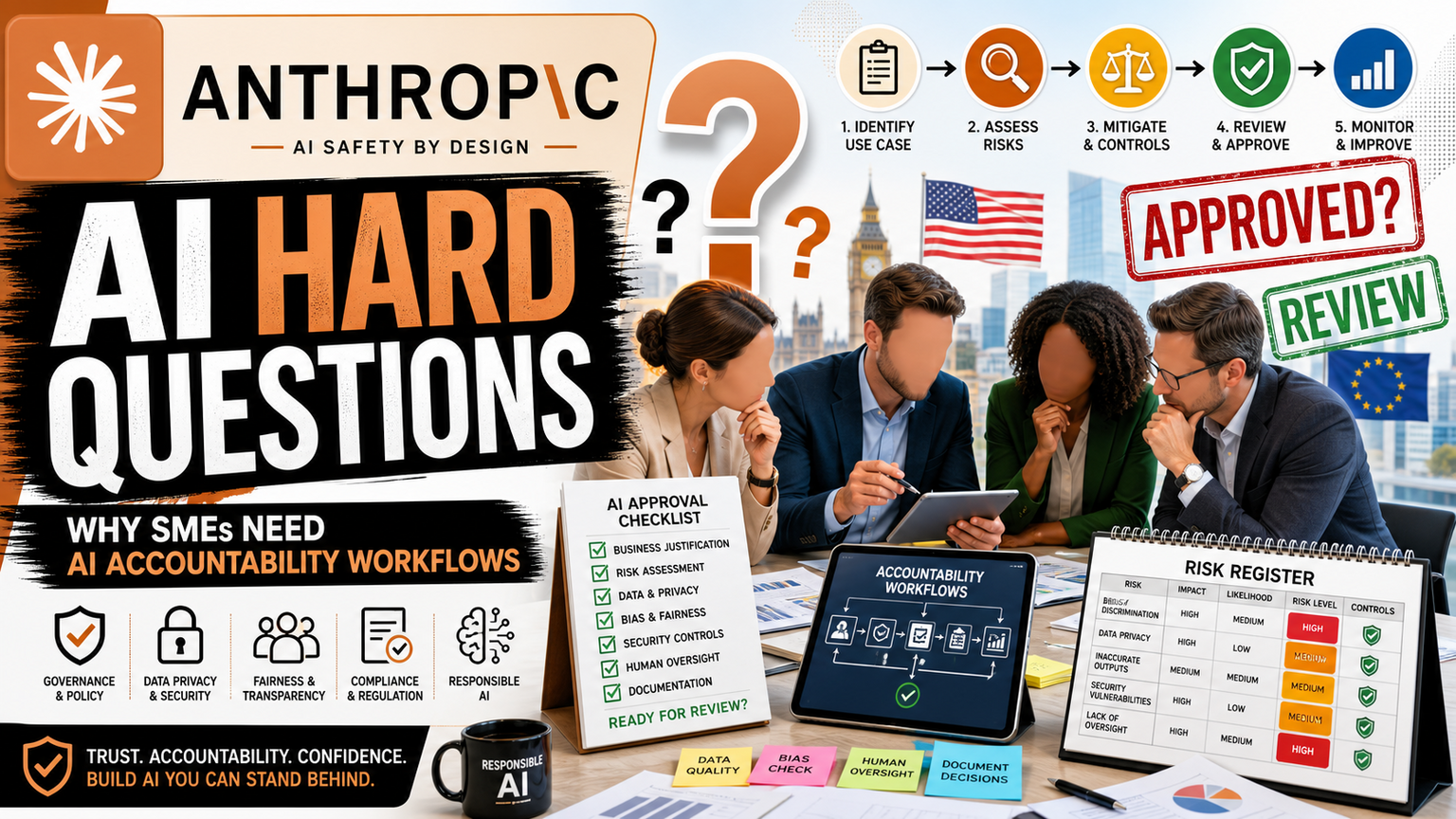
# Quick answer Anthropic's 9 July announcement, "Inviting hard questions", is not just public relations. It is a useful signal for SMEs that AI adoption is moving from novelty to accountability. If customers, staff, reg
Quick answer
Anthropic's 9 July announcement, "Inviting hard questions", is not just public relations. It is a useful signal for SMEs that AI adoption is moving from novelty to accountability. If customers, staff, regulators, and suppliers are asking hard questions about AI, a business needs a workflow for answering them.
Hajikreena's view: SMEs should not wait until an AI tool causes confusion, cost leakage, or a customer complaint before deciding who owns AI decisions. The practical answer is an accountability workflow with named owners, approval checkpoints, evidence logs, and monthly improvement.
What this means for SMEs
Anthropic says it is asking the public for hard questions about AI's effects on jobs, society, families, science, medicine, risk, and human agency, and says it will publicly track and report actions it takes in response. For business owners, the lesson is simple: AI systems now need a response process, not just a license and a login.
An SME using AI for support triage, sales follow-up, document processing, reporting, or internal knowledge search should be able to answer five practical questions:
1. Which use cases are approved and which are not approved?
2. Who reviews outputs before they affect customers, staff, money, or compliance?
3. Where are prompts, decisions, exceptions, and human overrides logged?
4. How are AI costs, errors, bias concerns, and privacy risks monitored?
5. What changes every month based on incidents, feedback, and measured outcomes?
This is especially relevant for UK, US, and European businesses because customers and regulators increasingly expect clear governance around data privacy, employment impact, security, and automated decision making.
Competitor lens
Global SaaS tools such as Zapier, n8n, Make, Lindy, Gumloop, Bardeen, Relevance AI, and Stack AI make it easier to build automations and agents. AI consulting firms in the UK, US, and Europe also publish useful material on AI safety, agents, RAG, decision intelligence, and production AI. Those tools and advisers can be valuable.
What many SMEs still miss is the workflow around the AI task. A support agent is not complete when it drafts a reply. A CRM automation is not complete when it updates a field. A reporting assistant is not complete when it creates a chart. The business still needs intake rules, escalation paths, human review, evidence capture, monitoring, and improvement cycles.
Tools automate tasks. GOFTUS automates the workflow around the task.
That is the practical counter-positioning. GOFTUS helps SMEs turn AI from a scattered set of prompts and SaaS experiments into governed operating systems with clear owners, integrations, review gates, and measurable outcomes.
Summery for SMEs
| Question | SME risk if ignored | GOFTUS workflow response |
|---|---|---|
| Who owns AI decisions? | Nobody knows who approves risky outputs | Assign use-case owners and review roles |
| What can AI do? | Staff use tools in inconsistent or unsafe ways | Define approved use cases and blocked actions |
| Where is evidence stored? | Errors cannot be audited after the fact | Log prompts, outputs, approvals, overrides, and exceptions |
| How are risks monitored? | Cost, privacy, accuracy, and bias issues appear late | Track incidents, spend, quality checks, and customer feedback |
| How does the system improve? | Automations decay after launch | Run monthly reviews and update workflows based on real outcomes |
FAQ
Is Anthropic's announcement a product launch?
No. It is a public accountability initiative rather than a new SME software product. The business signal is still useful because it shows that AI leaders are being pushed to explain jobs, safety, benefits, and risks more clearly.
Do small businesses need AI governance if they only use basic tools?
Yes, but governance should match the risk. A small business does not need enterprise bureaucracy for every prompt. It does need clear rules for customer-facing messages, personal data, financial decisions, HR decisions, legal content, and anything that can damage trust.
How can GOFTUS help with AI accountability workflows?
GOFTUS can map where AI is already being used, identify high-value workflow opportunities, add human review gates, connect systems such as CRM and support tools, create logging and reporting, and run monthly improvements so AI work stays measurable and safe.
Practical GOFTUS CTA
If your business is testing AI agents, automations, or internal assistants, GOFTUS can help you build the accountability workflow around them. Start with one high-value process such as support triage, CRM follow-up, reporting automation, document handling, or internal knowledge search. We will define the use case, connect the tools, add review gates, track outcomes, and improve the workflow each month.
Sources and source notes
Main source: Anthropic, "Inviting hard questions", published 9 July 2026. Other Reddit feeds returned 429 rate limits, so this article treats Reddit as an adjacent community signal, not as confirmation of the official announcement.
X signal: xurl was not installed in the cron environment, so no X posts were used.