Anthropic's Claude for Teachers Shows Why SME AI Training Needs Workflow Controls
Claude for Teachers is a fresh reminder that SME AI training needs approved knowledge, workflow owners, review loops, and practical controls.
# Anthropic's Claude for Teachers Shows Why SME AI Training Needs Workflow Controls Meta description: Anthropic's Claude for Teachers shows SMEs why AI training needs approval gates, trusted knowledge, workflow owners,
Anthropic's Claude for Teachers Shows Why SME AI Training Needs Workflow Controls
Meta description: Anthropic's Claude for Teachers shows SMEs why AI training needs approval gates, trusted knowledge, workflow owners, review loops, and safer rollout.
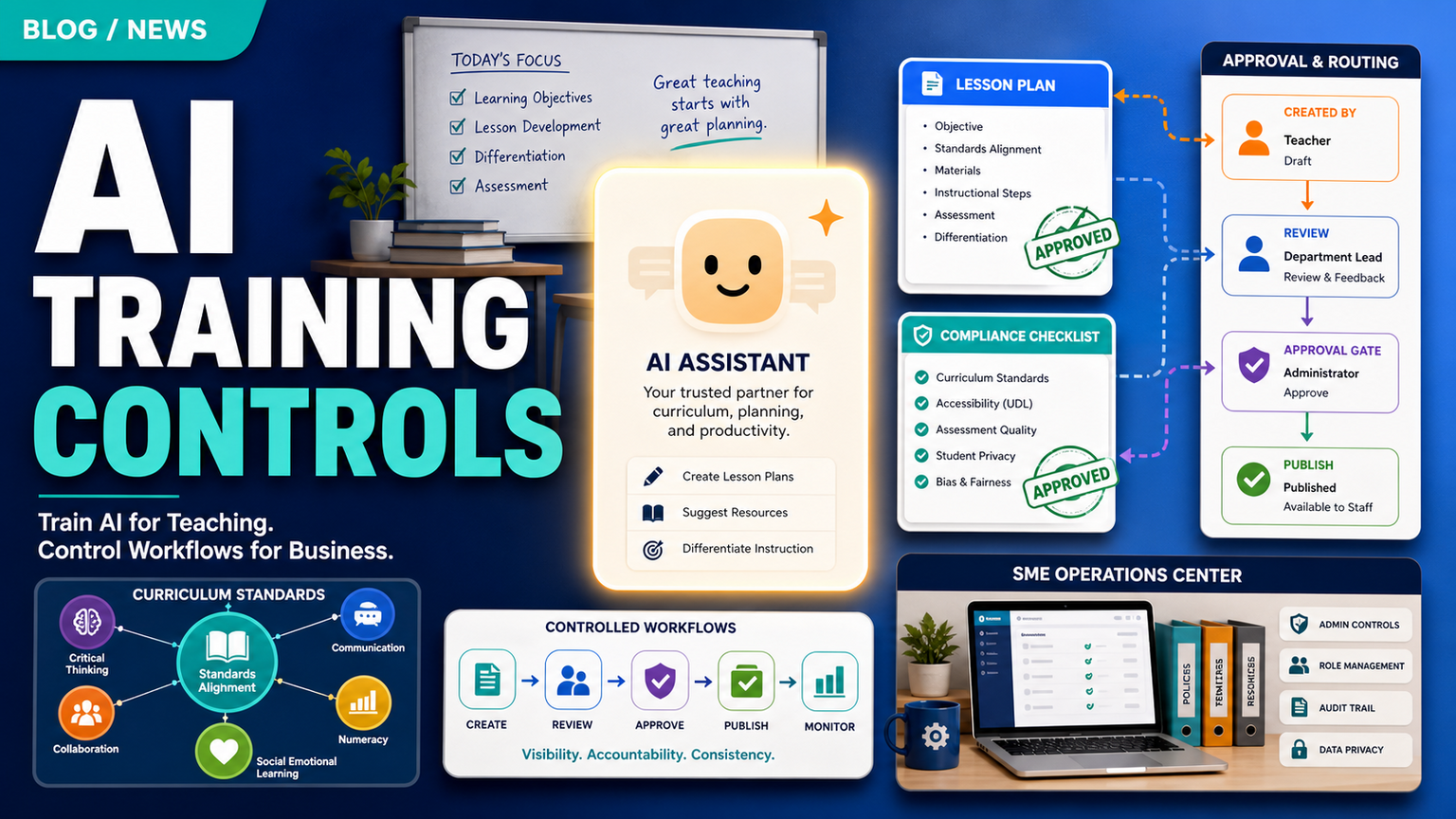
Anthropic announced Claude for Teachers on 14 July 2026, offering verified K-12 educators in the US free access to premium Claude capabilities, a library of teaching skills, and curriculum connections mapped to academic standards. The education angle is obvious, but the business lesson is wider. AI becomes useful when it is trained around trusted knowledge, approved workflows, clear review steps, and a human owner who knows when the assistant should stop.
For UK, US and EU SMEs, that is the real signal. Whether the use case is staff onboarding, sales enablement, support training, compliance guidance, document processing, CRM follow-up or internal knowledge search, the risk is not simply that an AI tool gives a weak answer. The bigger risk is that a team starts using AI without deciding which sources are trusted, who approves outputs, where answers are saved, and how mistakes are reviewed.
Thirumurugan's view: Claude for Teachers is not just an education product story. It is a reminder that AI training should be connected to the operating system of the business. GOFTUS helps SMEs turn AI access into controlled workflows through AI automation services, AI agents, internal knowledge assistants, document automation, support triage and monthly improvement reviews.
What this means for SMEs
Most small teams already have training problems. New starters ask the same questions. Managers repeat policies in Slack or Teams. Salespeople use different versions of the same product explanation. Support teams answer from memory. Operations staff know the process, but the process is scattered across PDFs, spreadsheets, email threads, CRM notes and old onboarding documents.
Putting a general AI assistant on top of that mess can make the mess faster. It can draft answers, but it may also copy outdated wording, skip context, or create a response that sounds confident before anyone checks whether it matches the current workflow.
The Claude for Teachers announcement points to a better pattern: connect the assistant to a specific body of trusted knowledge, give it task-specific skills, map it to standards, and keep the teacher in control. SMEs can copy the pattern without copying the education use case. The equivalent business version is an AI training workflow that knows the approved product facts, policy documents, CRM fields, escalation rules, service boundaries and review owners.
That matters in trust-heavy sectors. A recruitment agency, accountancy firm, clinic, legal services provider, SaaS vendor, ecommerce brand or B2B operations company cannot treat training content as casual chat. The assistant should help people learn the process and draft useful work, but the business still needs approval gates before customer-facing or compliance-sensitive information goes live.
Why AI training needs workflow controls
The first control is source control. A business should decide which documents, pages and systems the assistant is allowed to use. Old price sheets, expired service descriptions and unapproved policy drafts should not become training material by accident.
The second control is role control. A support trainee needs different guidance from a sales manager. A finance assistant should not see the same examples as a marketing intern. GOFTUS designs AI workflows so the assistant respects role boundaries and routes exceptions to the right person.
The third control is output control. Some answers can be sent quickly. Others should become drafts for review. High-risk topics, customer complaints, financial claims, legal wording, security details and safety-related content should have a clear approval path.
The fourth control is measurement. If an AI training workflow answers the same question badly every week, the underlying process may be unclear. GOFTUS looks at unanswered questions, corrected drafts, escalation reasons and CRM outcomes so the workflow improves over time.
There are many useful options in the market. UK firms such as Faculty AI, Deeper Insights, Waracle and Brainpool AI can support advanced AI projects. US providers such as LeewayHertz, Markovate, SoluLab and BairesDev can build custom systems. European teams such as Addepto, STX Next, Netguru and 10Clouds bring strong engineering and delivery capability. SaaS tools such as Zapier, n8n, Relevance AI, Lindy, Gumloop, Bardeen, Make and Stack AI can connect tasks quickly.
The gap for many SMEs is not tool access. It is ownership of the workflow around the tool. Tools automate tasks. GOFTUS automates the workflow around the task.
That means GOFTUS starts with the operating question: who needs the answer, which source is trusted, what system must be updated, what should be reviewed, what should be logged, and what happens when the AI is unsure? A tool can generate a training answer. A workflow makes sure the answer is approved, saved, routed, measured and improved.
What SMEs should do next
Start with one training or knowledge workflow, not every process at once. Choose a painful area where staff repeatedly ask for help or customers receive inconsistent answers. Good starting points include onboarding, sales objection handling, support triage, document intake, internal policy search and service delivery checklists.
Next, list the approved sources. These might include service pages, pricing rules, delivery SOPs, CRM fields, compliance notes, proposal templates, call scripts, support macros and internal FAQs. Remove outdated material before the assistant is connected.
Then decide the review rules. Which outputs can be used internally? Which outputs need manager approval? Which topics should be escalated to a human every time? Which CRM or support fields should be updated after approval?
Finally, measure the workflow. Track repeated questions, unanswered questions, corrected answers, handoff delays and missed follow-ups. If the AI helps staff find answers faster but creates more review work elsewhere, the workflow needs adjustment.
If your team is already experimenting with Claude, ChatGPT, Gemini, Copilot, n8n or another AI tool, start with a workflow automation review before the pilot turns into shadow AI.
Anthropic's Claude for Teachers is a fresh education news signal, but the SME lesson is broader. AI training works best when it is connected to approved knowledge, clear skills, human review and practical workflow ownership. The businesses that benefit fastest will not be the ones with the most AI accounts. They will be the ones that know where AI fits, what it is allowed to read, who approves sensitive outputs, and how the workflow gets better each month.
Is Claude for Teachers only relevant to schools?
No. The product is for verified K-12 educators in the US, but the operating pattern is relevant to SMEs. It shows how AI can be more useful when it is connected to trusted material, specific tasks and human control instead of being treated as a generic chat window.
What is the safest first AI training workflow for an SME?
A good first workflow is internal knowledge support for staff onboarding, support answers or sales enablement. GOFTUS can connect approved documents, CRM notes and review steps so the AI helps staff learn faster without sending unapproved answers to customers.
Should SMEs buy AI tools or build workflow controls first?
SMEs should do both in the right order. Tool access is useful, but controls decide whether the tool improves operations. Before expanding AI use, map the workflow, define sources, add review gates, and decide where outputs should be saved or escalated.
Primary source: Anthropic, "Introducing Claude for Teachers", published 14 July 2026. X was unavailable in this cron environment because xurl was not installed.