Alibaba's Claude Code Ban Shows Why AI Coding Workflows Need Governance
A reported Alibaba ban on Claude Code is a reminder that SMEs need governed AI coding workflows, not unmanaged tool access.
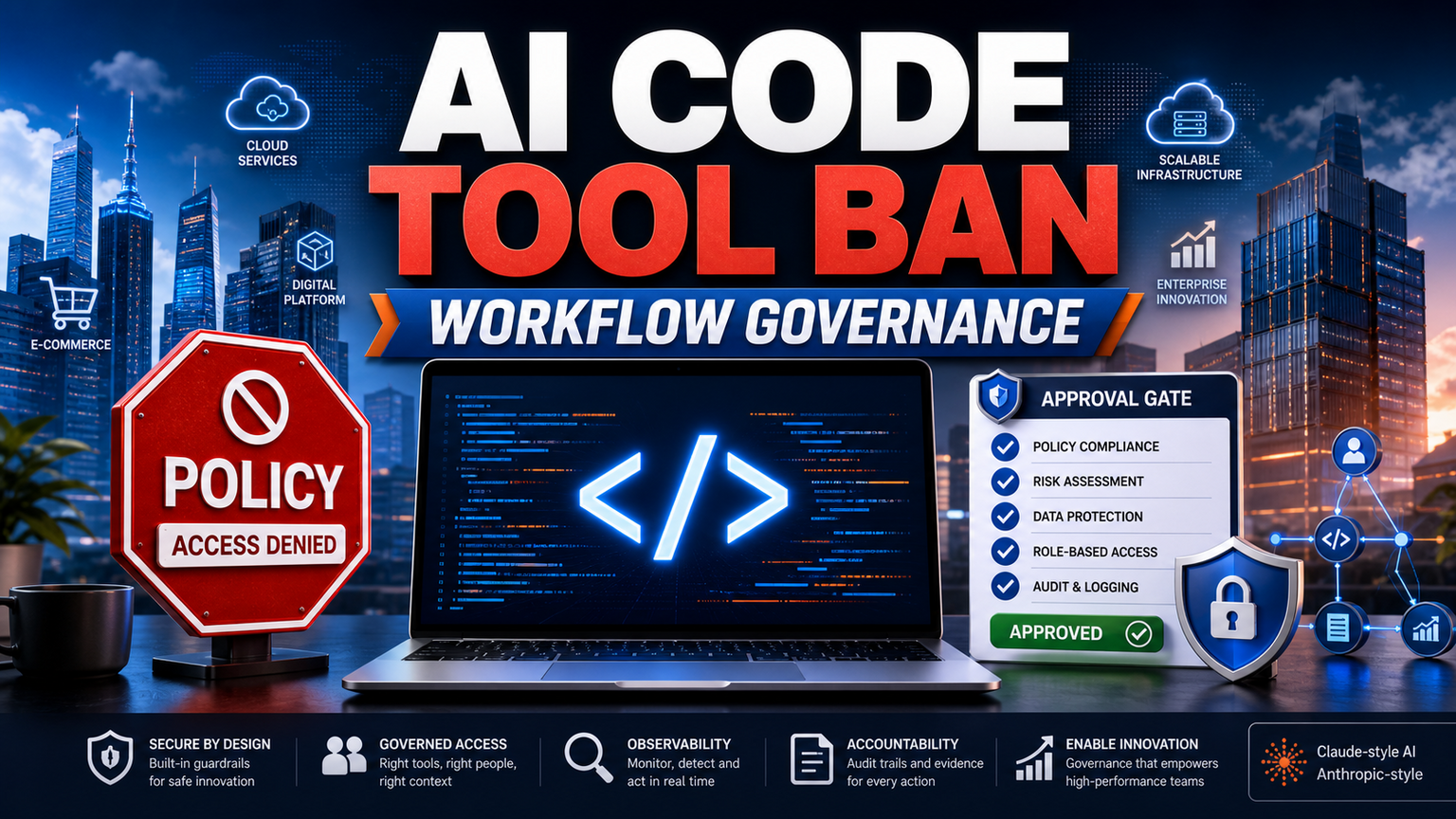
Reports that Alibaba plans to ban employees from using Anthropic's Claude Code should not be read only as a vendor dispute. For SMEs, the practical lesson is simpler: AI coding assistants need policy, access control, review, logging, and fallback workflows before they become part of production work. Thirumurugan's view: if a coding assistant can influence product, customer data, infrastructure, or internal scripts, it belongs inside an approved workflow, not inside a private developer habit.
What this means for SMEs
AI coding tools are moving from experiments into daily work. That makes them useful, but it also makes them operational risk if nobody owns the surrounding process.
For a UK, US, or European SME, the core question is not whether Claude Code, Copilot, Cursor, OpenAI tools, or local coding models are good. The question is whether the business can prove who used the tool, what data was shared, what code changed, who reviewed it, and how the change was deployed.
A practical SME setup should include:
an approved tool list for staff and contractors
rules for customer data, credentials, logs, and proprietary code
human review before AI-generated code reaches production
secure repo permissions and role-based access
audit logs for prompts, commits, tickets, and deployment steps where available
a fallback route when a preferred AI tool is unavailable, too costly, or blocked
This matters because a ban at a large technology company can look remote from SME reality. It is not. The same pattern appears at smaller firms when staff adopt AI tools faster than leadership updates the workflow.
Global SaaS competitors such as Zapier, n8n, Make, Bardeen, Lindy, Relevance AI, Gumloop, and Stack AI are useful for automating tasks around tickets, code updates, approvals, and notifications. US and European AI consultancies often publish guides about agentic AI, RAG, production AI, software audits, and secure development.
The gap for SMEs is the operating layer between the tool and the business outcome. Tools automate tasks. GOFTUS automates the workflow around the task.
That means GOFTUS would treat an AI coding assistant as one component inside a wider system: intake ticket, repository context, security rule, human reviewer, test run, deployment check, monitoring alert, and monthly improvement review. SaaS tools and consultants can help, but SMEs need a designed workflow that survives tool changes, vendor bans, staff turnover, and audit questions.
Why the workflow matters more than the coding assistant
A coding assistant can write code quickly. It cannot decide by itself whether a business should share a legacy integration file, paste a customer export, bypass a test, or deploy a change to a live CRM workflow.
The workflow should answer five questions before AI coding becomes normal:
1. What code and data can be shown to the assistant?
2. Which teams are allowed to use which tools?
3. What review steps are mandatory before merge or deployment?
4. What evidence is stored for audit, client assurance, and internal learning?
5. What happens if the tool is blocked, deprecated, rate-limited, or replaced?
For SMEs, this is not heavy enterprise bureaucracy. It is basic operational hygiene for any company that relies on software, automations, CRM scripts, reporting pipelines, or customer support workflows.
| Signal | SME risk | Practical GOFTUS response |
|---|---|---|
| Reported Alibaba restriction on Claude Code | Staff may use unapproved AI coding tools without governance | Build an approved AI tool policy and review path |
| AI coding assistants entering daily engineering work | Code changes can reach production without enough context | Add ticket, test, review, and deployment gates |
| Vendor access can change quickly | Teams may become dependent on one assistant | Design fallback workflows across approved tools |
| Data and IP concerns around code assistants | Sensitive code or customer data may be shared incorrectly | Define data classes, prompt rules, and logging expectations |
| Competitor content focuses on tools and agents | SMEs still need process ownership | Connect automation tools to accountable business workflows |
Should SMEs ban AI coding tools?
Not by default. A blanket ban can slow useful work. A better first step is to define which tools are approved, what data can be used, which repositories are allowed, and which review steps are required before production changes.
What is the biggest risk with AI coding assistants?
The biggest risk is unmanaged workflow adoption. The tool may be capable, but the business can still lose control if staff paste sensitive information, skip review, or deploy generated code without tests and ownership.
How can GOFTUS help with AI coding governance?
GOFTUS can map your current software and automation workflow, define approved AI tool usage, add human review gates, connect tickets to tests and deployments, and create monthly monitoring so the process improves over time.
If your team is already using AI coding tools, do not wait for a vendor ban or client question to expose the gap. GOFTUS can help design a practical AI coding workflow with access rules, review checkpoints, audit evidence, fallback tools, and measurable delivery outcomes.