Alberta's Claude Cybersecurity Scan: The SME Workflow Lesson
Alberta's Claude security scan shows why SMEs need review, audit trails, and workflow controls around AI coding agents.
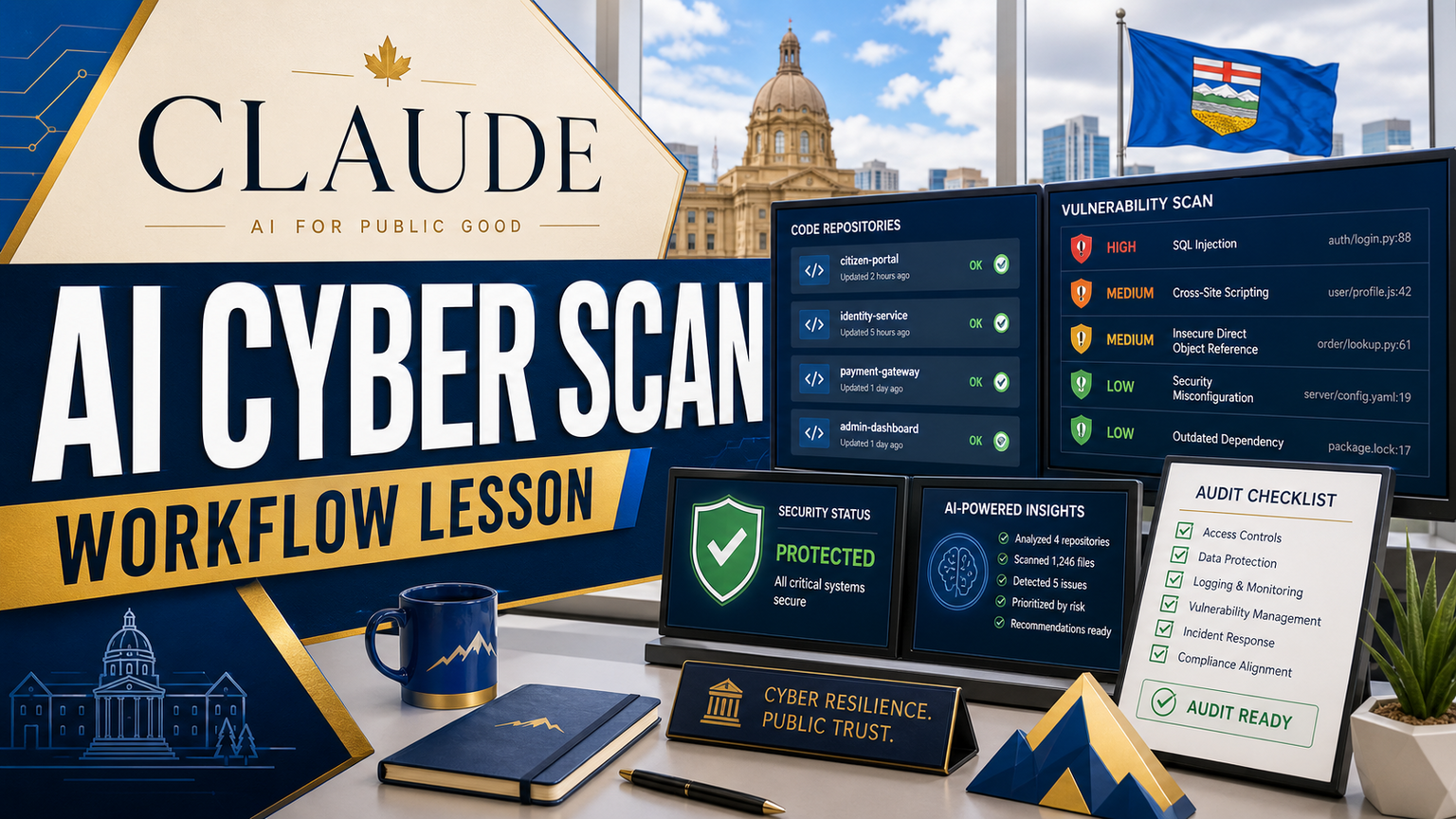
Anthropic says the Government of Alberta used Claude Code and Claude models to review government systems, find cybersecurity vulnerabilities, and support fixes across legacy code. For SMEs, the useful lesson is not simply that an AI coding agent can scan code. It is that the scan only matters when it sits inside a managed workflow with scope, access control, human review, remediation, audit evidence, and repeat checks. The SME takeaway is practical. AI can speed up security review, but businesses still need owners, approvals, logs, and a plan for what happens after the model finds a risk.
What this means for SMEs
Most small and mid-sized firms do not have 466 million lines of code, a provincial security mandate, or a dedicated public-sector technology ministry. They do have the same operating problem in smaller form: old websites, CRM customisations, spreadsheet macros, internal scripts, unsupported plugins, shared inboxes, and undocumented automations that quietly carry risk.
The Alberta story matters because it treats AI as part of a workflow, not a magic scanner. A useful SME version would look like this:
1. Define the asset list: website, CRM, integrations, cloud folders, support tools, payment flows, and internal apps.
2. Run AI-assisted review on bounded repositories, documents, and configuration notes.
3. Route findings to a human owner who can confirm business impact.
4. Prioritise fixes by customer data risk, revenue risk, and operational dependency.
5. Create tickets, approvals, and evidence for every accepted fix.
6. Re-run checks monthly and after major changes.
That is where AI agents become useful for business operations. They reduce review time, but the organisation still needs accountability around what gets changed, who signs it off, and how the result is monitored.
For UK, US, and European SMEs, the regional relevance is clear: cybersecurity, data protection, and supplier assurance are increasingly part of procurement, insurance, and customer trust conversations. AI-assisted checks can help, but only if the process creates evidence that a buyer, auditor, or board can understand.
This topic overlaps with three competitor categories. UK firms such as Faculty AI, Deeper Insights, Waracle, and Brainpool AI often speak to enterprise AI safety, decision intelligence, and public-sector use. US firms such as LeewayHertz, Markovate, SoluLab, and BairesDev publish heavily around AI agents, AI security, and industry use cases. Global SaaS tools such as Zapier, n8n, Relevance AI, Lindy, Gumloop, Bardeen, Make, and Stack AI help teams automate repeatable tasks.
Those tools and consultants can be valuable. The gap for SMEs appears after the demo. A vulnerability scan, code assistant, or workflow builder is not enough on its own if the business has no triage queue, no approval rule, no rollback path, no monthly review, and no evidence trail.
Tools automate tasks. GOFTUS automates the workflow around the task.
For a security workflow, that means GOFTUS would focus on the operating system around the AI: which systems are in scope, how findings are categorised, where fixes are routed, when humans approve changes, how exceptions are documented, and how the process improves every month. The practical contrast is not SaaS versus services. It is task automation versus accountable workflow automation.
| Question | Practical SME answer | GOFTUS workflow angle |
|---|---|---|
| What changed? | Anthropic highlighted a public-sector Claude cybersecurity review in Alberta. | Use AI review as one step in a governed security workflow. |
| Why should SMEs care? | Smaller firms also carry hidden risk in old apps, plugins, scripts, and integrations. | Build an asset list, risk queue, approval path, and monthly review cycle. |
| What should not be copied blindly? | Do not let an AI agent change production systems without review. | Add human sign-off, logging, rollback, and monitoring before automation acts. |
| Where is the opportunity? | Faster first-pass review of code, documents, and configuration notes. | Turn findings into tracked tickets, owner decisions, and evidence. |
Is this confirmed news?
Yes. The primary source is Anthropic's official post saying the Government of Alberta used Claude to find and fix cybersecurity vulnerabilities across government systems.
Should SMEs use AI agents for cybersecurity reviews?
Yes, but within limits. AI agents can help inspect code, configuration notes, support processes, and documentation faster than manual review alone. They should not be treated as the final authority. A human owner still needs to confirm the issue, approve the fix, and verify the result.
What is the safest first workflow to automate?
Start with a non-production review workflow. Let the AI summarise risks from code repositories, CRM automations, website plugins, support macros, and cloud folder permissions. Then route findings into a human-reviewed ticket list with priority, owner, due date, and evidence.
Practical GOFTUS CTA
If your business wants AI agents but cannot afford uncontrolled changes, GOFTUS can design the workflow around the agent. We help SMEs map systems, set access rules, build review queues, connect CRM and support tools, add human approval, monitor outcomes, and improve the workflow month by month.