How SMEs choose AI tools without breaking workflows or budgets
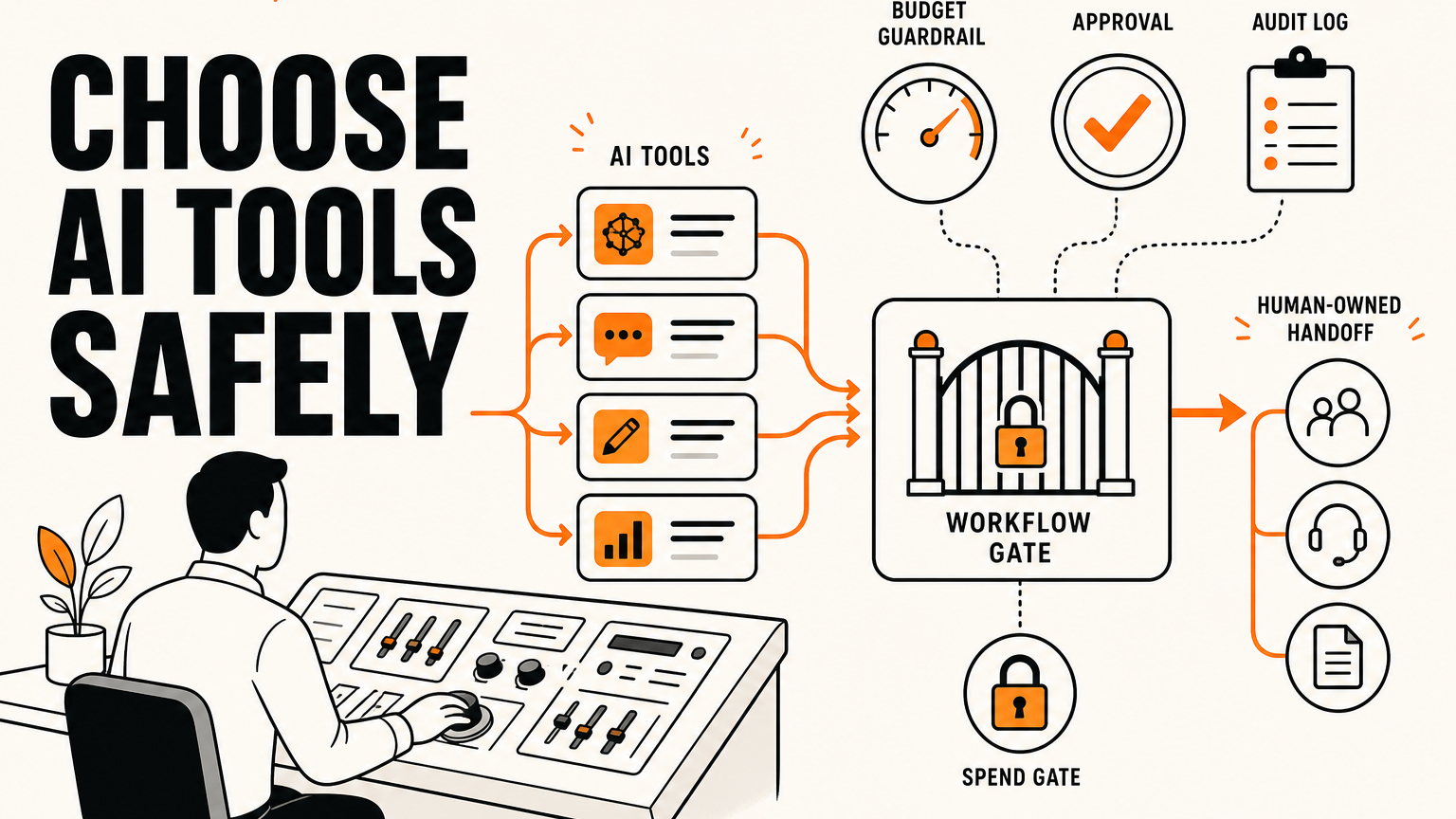
AI tools can help SMEs save time, but only when workflow rules, spend gates, approvals, and handoffs are designed before switching.
# How SMEs choose AI tools without breaking workflows or budgets ## Quick answer AI tools are still the highest scoring keyword in the latest GOFTUS daily SEO input, with a Trends score of 100. The buyer problem is not
How SMEs choose AI tools without breaking workflows or budgets
Quick answer
AI tools are still the highest scoring keyword in the latest GOFTUS daily SEO input, with a Trends score of 100. The buyer problem is not whether SMEs should try more tools. The buyer problem is how to choose AI tools without breaking the workflow that already serves customers, sales, support, finance, and operations.
This post uses a Reddit social signal from r/artificial where builders discussed switching from expensive AI tools to cheaper models as quality improves. It also cross-checks the cost pressure with Google News RSS coverage of Gartner's 17 August 2026 prediction that AI inference costs per agentic workflow will rise sharply through 2028, plus coverage from The Register and Computerworld. Reddit is treated here as operator sentiment, not verified proof of a market shift.
For GOFTUS, the practical lesson is simple: AI tool selection needs workflow rules. Before a business swaps ChatGPT, Claude, Gemini, DeepSeek, Perplexity, Copilot, n8n agents, or another stack, it needs owners, spend limits, fallback routes, approval points, browser boundaries, and an evidence log. The right place to start is a narrow AI automation workflow that proves value before the tool list grows.
What this means for SMEs
Many small and mid-sized teams now have more AI options than operating discipline. A founder sees one model get cheaper. A marketer finds a better image or video tool. A support lead tries a new chatbot. A developer adds an agent to a repo. Each decision feels small, but the combined workflow can become fragile quickly.
The failure pattern is familiar. Staff copy customer data into a tool without checking data rules. A cheaper model changes answer quality. An agent updates a record but no one owns the review.
That is why AI tools should be selected by workflow fit, not feature excitement. The first question is not which model is smartest. It is: what business process will this tool own, what systems can it touch, who checks the output, what happens when it fails, and how will the team know whether it saved time?
For UK, US, and EU SMEs, this matters because customer trust, data handling, and staff accountability sit inside everyday operations. Tool swapping without process design turns AI into shadow IT. Tool selection with workflow design turns AI into a measurable operating system.
Hajikreena's view
Hajikreena's view on the current AI tool debate is that cheaper tools are useful only when the workflow around them is explicit. If a model helps draft support replies, the workflow still needs approved knowledge, escalation rules, tone boundaries, and CRM notes. If an AI agent researches prospects, the workflow still needs source checks, enrichment limits, and a human decision before outreach. If a browser agent logs into a portal, the workflow needs login boundaries, human approved actions, and stop rules.
The strongest teams will not have the longest AI tool stack. They will have the clearest operating rules.
GOFTUS usually starts this with a small workflow map. We define the trigger, input source, owner, approval step, system handoff, exception route, and review metric. Then we choose tools. That order prevents the common trap where a team buys software first and later discovers no one knows how it fits into daily work.
Competitor lens
SaaS tools such as Zapier, n8n, Relevance AI, Lindy, Gumloop, Bardeen, Make, and Stack AI can be valuable parts of the stack. Consultants such as Faculty AI, Deeper Insights, Waracle, Brainpool AI, LeewayHertz, Markovate, SoluLab, BairesDev, Addepto, STX Next, Netguru, and 10Clouds can also help with AI strategy or implementation.
The gap for SMEs is usually workflow ownership after the first build. A connector can move data, but it does not decide who reviews exceptions. A model can draft text, but it does not know which customer promises are approved.
Tools automate tasks. GOFTUS automates the workflow around the task. That means we care about the queue before AI acts, the evidence while it acts, and the handoff after it acts. The tool is one component. The operating workflow is the product.
What SMEs should do next
Start with one AI tool decision that already creates friction. It might be customer support replies, lead qualification, reporting, document processing, marketing content, or a browser-based admin task. Write down the current manual steps, the tools involved, the sensitive data, and the point where a human must approve the outcome.
Then create four lanes. Observe: the AI reads or summarizes but cannot change anything. Prepare: the AI drafts a reply, report, record, or task. Approve: a human checks the decision, edits it, or rejects it. Act: the approved output moves into CRM, support, finance, documents, outreach, or browser tasks with logs attached.
This lane model makes AI tool selection safer. A cheaper model might be fine for observe and prepare. A stronger model might be reserved for complex decisions. A browser agent might be allowed to collect screenshots but not submit forms. An automation platform might move approved data but never invent a policy.
The goal is to make tool changes reversible, reviewable, and measurable. If a new tool increases errors, the logs should reveal that before customers feel it.
Summery for SMEs
AI tools are becoming more capable, cheaper in some places, and more expensive in others when agentic workflows consume more compute. That mix will push SMEs to test alternatives quickly. The safe move is not to ban switching or chase every new model. The safe move is to select tools against workflow rules.
Use AI where it removes repeatable work. Keep humans where judgment, money, reputation, login access, or customer promises are involved. Add spend gates so experiments do not become hidden costs. Add approval gates so recommendations do not become uncontrolled actions. Add audit logs so every change can be traced.
If your team is comparing AI tools this month, GOFTUS can turn the decision into a practical workflow map through /services.
FAQ
Source notes
Reddit social signal: r/artificial discussion titled "Chinese AI models are getting good enough to replace tools I actually pay for-is anyone else switching?" from the GOFTUS Reddit intelligence run on 2026-08-19. This is treated as social sentiment, not verified market data.
News cross-check: Google News RSS surfaced Gartner's 17 August 2026 item "Gartner Predicts AI Inference Costs Per Agentic Workflow Will Increase More Than Fivefold Through 2028" plus The Register and Computerworld coverage about agentic AI cost pressure. These are used as headline-level cost context.
SEO source: GOFTUS daily SEO FAQ output from 2026-08-18 listed "ai tools" as a target keyword with Trends score 100 and product update high keyword "AI tool selection for SME workflow automation".