AI tools need spend approval before agents touch money
AI tools can draft, compare, and prepare financial actions, but SMEs need spend limits, approval gates, audit logs, and fallback rules before agents act.
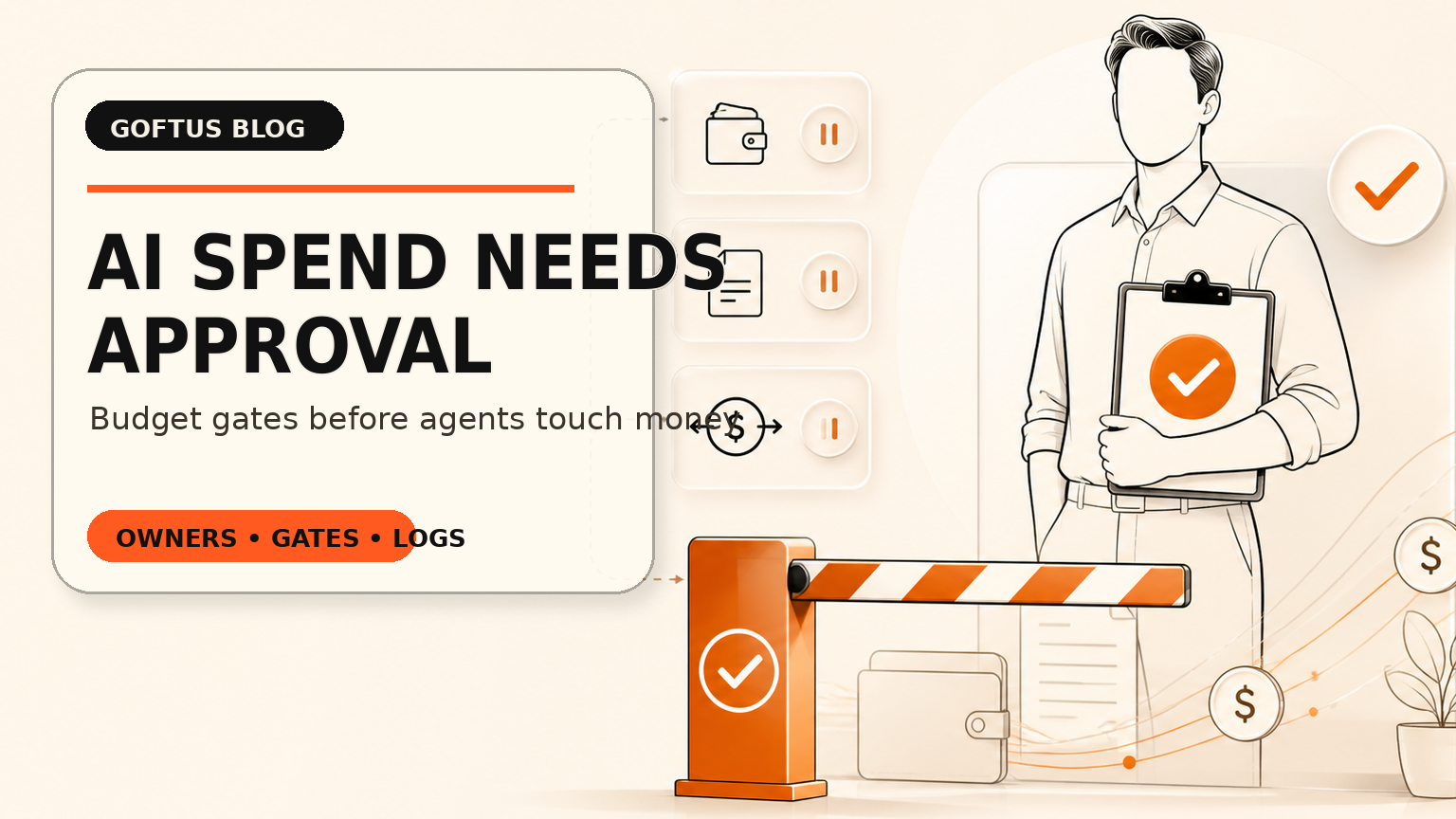
# AI tools need spend approval before agents touch money Meta description: AI tools can draft, compare, and prepare financial actions, but SMEs need spend limits, approval gates, audit logs, and fallback rules before ag
AI tools need spend approval before agents touch money
Meta description: AI tools can draft, compare, and prepare financial actions, but SMEs need spend limits, approval gates, audit logs, and fallback rules before agents act.
Quick answer
The best SME use of AI tools is not letting an agent make financial decisions alone. It is letting AI prepare the research, options, drafts, and checks while a named person approves spending, customer commitments, refunds, invoices, trading actions, or vendor changes. GOFTUS would turn the tool into a workflow with spend limits, approval owners, exception logs, and review dates before any action touches money.
What this means for SMEs
The daily GOFTUS SEO input put `ai tools` at a 100 Trends score, and today’s Reddit intelligence added a sharp operator warning: a r/ClaudeAI post described an agentic account losing a large amount of money after Claude was allowed to handle financial decisions for a month. Reddit is social heat, not a verified audit trail, but the business lesson is useful. Once AI tools move from chat into decisions about money, approvals stop being admin friction and become the product.
That is the difference between using AI as a helpful assistant and turning it into an unsupervised operator. A small business can use ChatGPT, Claude, OpenAI tools, browser agents, spreadsheets, n8n, Make, Zapier, or custom scripts to prepare work faster. The risk appears when the output changes a bank balance, sends a refund, updates a quote, switches a vendor, posts an offer, buys inventory, or submits a portal form without a clear owner.
GOFTUS would start by splitting the workflow into four lanes. The first lane is observe: AI can read approved sources, summarize options, extract line items, and flag missing evidence. The second lane is prepare: AI can draft a proposed action, calculate a range, write the customer note, or build a comparison table. The third lane is approve: a named owner checks the amount, source, customer impact, risk level, and next step. The final lane is act: only low-risk actions can run automatically, while anything financial, legal, customer-facing, or browser-submitted needs human approval and a log.
This structure keeps AI useful without pretending the model understands the full business context. The agent may see a prompt, a spreadsheet, and a tool list. The owner sees cash flow, customer history, brand risk, compliance concerns, seasonal context, and the cost of being wrong. That context gap is why spend limits matter. A workflow should define what AI may suggest, what it may prepare, what it may execute, and what it must escalate.
For example, an AI tool can compare three supplier quotes and recommend one. It should not approve a new supplier, change payment terms, or submit the purchase order unless the business has already set a rule for that exact case. A support workflow can draft a refund response and gather order evidence. It should not refund above a threshold or promise replacement terms without review. A sales workflow can draft a discount offer. It should not change margin rules without approval.
The same logic applies to model and tool selection. SaaS tools and consultants can be useful. n8n can orchestrate steps. Scripts can be efficient. Browser agents can handle repetitive portals. The missing layer is usually workflow ownership: who approves the action, where the evidence is stored, what happens when the AI is unsure, and how the system improves after a mistake.
Summery for SMEs
If your team is testing AI tools around money, do not start with full autonomy. Start with one repeated financial or commercial workflow and draw the stop lines. Put green actions below a safe threshold, amber actions into approval, and red actions into manual handling. Connect the workflow to /services so GOFTUS can map the trigger, data source, approval rule, CRM or support handoff, browser boundary, and monthly review.
The practical win is not a dramatic agent demo. It is fewer unsupported decisions, cleaner handoffs, faster preparation, and a visible record of who approved what before money moved. That is how AI tools become operational infrastructure instead of another risky experiment.
Competitor lens
Generic AI SaaS products often sell faster output. Automation platforms often sell more connectors. Consultants often sell strategy decks or isolated builds. Those can all help, but SMEs still need the control layer after the demo works. GOFTUS owns the workflow design, integration, monitoring, review, and improvement loop: triggers, owners, approval gates, audit logs, escalation paths, and safe browser actions.
The competitor gap is clearest when a tool acts confidently in an area where the business has unstated rules. A model can recommend. A workflow decides whether the recommendation is allowed to proceed. For SMEs, that workflow boundary is the difference between productive AI adoption and expensive cleanup.
FAQ
Should SMEs let AI tools make financial decisions?
Usually no. AI can prepare research, calculations, drafts, and options, but spending, refunds, pricing changes, vendor commitments, and customer promises should have a named approval owner.
What is the first control to add?
Start with a spend or impact threshold. Low-risk actions can be prepared quickly, medium-risk actions need approval, and high-risk actions stay manual until the workflow has enough evidence.
Where should logs live?
Keep logs where the work already happens: CRM, support desk, document system, finance tracker, or reporting dashboard. The log should show source, AI draft, approver, action, exception, and result.
Source notes
Social signal: GOFTUS Reddit intelligence, 2026-08-20, scored the r/ClaudeAI post “This is letting Claude handle a good amount of money for a month...” at 100, with 278 comments captured at run time. Reddit is used as operator sentiment, not independent financial verification.
News cross-check: Google News RSS for “AI agent security autonomous spending approval business” returned current AI-agent workflow and agentic commerce coverage, including CIO’s “Salesforce and SAP are putting AI agents inside your workflows. Who tells them no?” and FF News coverage of secure AI-agent commerce infrastructure. Direct article scraping was not required for the claim here; the RSS result is used as headline-level market context.
Daily SEO input: GOFTUS daily SEO FAQ and Search Console check, 2026-08-20, listed `ai tools` as a 100-score Trends keyword and recommended the angle “ai tools: approvals, owners, and ROI controls for SMEs.”