AI tool cost control needs workflow budget gates before teams scale prompts
AI tool cost control for SMEs means spend owners, approval gates, fallback routes, and review logs before prompts become hidden operating cost.
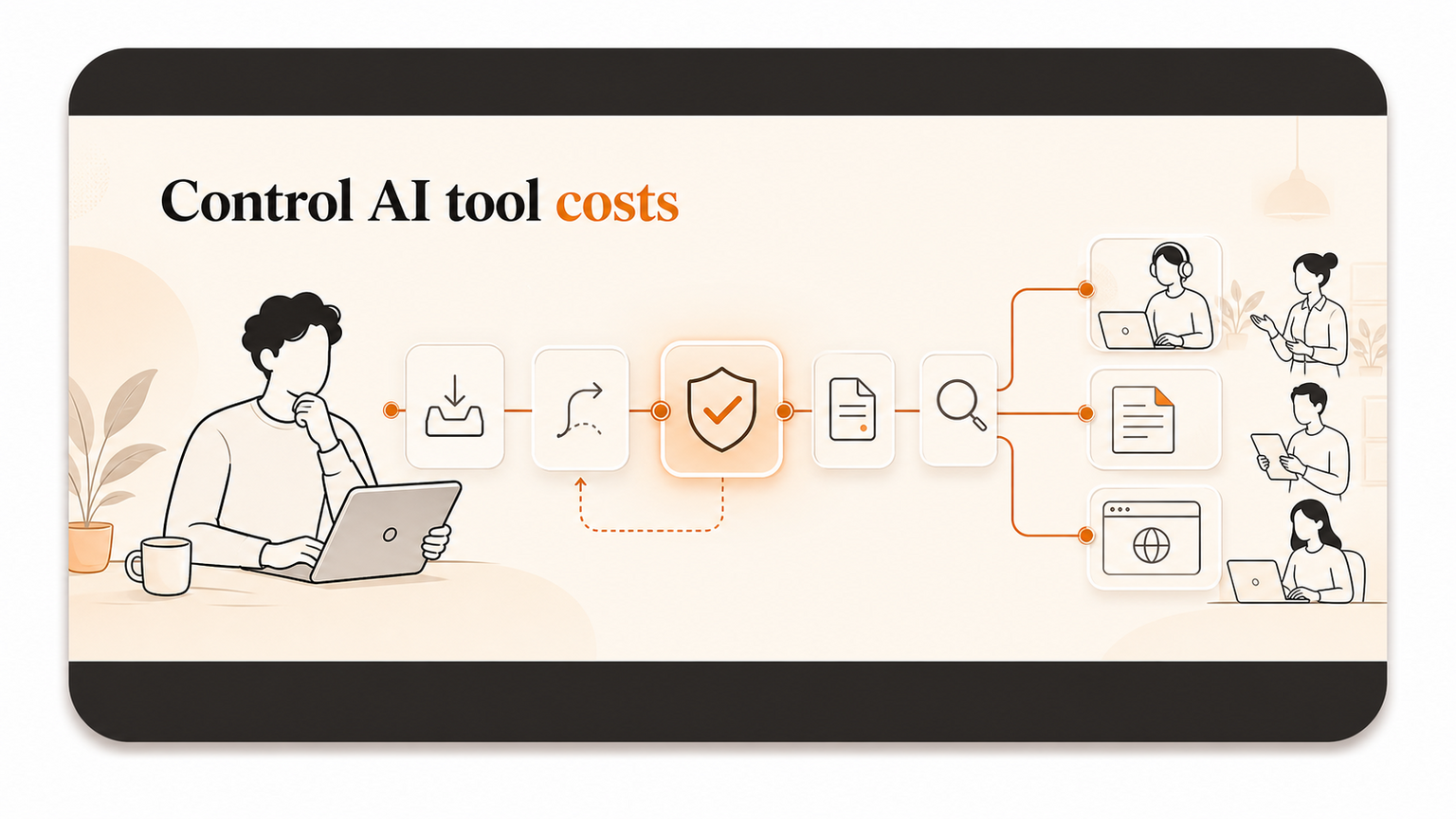
# Quick answer AI tool cost control is no longer only a finance problem. It is a workflow design problem. Today’s GOFTUS daily SEO run put `ai tools` at a 100 Google Trends relative score, `openai` at 96, `claude ai` at
Quick answer
AI tool cost control is no longer only a finance problem. It is a workflow design problem. Today’s GOFTUS daily SEO run put `ai tools` at a 100 Google Trends relative score, `openai` at 96, `claude ai` at 94, and related tool categories such as AI image and video generators above the 90 publishing threshold. The Reddit intelligence layer also surfaced 100-score operator signals: a LocalLLaMA post about expanding a large private AI cluster, an r/Automation discussion about deciding which actions need human review, and n8n posts about verification when a green checkmark does not prove the business outcome happened.
For an SME, the practical lesson is not to copy a homelab budget or ban AI tools. The lesson is to stop treating every prompt, agent, image generation, report, browser action, and support draft as a separate subscription decision. Costs rise when teams test tools without owners, run models on work that should be batched, leave agents retrying quietly, or use premium models for tasks where a cheaper route would be enough. GOFTUS would connect the issue to /services by turning AI spend into governed workflow lanes: observe, prepare, approve, act, log, and review.
What this means for SMEs
The social signal is useful because it shows how quickly AI experimentation can become infrastructure thinking. One Reddit operator is thinking about local capacity and many models. Another is asking whether money, customer data, or irreversible actions should ever run without a person checking first. That maps directly to SME cost control. A business does not need a server rack to have the same risk pattern. It may have ChatGPT seats, Claude seats, image tools, video tools, CRM enrichment, browser agents, n8n workflows, and support automation all running in different corners of the company.
The budget problem is usually hidden inside the work, not inside the invoice. A support workflow retries a model call after an API timeout. A reporting automation regenerates a monthly summary several times because source fields changed. A marketing assistant creates ten image variations when two approved concepts would do. A sales assistant enriches every lead instead of only qualified leads. Each line item may look small, but the workflow has no spend owner, no stop rule, and no monthly review.
GOFTUS would start by mapping which AI steps are low risk and reversible, which steps touch money or customer data, and which steps create visible customer output. Low-risk drafting can use a cheaper lane. Customer-facing answers, price changes, CRM updates, refunds, document edits, and browser submissions should move through approval and logging. That is where cost control and risk control become the same system.
Summery for SMEs
Use the daily keyword signal as demand evidence: AI tools are hot, but buying another tool is not the same as controlling the workflow. SMEs should define a primary route, a fallback route, and a human review route for each important AI-assisted process. The route should say who owns the budget, which model or tool is allowed, what must be checked before output leaves the business, and what evidence is stored after the action.
This is especially important for support, marketing, sales, documents, reporting, and browser-based tasks. These are areas where AI can prepare useful work quickly, but a bad output can create extra cost, confuse a customer, or trigger manual cleanup. A simple budget gate can ask: is this task worth premium reasoning, can it be batched, can a template handle it, does it need a human approval, and should the result be logged for review?
SaaS tools and consultants can help. A tool may show usage, a consultant may recommend a stack, and finance may flag the bill. The missing layer is usually the operating workflow that decides when AI should act, when it should pause, and how the business improves the rule next month. That is the layer GOFTUS owns.
Competitor lens
Most AI tool advice compares model price, token limits, or feature lists. That is useful, but it does not tell an SME whether a workflow should use premium reasoning, a cheaper model, a template, or a human. It also does not decide what happens when a model is unavailable, an agent loops, or a generated answer needs approval before entering a CRM, support desk, document, or web portal.
GOFTUS positions cost control around workflow ownership. The operating design defines spend thresholds, approval gates, fallback routes, action logs, exception queues, and monthly improvement reviews. That makes AI tool cost control measurable without slowing every employee down. Green lane tasks can run fast. Amber lane tasks need review. Red lane tasks need a named owner before action.
FAQ
What is AI tool cost control for SMEs?
AI tool cost control means designing the workflow so AI spend follows business value. Instead of only checking subscriptions at month end, the SME decides which tasks deserve premium models, which tasks can use cheaper routes, which tasks require approval, and which results must be logged.
Where should a business start?
Start with one repeated process such as support replies, lead qualification, marketing drafts, document updates, or reporting. Map the trigger, AI step, human check, final action, log, and owner. Then add a monthly review of cost, error rate, time saved, and customer impact.
When should GOFTUS use browser with AI controls?
Use browser with AI controls when an AI assistant touches live websites, portals, admin panels, checkout flows, CRM screens, or support systems. The browser step should prepare the action, show the human what will happen, require approval for sensitive steps, and save an audit trail.
Source notes
Primary SEO input: GOFTUS daily SEO FAQ and Search Console check for 2026-08-23, with Trends scores above 90 for `ai tools`, `openai`, `ai image generator`, `claude ai`, `ai video generator`, `ai code generator`, and `google gemini`. Social signal: GOFTUS Reddit intelligence for 2026-08-23, especially the 100-score LocalLLaMA AI cluster post, the 100-score r/Automation discussion about automating actions versus tasks, and n8n verification posts. News cross-check: Google News RSS results for AI tools, AI marketing, customer trust, and small-business AI adoption surfaced current headline-level context from outlets including TechCrunch, Forbes, YouGov, CX Today, CNBC, and CMSWire. These RSS items are used as headline-level context only, not as scraped full-article verification. Internal conversion path: /services.