AI Talking to AI at Work: The SME Workflow Governance Lesson
A hot r/technology and Fortune signal on AI-to-AI workplace messages shows why SMEs need workflow rules, review, and measurable automation.
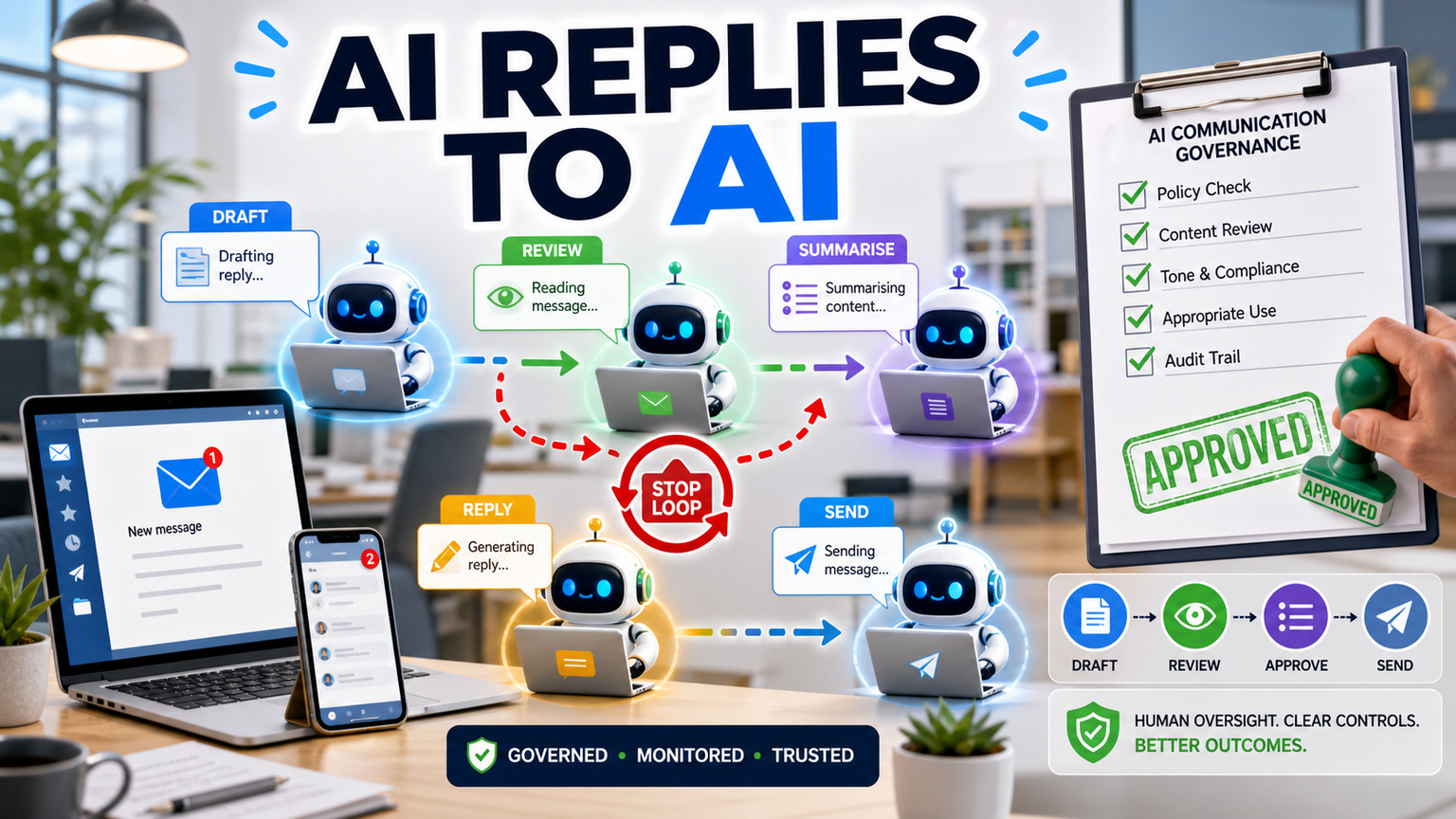
A hot r/technology thread is debating a Fortune report about workplace messages increasingly being drafted, summarised, or answered by AI on both sides. Thirumurugan's view: the risk for SMEs is not that AI helps with writing. The risk is that work starts moving through invisible assistant-to-assistant loops without ownership, context, or review. For UK, US, and European SMEs, this is a practical operations issue. If AI is touching email, sales follow-up, internal updates, support replies, calendar notes, or CRM tasks, the workflow needs rules before the habit scales.
What this means for SMEs
AI-generated communication can save time, but it can also create a new layer of operational fog. A customer asks a question, one assistant drafts the answer, another assistant summarises it, a third tool updates the CRM, and nobody checks whether the decision, promise, or tone still matches the business.
That creates four common risks:
1. Context loss: AI can compress the messy details that make a customer, supplier, or employee issue important.
2. Responsibility gaps: Teams may assume someone else reviewed the message because the workflow looks complete.
3. Poor handoffs: AI summaries can move work between sales, support, finance, and operations without enough source evidence.
4. Measurement confusion: Faster replies can look productive even when rework, escalations, or customer frustration rises.
The answer is not to ban AI writing. The answer is to design the workflow around it. SMEs should decide which messages AI can draft, which ones require approval, which systems are updated automatically, and which signals trigger human escalation.
A practical AI communication workflow should include:
Clear ownership for each AI-assisted reply.
CRM or helpdesk logging that stores source context, not just the final message.
Review rules for pricing, legal, HR, refunds, complaints, and high-value sales.
A fallback process when the AI is uncertain or customer sentiment changes.
Monthly review of response quality, rework, and conversion impact.
Global SaaS competitors such as Zapier, n8n, Relevance AI, Lindy, Gumloop, Bardeen, Make, and Stack AI make it easier to connect inboxes, CRMs, calendars, and AI agents. That is useful. US AI agent consultancies and SEO-heavy agent guides often show how to build an assistant quickly. European and UK AI consultancies often focus on PoCs, RAG, governance, sovereign cloud, or enterprise readiness.
What many posts miss is the operating layer between a clever assistant and a reliable business process.
Tools automate tasks. GOFTUS automates the workflow around the task.
For an SME, the real value is not only an AI that writes a reply. It is the complete system around that reply: intake, context lookup, draft, confidence check, approval, CRM update, escalation, reporting, monitoring, and monthly improvement. SaaS tools can be excellent components, but the business still needs workflow design, integration, human review, monitoring, and iteration.
This matters especially for UK, US, and European companies because customer communication can touch data protection, employment, regulated advice, financial commitments, and contractual promises.
| Question | Practical answer |
|---|---|
| What is the Reddit signal? | Workers are debating AI-generated workplace communication becoming AI-to-AI interaction rather than human-to-human coordination. |
| What is the business risk? | Faster messages can hide context loss, weak ownership, poor handoffs, and unreviewed commitments. |
| What should SMEs automate first? | Repetitive drafting, summaries, routing, CRM updates, and follow-up reminders with clear approval rules. |
| What should stay human-reviewed? | Pricing, contracts, complaints, HR, sensitive customer issues, legal or regulated statements, and high-value opportunities. |
| What is the GOFTUS angle? | Build the workflow around the AI task so speed, quality, review, and accountability improve together. |
Should SMEs stop employees using AI for emails?
No. A blanket ban usually pushes usage into shadow workflows. A better approach is to define which messages AI can draft, where source context must be stored, and when a human must approve the output.
What is the first workflow to fix?
Start with customer-facing follow-up. Map the path from inbound message to context lookup, draft reply, approval, CRM update, next action, and reporting. This gives SMEs a measurable workflow rather than scattered AI usage.
How can GOFTUS help with this?
GOFTUS designs practical AI automation around real business workflows: CRM follow-up, support triage, reporting automation, document processing, internal knowledge assistants, and agentic workflows with review and monitoring built in.
If your team is already using AI in inboxes, sales, support, or operations, GOFTUS can audit the workflow, identify risk points, and build a measurable automation system that improves monthly.
CTA: Book a GOFTUS workflow automation review to turn AI-assisted communication into a governed, measurable operating process.