AI productivity tools need workflow owners before staff automate tasks
AI productivity tools create ROI when SMEs assign owners, approvals, logs, and review gates before staff automate customer or money workflows.
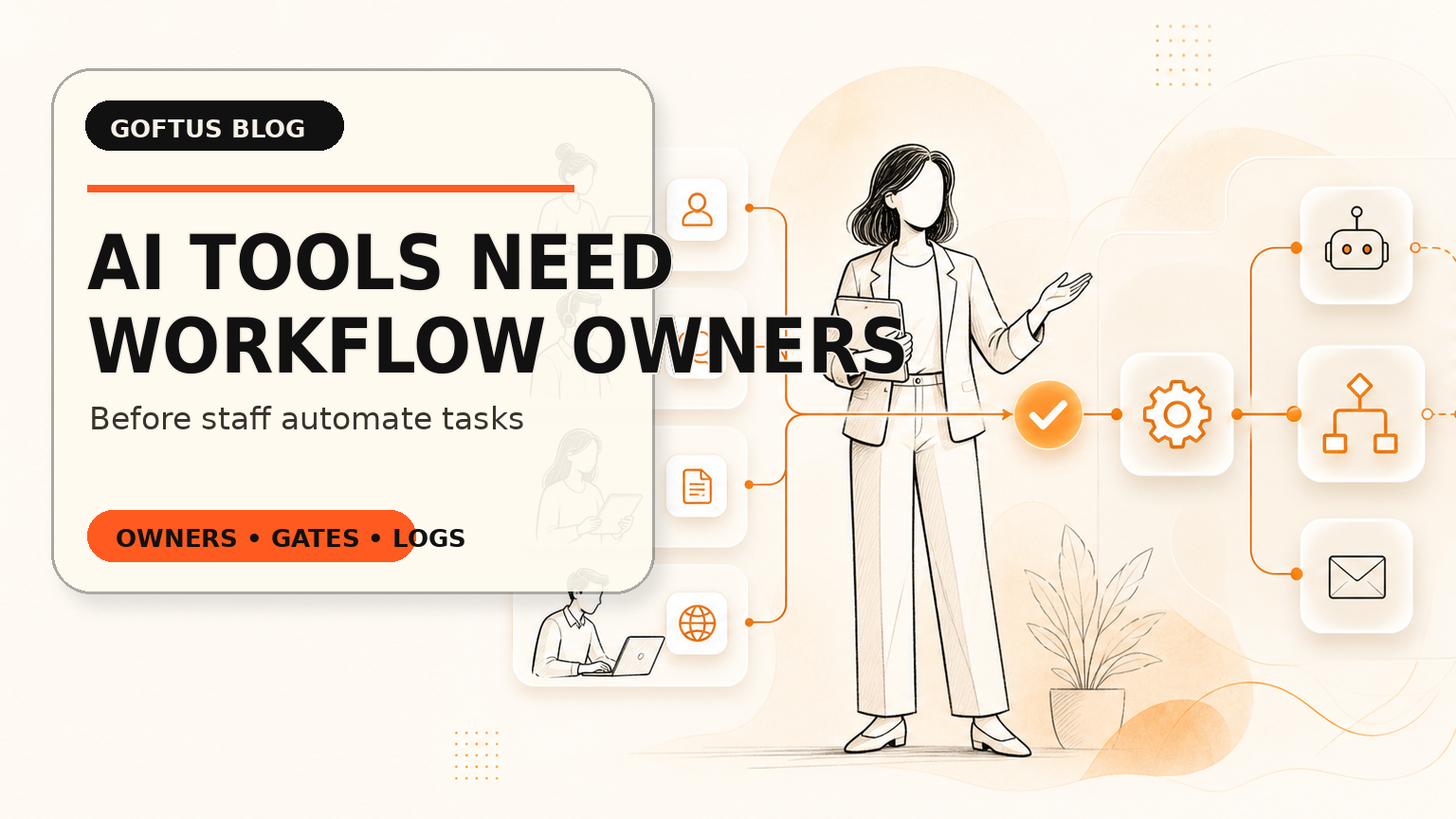
# AI productivity tools need workflow owners before staff automate tasks Meta description: AI productivity tools create ROI when SMEs assign owners, approvals, logs, and review gates before staff automate customer or mo
AI productivity tools need workflow owners before staff automate tasks
Meta description: AI productivity tools create ROI when SMEs assign owners, approvals, logs, and review gates before staff automate customer or money workflows.
Quick answer
AI productivity tools should not be judged only by how many prompts, chats, summaries, or automations they can create. For SMEs, the safer question is which workflow owner approves the tool before it touches a customer, invoice, CRM record, document, web portal, or support queue. The latest GOFTUS SEO input shows 90-plus interest around AI tools, best AI tools, AI productivity tools, ChatGPT, OpenAI, Claude AI, and related business workflow searches. The strongest social signal came from r/sysadmin, where an experienced systems engineer asked for practical AI use cases beyond simply asking an LLM questions. That is exactly the SME gap: staff can see that AI is useful, but they need a workflow map before experiments become business operations.
What this means for SMEs
The market is full of lists promising the best AI productivity tools for writing, meetings, search, support, coding, reporting, sales, and operations. Google News RSS results for this run surfaced headline-level coverage from Salesforce on AI tools for entrepreneurs, Microsoft on small and medium businesses already using AI, SBE Council on tools small businesses are adopting, and IBM business AI explainers. Those sources show the demand side clearly. Owners are not waiting for a perfect enterprise transformation plan. They are trying tools now.
The Reddit signal adds the operator reality. A sysadmin with 18 years of experience said they understood AI could handle boring and tedious work, but felt lost once the conversation moved beyond chatbots and into agents. That is a useful warning for SMEs. If technical staff are asking for a crash course, non-technical teams are even more likely to skip the architecture and jump straight to tool use.
GOFTUS would turn that uncertainty into a simple operating model. First, name the business process. Is the AI helping with support triage, sales follow-up, reporting, document preparation, lead qualification, meeting notes, invoice checks, or website actions? Second, name the owner. A productivity tool without an owner becomes shadow automation. Third, define what the AI may observe, prepare, recommend, or execute. Fourth, add approval gates for risky steps. Fifth, keep logs so the workflow can be reviewed when something goes wrong.
This matters because AI productivity tools often look harmless at the start. A staff member summarizes calls. Another drafts emails. Someone else creates a spreadsheet formula, a support reply, a contract note, or a browser action. Soon the business has dozens of small AI-assisted decisions with no common review path. The risk is not only hallucination. It is missed context, duplicated work, unapproved promises, inconsistent pricing, weak handoffs, and no evidence trail.
The better SME pattern is to separate green, amber, and red tasks. Green tasks are low-risk preparation: summarize internal notes, draft an email, classify an enquiry, compare documents, or prepare a report outline. Amber tasks need human review before leaving the business: customer replies, pricing explanations, refund wording, contract summaries, support instructions, and sales follow-up. Red tasks should not run without explicit approval and logs: payments, vendor changes, account access, CRM status changes, legal or compliance language, and actions inside external web portals.
GOFTUS can help SMEs turn this from policy into working systems through /services. The service layer is not just choosing a SaaS tool. It is connecting the tool to CRM, email, support, documents, spreadsheets, n8n, browser controls, or custom backend logic with visible owners and review points. A team might begin with a customer-support workflow where AI drafts answers, attaches source notes, assigns urgency, and prepares CRM updates. A human approves the customer-facing message. The system logs the question, answer, owner, and follow-up task. After a week, the business reviews exceptions and improves approved answer templates.
Summery for SMEs
For SMEs, the best AI productivity tool is the one that fits a controlled workflow, not the one with the longest feature list. Use today high-score trend signal as a reason to audit where staff already use AI. Then pick one workflow where faster preparation would clearly help, but final action still needs an owner. Start with observe and prepare. Add approve before customer, money, legal, access, or browser actions. Review the logs every week. That is how AI moves from scattered experiments into reliable operations.
Competitor lens
SaaS tools, consultants, and workflow builders can all be useful. A meeting assistant can summarize calls. A helpdesk AI can draft replies. A CRM plugin can score leads. A no-code platform can connect steps quickly. The weakness appears when nobody owns the full path from trigger to action to review.
GOFTUS competes by owning that path. Thirumurugan would map the process, define the approval gates, connect the systems, monitor exceptions, and improve the workflow after real usage. The practical contrast is simple: tools give capabilities, while GOFTUS builds controlled business outcomes. If an AI productivity tool prepares a refund response, GOFTUS makes sure the policy source, customer context, approval owner, CRM update, and audit log are all part of the same workflow.
FAQ
What should SMEs automate first with AI productivity tools?
Start with work that is frequent, repetitive, and easy to review. Good first workflows include enquiry classification, meeting note summaries, support reply drafts, sales follow-up preparation, report outlines, and document comparison. Avoid starting with payments, legal commitments, access changes, or live website submissions. GOFTUS usually starts by mapping one process, assigning an owner, and connecting the AI output to /services so the team can approve, log, and improve the workflow before expanding it.
How do AI productivity tools become risky?
They become risky when staff move from asking for drafts to letting tools change records, send messages, promise outcomes, or act in portals without approval. The risk grows when each department picks its own tool and nobody reviews prompts, sources, exceptions, or handoffs. SMEs can reduce that risk by using green, amber, and red task lanes, with human review for customer, finance, legal, support, document, and browser actions.
Why does GOFTUS focus on workflow owners?
A workflow owner decides what the AI may do, what needs approval, and what evidence must be saved. Without an owner, productivity tools create hidden processes that are hard to debug. GOFTUS uses owners, source checks, approval gates, logs, and improvement reviews so SMEs get measurable time savings without losing control of customer experience or operational risk.
Source notes
Reddit social signal: GOFTUS Reddit intelligence on 2026-08-21, r/sysadmin, "Basic crash course in AI use cases beyond asking an LLM questions?" The post is used as operator sentiment, not as a factual claim about AI products. Daily SEO source: GOFTUS SEO FAQ and Search Console run for 2026-08-20, with Trends scores at or above 90 including AI tools 100, best AI tools 93, and AI productivity tools 92. News cross-check: Google News RSS headline-level results for AI productivity tools and SME workflow governance, including Salesforce, Microsoft, SBE Council, IBM, and Spiceworks listings. Direct article bodies were not all scraped in this unattended run, so those are cited as market-context signals.