AI governance workflow for business data before it feeds the next model
AI governance workflow helps SMEs control emails, chats, documents, approvals, and audit logs before business data reaches AI tools and model workflows.
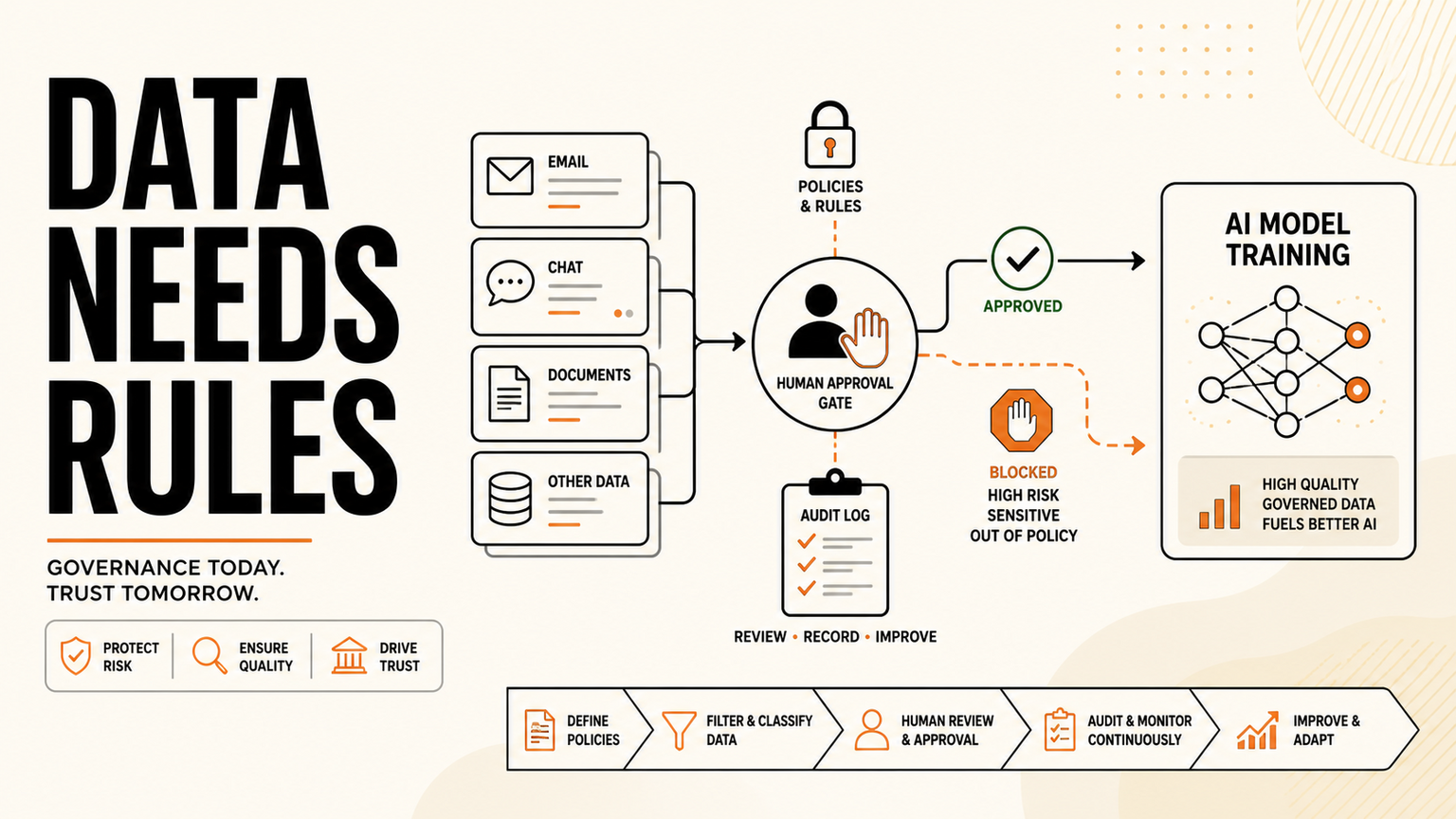
# AI governance workflow for business data before it feeds the next model ## Quick answer AI governance workflow is the operating layer that decides which emails, chats, documents, CRM records, support notes, and files
AI governance workflow for business data before it feeds the next model
Quick answer
AI governance workflow is the operating layer that decides which emails, chats, documents, CRM records, support notes, and files can be used by AI systems, who approves the use, and what gets logged. A fresh Reddit signal on 18 August 2026 pointed to an Axios story, also reflected in Google News RSS results, about Google buying a bankrupt airline data trove for AI improvement. That does not mean every SME faces the same transaction tomorrow. It shows why business data now has value after it leaves the tool where staff created it.
For UK, US, and EU SMEs, the practical lesson is simple. Before staff connect AI tools to inboxes, shared drives, CRMs, support desks, or browser workflows, the company needs rules. GOFTUS helps businesses turn those rules into workflow automation with intake, classification, approval, logging, and review. The goal is not to block AI. The goal is to make useful AI safer, more explainable, and easier to improve.
What this means for SMEs
Most small and mid-sized companies already hold more useful data than they realise. Sales emails explain objections. Support chats reveal recurring service gaps. Documents contain pricing logic, policies, implementation notes, contracts, forms, and operational history. Meeting notes show decisions. CRM records show which leads moved and which ones stalled.
When AI tools arrive, this data can become fuel for summaries, answer drafting, sales follow-up, customer support, reporting, document processing, and agentic workflows. But the same value creates risk. A staff member may paste sensitive text into a model. A browser agent may read a portal it should not touch. A workflow builder may sync a folder without separating approved knowledge from private records. A vendor may offer a helpful feature while the business has not yet defined its own data boundaries.
An AI governance workflow gives the team a repeatable way to decide. It should classify data before use, mark approved sources, block sensitive inputs, request human review for unclear material, and keep an audit log. It should also define what AI may do with the output. Drafting an answer is one thing. Updating a customer record, sending a quote, changing a policy file, or submitting data through a web portal needs stronger control.
This matters because SMEs often adopt tools quickly. Zapier, n8n, Make, Bardeen, Lindy, Gumloop, Relevance AI, and Stack AI can move data fast. That helps only when someone owns the source of truth, approval rule, exception path, and monthly review.
Bharatvaj's view
Bharatvaj's view is that AI governance should start as a workflow, not a policy PDF. A policy document may say staff should protect customer data, but the real test happens when someone wants to summarise a sales inbox, automate support replies, process uploaded documents, or let an AI agent use a browser.
The better pattern is observe, classify, approve, act, and review. First, observe where business data already moves. Second, classify the data into public, internal, customer-specific, sensitive, regulated, or do-not-use. Third, approve safe sources and safe actions. Fourth, let AI help only inside those lanes. Fifth, review logs and exceptions every month.
GOFTUS can apply this to practical workflows: document automation that extracts data only from approved folders, CRM automation that suggests notes before writing them, customer support automation that drafts answers from approved knowledge, and AI agents that ask before taking browser or account actions. The result is not slower AI. It is AI that staff can trust because the business knows what it is allowed to read and do.
Competitor lens
Consultancies such as Faculty AI, Deeper Insights, Waracle, Brainpool AI, LeewayHertz, Markovate, SoluLab, BairesDev, Addepto, STX Next, Netguru, and 10Clouds can support AI strategy and delivery. SaaS tools such as Zapier, n8n, Relevance AI, Lindy, Gumloop, Bardeen, Make, and Stack AI can connect systems and automate useful steps.
Those options can be valuable. The missing layer for many SMEs is the workflow around business data. Who approved the source? Which folder is safe? Which fields are excluded? Which browser action needs human approval? Which exception stops the automation? Who reviews the log after the system runs?
Tools automate tasks. GOFTUS automates the workflow around the task. That means GOFTUS can use connectors, models, and agents where they fit, but the core value is designing the control loop: data intake, source approval, human review, safe action, audit evidence, and continuous improvement.
What SMEs should do next
First, list the places where business data would be useful to AI: shared drives, email, chat, CRM, support tools, spreadsheets, proposals, invoices, policy documents, and websites. Mark each source as approved, needs review, sensitive, or blocked.
Second, separate read-only AI from action-taking AI. A model that summarises approved documents has different risk from an agent that updates CRM, replies to customers, changes a file, or submits a browser form. If the workflow touches external systems, add approval gates and logs. For browser-based automation, GOFTUS can connect the work to controlled AI agents with login boundaries, stop rules, and human-approved actions.
Third, build one narrow workflow before scaling. For example, route approved support documents into answer drafting, send uncertain answers to a human, log the source used, and review unanswered questions monthly. Or process incoming sales documents, extract fields, ask for approval, then update CRM only after review.
Fourth, measure the outcome. Good AI governance should reduce repeated manual checks and make automation easier to expand. If the team cannot see what the workflow read, suggested, changed, or stopped, it is not ready for wider use. GOFTUS can help through its AI automation services or a £100 Startup Kit diagnostic to find the safest first workflow.
Summery for SMEs
Business data is becoming more valuable as AI systems move closer to email, chat, documents, CRM, support, and browser actions. SMEs do not need to avoid AI, but they do need a workflow that controls what data can be used, who approves risky steps, what actions are allowed, and what evidence is logged. Start with one narrow workflow, prove the control loop, then expand.
FAQ
Is AI governance only for large enterprises?
No. SMEs need AI governance because small teams often connect new tools quickly and rely on informal judgement. A lightweight workflow with approved sources, review gates, and logs can protect customer data without creating enterprise bureaucracy.
What data should be blocked from AI workflows first?
Start by blocking customer secrets, passwords, payment details, sensitive HR records, confidential contracts, regulated information, and private account data unless there is a clear approved use. Mark uncertain sources for human review before automation.
How does this connect to browser with AI controls?
When an AI workflow uses a browser to read portals, update records, download files, or submit forms, the business needs approval gates, login boundaries, action logs, and stop rules. That is where browser with AI controls turns governance into everyday practice.
Source notes
Reddit intelligence for 2026-08-18 scored a r/ArtificialInteligence discussion at 100 for the headline: Google wins bankruptcy auction for Spirit Airlines emails, chats, and documents, and will use the data to improve products and AI models. Reddit is treated as social heat, not as verified fact.
The linked Axios page returned HTTP 403 in this cron environment. Google News RSS searches for the exact topic surfaced headline-level cross-checks from GIGAZINE, Yahoo Finance, Malay Mail, The Traveler, and related sources. These were used as headline-level cross-checks, not as scraped full-article verification.
Recent GOFTUS posts and today's FAQ automation cluster were checked before drafting. Because the 2026-08-18 FAQ automation post already exists, this run selected a normal trend and news post mapped to the evergreen keyword ai governance workflow.