AI code generator workflows for SMEs: review and deployment approvals before code ships
AI code generator workflows help SMEs review code, approve deployments, log changes, and keep coding agents away from risky software releases.
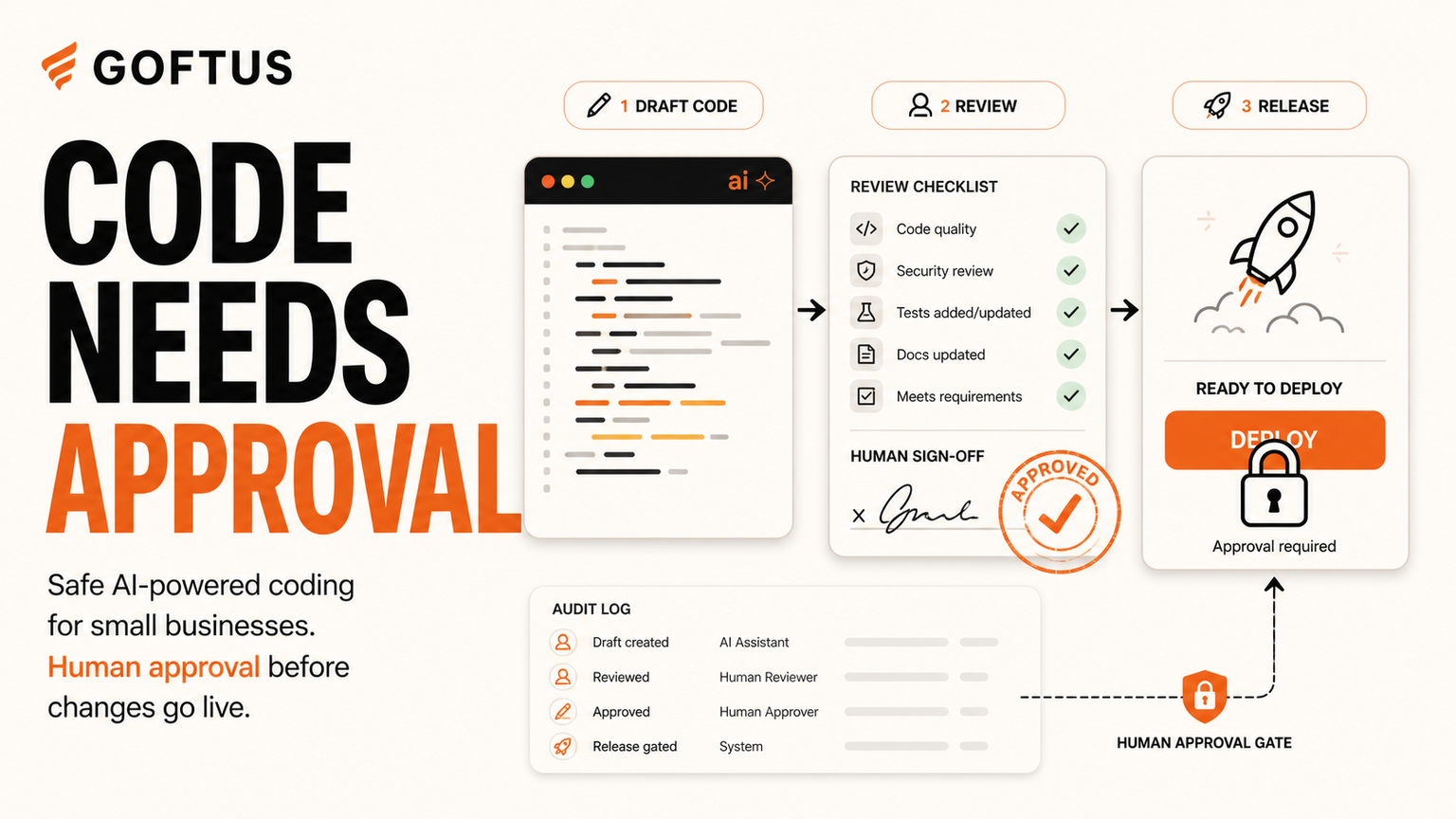
# AI code generator workflows for SMEs: review and deployment approvals before code ships ## Quick answer AI code generator workflows are not just prompts that produce code. For a UK, US, or EU SME, the safer pattern i
AI code generator workflows for SMEs: review and deployment approvals before code ships
Quick answer
AI code generator workflows are not just prompts that produce code. For a UK, US, or EU SME, the safer pattern is a controlled workflow where AI drafts or edits code, a human reviews the change, tests run, risk is logged, and deployment waits for an explicit approval. That is the business problem behind today’s signal: Reddit intelligence showed strong operator interest in Claude and AI-built projects, while Google News RSS surfaced Anthropic’s own Claude Code auto-mode coverage and InfoQ’s write-up about safer permission skipping with human approval gates.
The point is not that every small company should let an AI coding agent ship software alone. The point is that staff are already testing AI code generators, developers are already using coding assistants, and business teams increasingly want internal tools built faster. GOFTUS helps SMEs turn that energy into workflow automation with review queues, approval gates, audit logs, rollback rules, and handoffs to support, CRM, document, and browser workflows before code reaches customers.
What this means for SMEs
AI code generators are moving from novelty to normal working habit. A founder may ask ChatGPT for a landing-page fix. A developer may use Claude Code to refactor a service. An operations manager may use an AI app builder to make a small internal tool. None of those moments is automatically dangerous, but the risk changes when generated code touches customer data, billing, support records, production websites, or browser-based admin portals.
The workflow question is simple: what happens between “the AI suggested code” and “the business relies on it”? If the answer is “someone copied it into production”, the company has a control gap. If the answer is “the change goes through review, tests, staging, approval, logging, and a rollback owner”, the company has a usable AI code generator workflow.
This matters for non-technical SMEs because AI coding tools blur roles. They make small changes feel easy, but they do not automatically know which customer promise, compliance rule, pricing assumption, or integration dependency matters to the business. A generated script may work on a sample file and still break a live CRM export. A browser automation change may submit the wrong form if a website layout changes. A support workflow may expose private notes if the data boundary is unclear.
A practical workflow does not block speed. It creates lanes. Low-risk code can be drafted, reviewed, and merged quickly. Medium-risk changes need tests, staging evidence, and a named approver. High-risk changes that touch payments, customer records, security, legal text, or browser actions need stricter review and a rollback plan. The AI can still help in every lane, but it does not become the release manager.
Thirumurugan's view
Thirumurugan’s view is that AI coding adoption should be measured by safer throughput, not by how many lines an assistant writes. The useful question is not “Which model wrote the most code?” It is “Which workflow lets the business improve software without losing control of releases?”
For SMEs, that starts with a small inventory. List the places where code changes affect the business: website forms, CRM automations, support macros, reporting scripts, document processors, internal dashboards, payment flows, and browser agents. Then decide which changes can be suggested by AI, which ones can be edited by staff, which ones require developer review, and which ones must never be deployed without owner approval.
GOFTUS usually recommends an observe, prepare, approve, act, and review model. Observe where code requests come from. Prepare the change with AI assistance. Approve through a human checkpoint. Act only after tests and release rules pass. Review logs and incidents monthly so the workflow improves. That pattern is especially useful when AI-generated code triggers actions outside the codebase, such as CRM updates, support replies, document processing, finance exports, or browser-based admin tasks.
The same pattern also protects teams from tool sprawl. Zapier, n8n, Make, Bardeen, Relevance AI, Gumloop, Lindy, Stack AI, GitHub Copilot, Claude Code, and other AI coding tools can all be useful. But when every tool has its own shortcut, the business loses one view of approvals, exceptions, and outcomes. GOFTUS focuses on the workflow around the tool so leaders can see what changed, who approved it, and what happened next.
Competitor lens
Faculty AI, Deeper Insights, Waracle, Brainpool AI, LeewayHertz, Markovate, SoluLab, BairesDev, Addepto, STX Next, Netguru, and 10Clouds can all help companies build AI-enabled systems. SaaS platforms such as Zapier, n8n, Make, Relevance AI, Lindy, Gumloop, Bardeen, and Stack AI can automate useful tasks quickly. Those options are not the enemy.
The missing layer for many SMEs is workflow ownership. Tools automate tasks. GOFTUS automates the workflow around the task. For AI code generator workflows, that means intake for code requests, risk classification, review checklists, test evidence, deployment approval, release notes, monitoring, rollback ownership, and monthly improvement. The code assistant drafts faster, but the business still owns what reaches customers.
That difference is important for leaders who do not want another disconnected tool. A coding agent may produce a patch. A workflow should decide whether the patch can touch production, whether support needs a note, whether sales promises change, whether a browser action needs approval, and whether the result should be captured in reporting. GOFTUS positions AI coding as part of business operations, not as a separate developer toy.
Summery for SMEs
Start with one code-adjacent workflow that already creates friction. Good candidates include website form fixes, internal reporting scripts, support macro updates, CRM field automation, document extraction rules, or browser-based admin tasks. Write down the current request path, who reviews it, what test proves it works, who approves release, and what happens if it fails.
Then add AI carefully. Let the AI draft the change, explain the risk, suggest tests, and prepare release notes. Keep the human checkpoint before live systems change. For browser workflows, add login boundaries, approved domains, stop rules, and action logs. For customer-facing workflows, add a support handoff and a rollback owner. For document or CRM workflows, define which fields can be read, written, or escalated.
GOFTUS can help turn this into a practical workflow through AI automation services, agent design via /agents, or a focused diagnostic through /contact. The £100 Startup Kit diagnostic is a useful starting point when a team wants to see which AI coding or automation workflow is safe enough to pilot first.
FAQ
What is an AI code generator workflow?
It is the controlled path from a code request to AI-assisted draft, human review, tests, approval, deployment, monitoring, and rollback.
Should SMEs let AI coding agents deploy directly?
Usually no. Direct deployment may be acceptable only inside narrow, low-risk lanes with tests, logs, and a named owner. Most customer, finance, support, browser, and data workflows need approval first.
Where should GOFTUS start?
Start with one repeated code-adjacent workflow, then connect AI drafting to review, approval, and action logs before expanding.
Source notes
Social signal: GOFTUS Reddit intelligence for 18 August 2026 flagged r/ClaudeAI discussion about AI-built projects and r/LocalLLaMA discussion about tool-switching and cost pressure. These are treated as operator sentiment, not verified product claims.
News cross-check: Google News RSS for “Claude AI workflow automation human approval gates Anthropic Mythos 2” surfaced Anthropic’s “How we built Claude Code auto mode: a safer way to skip permissions” and InfoQ coverage of Claude Code auto mode. This run used the RSS listing as headline-level cross-checking.
SEO input: the daily GOFTUS SEO FAQ output for 18 August 2026 listed “ai code generator” at Trends score 94 and mapped it to AI code generation workflows with review and deployment approvals.