AI code generator workflows need approval gates before code reaches customers
AI code generator workflows need review, approval, rollout, and rollback gates before code changes customer-facing systems or support operations.
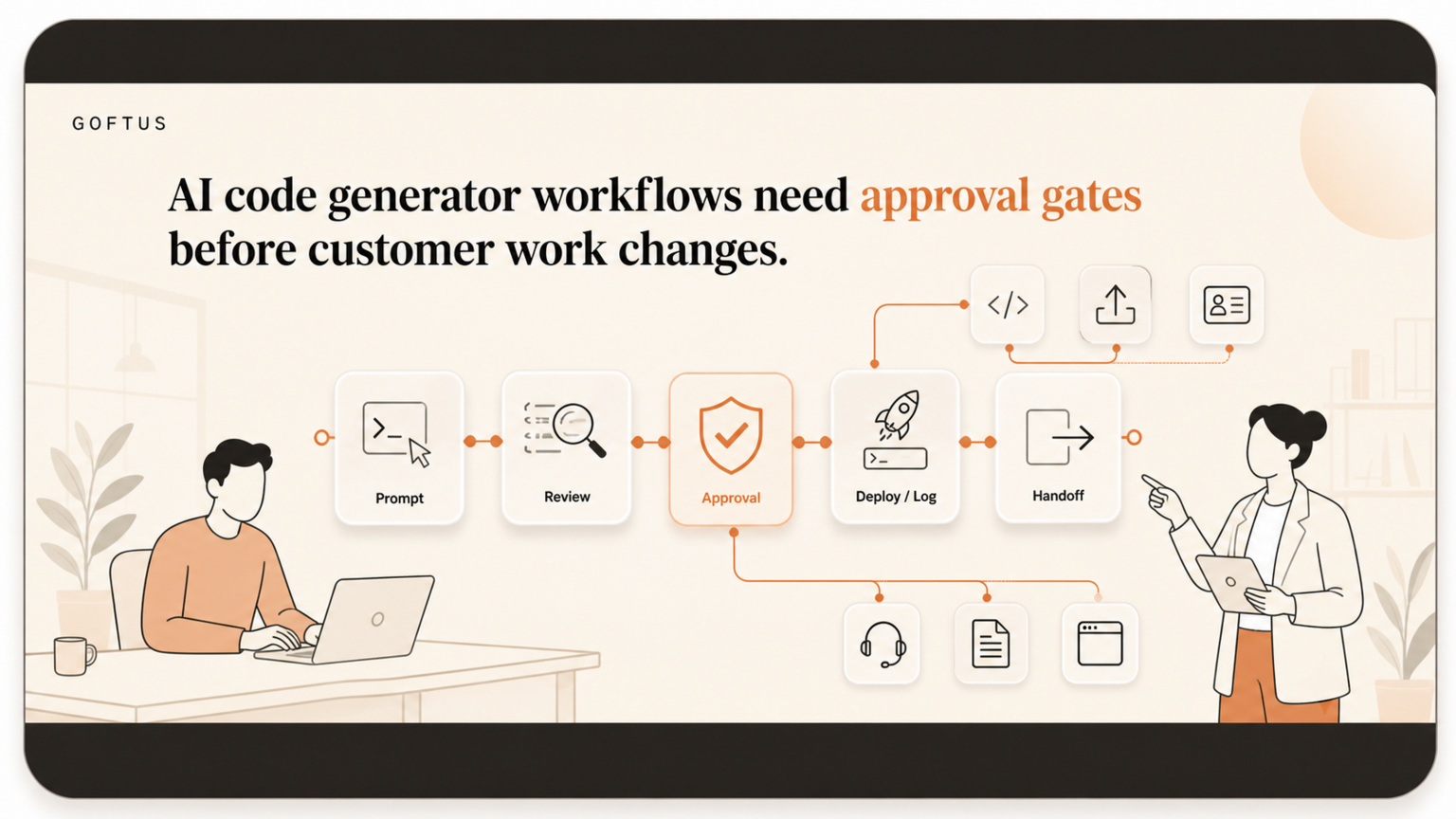
# Quick answer AI code generator adoption is moving faster than most small teams can govern. GOFTUS should treat the 2026-08-23 daily SEO run as the primary input here: `ai code generator` scored 94 in the US Trends set
Quick answer
AI code generator adoption is moving faster than most small teams can govern. GOFTUS should treat the 2026-08-23 daily SEO run as the primary input here: `ai code generator` scored 94 in the US Trends set, while nearby high-score terms included `ai tools` at 100, `chatgpt` at 100, `openai` at 96, and `claude ai` at 94. The Reddit intelligence layer backed the same operator concern with 100-score pages about Claude Code context handling, n8n workflow uncertainty, and the idea that asking AI a question is the wrong workflow for research. The signal is not that every SME needs more code generated. The signal is that code output now needs the same workflow control as sales, support, finance, and operations changes.
For SMEs, the risk is simple. A code assistant can draft a patch, migration, Zapier script, n8n workflow, support macro, or website change in minutes. But speed without ownership creates hidden technical debt. If nobody reviews the source, tests the edge cases, approves the affected customer journey, records the change, and confirms rollback, the business is not automating safely. It is letting a tool make operational choices without a workflow owner.
What this means for SMEs
An AI code generator should sit inside an approval workflow, not beside it. Start by separating work into four lanes. Green lane changes are drafts, documentation, test data, internal notes, and non-production prototypes. Amber lane changes touch live workflows but stay behind a reviewer, such as CRM field mapping, support routing, report formulas, website copy blocks, or internal tools. Red lane changes affect production code, payments, permissions, customer messages, browser actions, data exports, or public content. Those require explicit approval, logs, and rollback before release.
The daily Reddit signal is useful because it shows where teams get stuck. Developers discuss context windows, MCP servers, tool reliability, and whether workflow builders actually completed the intended job. Non-developers see the same problem in business terms: the AI looks productive, but nobody knows which action was safe, which was only a suggestion, and which needs a human decision.
GOFTUS solves this by designing the operating layer around the tool. A SaaS coding product can help draft faster. A consultant can advise on a stack. GOFTUS focuses on the workflow around the output: intake, source check, reviewer assignment, approval gate, deployment path, exception handling, monitoring, and improvement cycle. That is where SMEs get reliable automation instead of scattered experiments.
Competitor lens
AI coding assistants, low-code platforms, and developer consultants are useful. They can shorten build time, reduce blank-page effort, and help teams prototype new internal systems. The gap appears after the first working demo. Who owns the business rule? Who approves the generated change? Which customer records can the automation update? Which browser sessions can it use? Where is the audit log if a support reply, invoice field, or lead handoff goes wrong?
That is the practical GOFTUS contrast. We do not position the code generator as the transformation. We position the workflow as the product. The code assistant is one input inside a controlled system that includes human review, access limits, test evidence, release notes, and measured outcomes.
Summery for SMEs
If your team is already using an AI code generator, do not start by banning it or giving it full freedom. Start by making the path visible. Every generated change should have a request, a business owner, a reviewer, a test result, an approval record, and a release or rollback note. That standard can apply to code, n8n flows, CRM automations, browser agents, support macros, and reporting scripts.
A simple first step is to route generated changes through a shared approval board. Capture the prompt or requirement, affected system, data touched, customer impact, reviewer, and final decision. Use GOFTUS services at /services when you need that board connected to real operations instead of another unused checklist. Use /agents when the workflow includes AI agents that can prepare actions before humans approve them.
FAQ
Should SMEs stop staff from using AI code generators?
No. Blocking the tool usually pushes usage into shadow workflows. The better response is to define safe lanes, review requirements, access limits, and release rules. Staff can still use AI for drafts, tests, documentation, and prototypes while customer-facing changes stay behind approval.
Where should the first approval gate sit?
Place the first gate before any generated output touches production data, customer messages, payments, account access, browser submissions, or published content. The reviewer should understand both the business process and the technical risk.
How does this connect to GOFTUS automation services?
GOFTUS turns generated output into governed workflow. We map the process, define owner decisions, connect the right systems, build the approval and logging layer, then monitor what actually happens after launch.
Can no-code and n8n workflows use the same controls?
Yes. The same rule applies whether the output is code, a Zapier step, an n8n workflow, a CRM automation, or a browser-agent action. The business needs source control, review, approval, logs, and exception routing before action.
Source notes
Primary SEO input: GOFTUS daily SEO FAQ and Search Console check for 2026-08-23, where `ai code generator` scored 94 and related AI-tool terms scored 90 or higher. Social signal: GOFTUS Reddit and keyword intelligence for 2026-08-23, including 100-score operator pages in r/Anthropic, r/n8n, r/Automation, and r/artificial about AI workflows, code context, and action reliability. News cross-check: Google News RSS results surfaced AWS guidance on applying Amazon Bedrock Guardrails to code generation workflows, Anthropic coverage about safer Claude Code auto mode, GitLab coverage of Claude Code workflows, and broader AI development workflow coverage. Direct article access varies by publisher, so RSS headline-level evidence is used as the cross-check rather than claiming full-page scraping.