AI Automation Budget Governance: Plan Model Fallbacks Before Costs Shift
AI automation budget governance helps SMEs control model costs, approve fallback routes, and keep CRM, support, browser, and document workflows safe.
# Quick answer AI automation budget governance is the operating system SMEs need when model prices, open-weight options, and vendor availability keep shifting. The fresh signal today is not simply that Qwen 3.8 open wei
Quick answer
AI automation budget governance is the operating system SMEs need when model prices, open-weight options, and vendor availability keep shifting. The fresh signal today is not simply that Qwen 3.8 open weights are being discussed in AI communities. The business lesson is that UK, US, and EU operators should not wire one model, one SaaS agent, or one browser automation into customer work without a cost owner, fallback lane, approval rule, and audit trail.
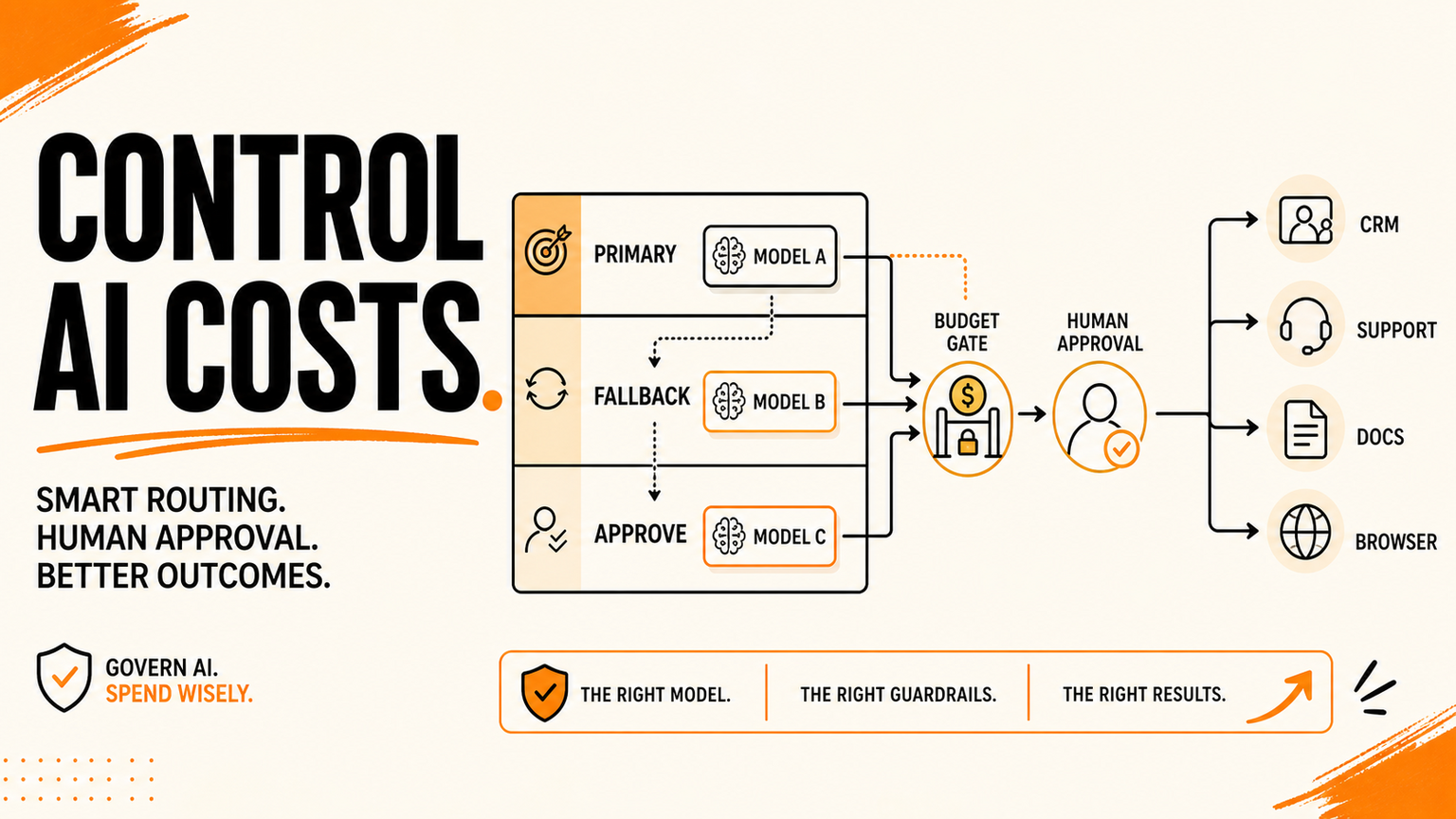
For GOFTUS, the practical answer is simple: map the workflow first, then decide which AI model or tool is allowed to help. A sales follow-up, support triage, reporting routine, document review, or browser task should have a primary model, an approved lower-cost fallback, and a human approval step before the output changes a record or reaches a customer. That is where our AI automation services fit: not just choosing tools, but designing the workflow around the tool.
What this means for SMEs
Open-weight model news matters because it changes the economics of AI. A model such as Qwen can create pressure on closed platforms, while closed vendors can still be better for reliability, privacy controls, support, or specific agent features. A small business does not need to win the model debate. It needs a rule for when to use each route.
That rule should be written at workflow level. For example, a chatbot answer can use a low-cost route when it is pulling from approved FAQs. A refund recommendation might require a stronger model and a manager review. A browser agent that logs into a portal should prepare the action, but a person should approve the final submit. A monthly management report can draft with one model, verify against source data, and fall back to a second provider if the first route is unavailable or too expensive.
This is why AI automation budget governance is becoming a buyer problem, not a finance footnote. Without it, teams discover cost drift late. Staff add extra AI subscriptions because the first tool hit a limit. Automation builders switch providers without updating prompts, logs, or review rules. Leaders then cannot explain which model touched which customer workflow, what it cost, or why an answer was approved.
Hajikreena's view: treat model choice like a workflow change request. If a new open-weight model, hosted API, or SaaS agent looks attractive, ask four questions before production use. What task will it handle? What data can it see? What is the spend ceiling? What human or system check happens before action? If those answers are vague, the business is not ready for autonomous use.
Where the fresh signal fits
The Reddit signal came from r/LocalLLaMA discussion around Qwen 3.8 open-weight models. That is social heat, not a verified procurement recommendation. Google News RSS also surfaced coverage from The Decoder describing Alibaba's Qwen 3.8 open-weight releases under Apache 2.0, plus South China Morning Post coverage about broader Qwen availability. The safe conclusion is not that every SME should switch models. The conclusion is that model options are multiplying, which makes governance more important.
Open weights can help teams test local or private routes. Hosted models can reduce infrastructure burden. SaaS workflow tools can move quickly. Custom scripts can keep costs predictable. Each option can be right, but only if the workflow records why it was chosen and when it should hand off.
For SMEs, the winning pattern is a small model-routing policy. Green work can be drafted automatically, such as classifying enquiries, summarising notes, or preparing internal checklists. Amber work can be prepared by AI but reviewed by a person, such as CRM updates, support replies, invoice notes, browser form changes, or document edits. Red work should require explicit approval or stay manual, especially finance, legal, customer commitments, access changes, and public content.
Competitor lens
Faculty AI, Deeper Insights, Waracle, Brainpool AI, LeewayHertz, Markovate, SoluLab, BairesDev, Addepto, STX Next, Netguru, and 10Clouds can all help businesses plan or build AI systems. Zapier, n8n, Make, Bardeen, Gumloop, Lindy, Relevance AI, and Stack AI can also be useful for automating tasks.
The gap appears after the demo. Tools automate tasks. GOFTUS automates the workflow around the task. That means defining who owns the process, which model is allowed in each lane, where the fallback route lives, how approvals are captured, what logs prove the action, and how the workflow improves each month.
A generic AI consultant may recommend a better model. A tool vendor may recommend more usage. GOFTUS asks whether the business can still run the customer workflow when a model is slow, expensive, unavailable, or replaced. That is the difference between AI experimentation and operating discipline.
What SMEs should do next
Start with one expensive or fragile workflow. Good candidates are lead follow-up, support triage, proposal drafting, recurring reports, supplier emails, FAQ answers, document processing, or browser-based admin. Write down the current steps, the decision points, the systems touched, and the person who owns the result.
Then add budget gates. Set a monthly spend owner. Decide which actions can use a lower-cost route and which need a premium route. Document a fallback model or manual lane before the team needs it. If staff already use multiple AI tools, create a simple register that lists purpose, owner, data allowed, approval rule, and review date.
Next, add action boundaries. AI can observe, prepare, and recommend more often than it should act. For CRM, support, finance, browser portals, and document repositories, the safest first version is usually prepare-and-approve. The automation drafts the update, explains the source, routes it to the right owner, and logs the decision. Only after the team trusts the lane should low-risk actions move closer to automatic execution.
Finally, review monthly. Budget governance is not a one-time policy. Model costs, limits, and quality change. New open-weight releases create opportunities. Vendor restrictions can create bottlenecks. The workflow should show which route was used, what it cost, which exceptions happened, and what should change next.
GOFTUS can help design that operating layer through AI automation services, agent workflows, reporting automation, CRM follow-up, support triage, document processing, and controlled browser automation. The £100 Startup Kit diagnostic is a useful first step when a business wants to see where AI spend is leaking and which workflow should get budget gates first.
Summery for SMEs
AI automation budget governance helps SMEs avoid tool sprawl, surprise AI bills, and unsafe model swaps. The point is not to pick a permanent winner between open-weight models, closed APIs, and SaaS agents. The point is to define which workflow uses which route, what the fallback is, who approves risky actions, and how the result is logged. If a model changes, the workflow should stay under control.
FAQ
Is Qwen 3.8 proof that SMEs should move away from closed AI tools?
No. It is a signal that options are expanding. SMEs should compare routes inside a controlled workflow, not replace one dependency with another.
What is the first budget governance step for AI automation?
Pick one workflow, name the owner, define a monthly spend ceiling, set a fallback route, and require approval before high-risk actions.
Where should GOFTUS fit?
GOFTUS designs the workflow layer around AI tools, agents, CRM, support, browser tasks, documents, reporting, approvals, logs, and monthly improvement.
Source notes
Social signal: GOFTUS Reddit intelligence, 2026-08-15, r/LocalLLaMA: "Qwen 3.8 35BA3B spotted". Treated as social/operator heat, not verified product advice.
News cross-check: Google News RSS surfaced The Decoder coverage of Qwen 3.8 open-weight model releases and South China Morning Post coverage of Qwen 3.8 availability. Direct article scraping was not required for this run; the RSS headlines were used as source cross-checks.
Positioning note: This post converts the model-release signal into the evergreen buyer problem "ai automation budget governance" for SMEs.