AI app builder workflows need approval gates before non developers ship tools
AI app builders help non developers move fast, but SMEs need approval gates, owners, logs, and safe handoffs before new tools reach customers.
# Quick answer AI app builders are becoming useful for small teams because they let non developers turn a process idea into a working internal tool quickly. The risk is not that staff experiment. The risk is that a prot
Quick answer
AI app builders are becoming useful for small teams because they let non developers turn a process idea into a working internal tool quickly. The risk is not that staff experiment. The risk is that a prototype starts changing customer records, quotes, support promises, finance files, or website actions before anyone owns the workflow. GOFTUS treats AI app builders as a workflow design problem first: define the trigger, set the owner, add review gates, log every action, and only then connect the app to CRM, support, documents, n8n, or browser-based work.
What this means for SMEs
The daily SEO input flagged `ai app builder` as a 92-score Trends discovery keyword, while `ai tools` and `chatgpt` remained at 100. That says buyers are not only searching for general AI tools. They are searching for ways to build useful apps without waiting for a software team. The Reddit signal supports the same shift: an r/n8n operator described a plan for autonomous AI teams orchestrated through n8n and MCP, while an r/Automation builder described an open-source RPA platform combining deterministic automation, browser automation, and AI agents.
For an SME, that energy is productive only when it is routed through controls. A staff member can use an app builder to collect lead details, summarize a support case, draft a quote, prepare a supplier email, or generate a content brief. Those are good first uses. The problem starts when the same tool can also send the quote, update the CRM, publish the page, trigger refunds, or submit forms in a web portal without review.
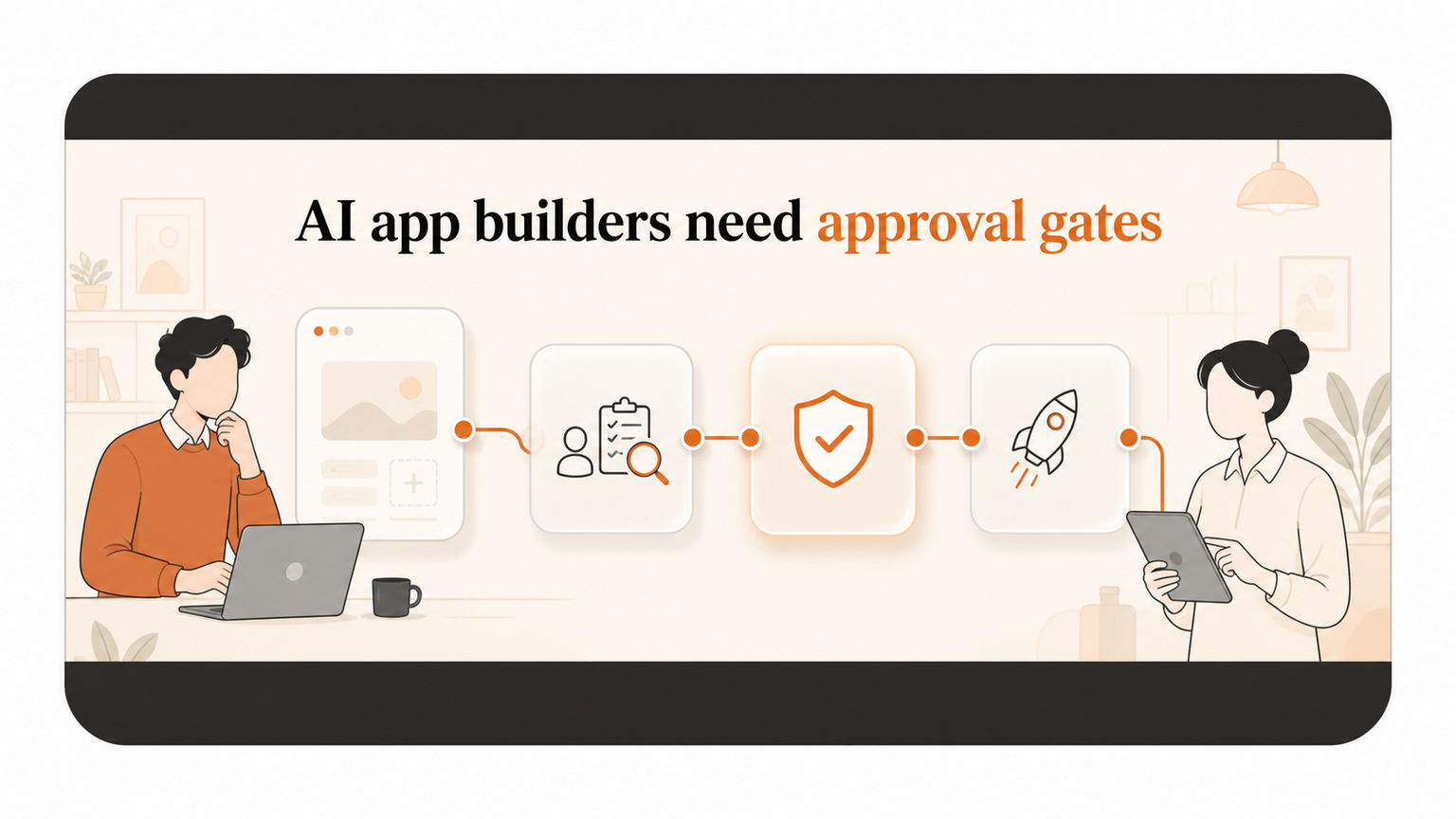
A safe AI app builder workflow has four lanes. First, observe: the app can read approved sources and prepare a suggested output. Second, prepare: it can draft the next step and show what data it used. Third, approve: a named person checks risk, price, customer promise, brand claim, or data exposure. Fourth, act: only approved actions write back to systems, send messages, or trigger browser automation.
This is why GOFTUS does not position AI app builders as magic software replacement. We use them as a faster front end for controlled workflows. The app is allowed to be flexible. The workflow around it is not.
Summery for SMEs
If your team is testing an AI app builder this month, do not start with the most impressive demo. Start with the business process that currently creates delay, rework, or lost follow-up. Write down where the data enters, who checks it, what the AI may prepare, what it may not change, and what record proves the action happened.
A practical first build might be a lead-intake helper. The AI app can read a website form, classify the request, draft a qualification note, and propose the next email. It should not silently change pipeline stage, promise a delivery date, or send pricing. Those steps need an approval gate. Another good first build is a support triage app. It can summarize the customer problem, find the likely product or policy, and prepare a response. It should not close the ticket, issue credit, or update the account without a human check.
SMEs should also decide where the app lives. SaaS app builders, no-code platforms, n8n workflows, Microsoft or Google tools, and custom scripts can all be useful. The question is not which interface looks easiest. The question is whether the workflow has owners, permissions, logs, exception handling, and a monthly improvement loop.
GOFTUS helps teams convert these experiments into managed workflow systems. That can mean connecting an AI app builder to CRM, document automation, support queues, reporting, or browser actions. It can also mean saying no to automation where the customer risk is too high. The useful outcome is not a bigger tool stack. It is a workflow your team trusts enough to use every day.
Competitor lens
AI app builder vendors sell speed, templates, and access to models. Consultants often sell a one-off build. Both can be valuable, especially for proving that a process can be improved. The gap is ownership after the demo. Who monitors failed steps? Who reviews prompts and source data? Who decides when a workflow can act without approval? Who checks whether the app still matches the way the business actually works?
GOFTUS competes on that operating layer. We design the workflow, define the approval rules, connect the systems, monitor exceptions, and improve the process after staff start using it. If a SaaS tool is the right fit, we use it. If n8n, Make, Zapier, custom code, or a browser-controlled agent is safer, we use that instead. The tool is selected after the workflow risk is understood.
That matters because non developers are now able to create software-shaped workflows faster than managers can review them. Without controls, shadow apps multiply. With controls, the same creativity becomes a measurable operations advantage.
FAQ
What should an SME automate first with an AI app builder?
Start with a low-risk workflow where the AI prepares work but a human approves customer-facing or system-changing actions. Good examples include lead qualification notes, support summaries, quote checklists, meeting follow-ups, document intake, or reporting drafts. Avoid starting with refunds, pricing changes, payroll, compliance submissions, or unsupervised browser actions.
How do approval gates work in an AI app builder workflow?
Approval gates pause the workflow before a risky action. The AI can prepare the draft, list the source data, and recommend a next step, but a named owner must approve before the workflow writes to CRM, sends an email, updates a document, triggers n8n, or submits a browser form. That keeps the speed of AI while preserving accountability.
Where should GOFTUS link this workflow?
For SMEs ready to turn app-builder experiments into managed operations, start with /services. If the app will use agents that touch browser tools or live systems, also review /agents so action boundaries, approvals, and logs are designed before launch.
Source notes
Social signal: GOFTUS Reddit intelligence for 2026-08-21 scored r/n8n `Building an Autonomous Multi-Agent System (Hermes + MCP + n8n): Where should I start?` and r/Automation `I'm Open Sourcing my RPA platform for EVERYONE` as 100-score operator signals. These are treated as social sentiment and builder demand, not independent factual claims.
SEO signal: GOFTUS daily SEO FAQ output for 2026-08-21 listed `ai app builder` at 92 in Google Trends fallback data, with the rule that publishing inputs must be 90 or higher.
News cross-check: Google News RSS for `AI app builder no-code approval workflow small business` returned current coverage around AI agent builder tools, vibe-coded app security, low-code oversight, and AI app-builder platform comparisons. Direct article scraping was not required for this run, so the RSS listing is used as headline-level market context rather than a full-text citation.