AI Agents for SMEs: Approval Workflows Before Loop Orchestrators Act
AI agents need approval workflows before they touch CRM, support, finance, documents, browser tasks, or customer actions inside SME workflows.
# Quick answer AI agents are becoming easier to chain into loop orchestrators, but SMEs should not let those loops act on business systems without an approval workflow. The fresh social signal for this post is a 100-sco
Quick answer
AI agents are becoming easier to chain into loop orchestrators, but SMEs should not let those loops act on business systems without an approval workflow. The fresh social signal for this post is a 100-score r/ClaudeAI item from the latest GOFTUS Reddit intelligence titled "Example of a real working loop orchestrator." Treat that as social heat, not verified product evidence. It shows operator interest in agents that plan, call tools, review outputs, and keep moving through a task.
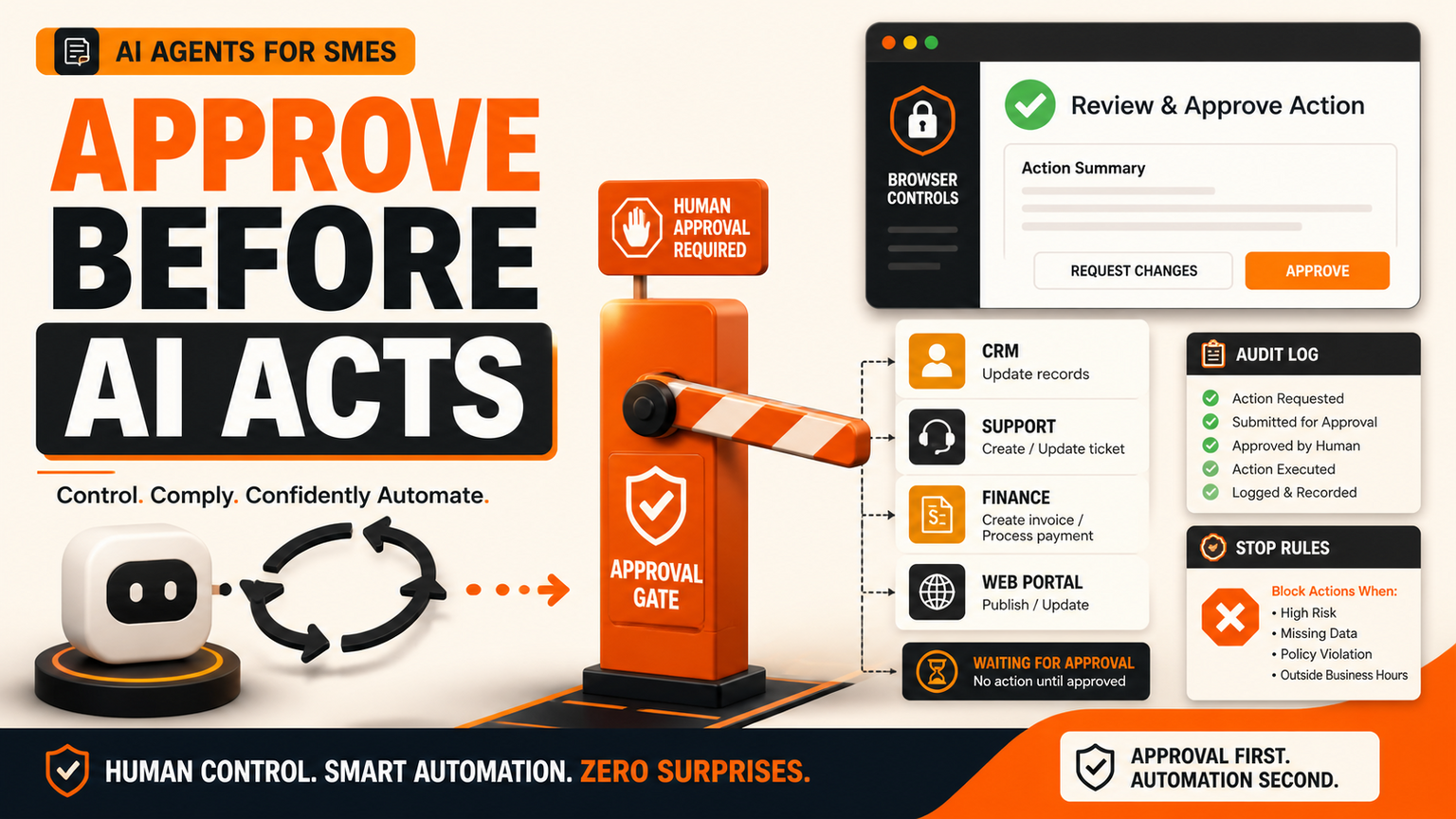
The business problem is control. An agent that can prepare work is useful. An agent that can update CRM records, submit support replies, change finance details, edit documents, or operate a web portal needs a clear pause point. GOFTUS helps SMEs build that operating layer through /agents, so AI agents can observe, prepare, request approval, act only inside limits, and leave a log.
For UK, US, and EU businesses, this matters before the first impressive demo becomes a production habit. A loop is only safe when the business knows who owns the workflow, what actions are allowed, what needs human review, and how to stop the agent when context changes.
What this means for SMEs
The market is moving from chat prompts to agents that coordinate work. Google News RSS results for AI agent governance and browser controls surfaced headline-level cross-checks from sources including CIO coverage on choosing an AI governance model before agents go live, Cloudflare browser-agent coverage, and wider security reporting on agent identity risk. Those listings do not prove any one vendor is right for SMEs. They do confirm the topic is active: businesses are asking how agents should be governed before they enter live workflows.
A small business does not need a giant AI programme to start safely. It needs a narrow workflow with defined lanes. For example, an agent may read a customer enquiry, draft a CRM note, find missing details, prepare a support reply, and suggest a next step. The approval workflow decides whether the reply is sent, the CRM is updated, or the task is routed to a person.
Without that structure, agent loops create hidden risk. They may repeat a flawed action, over-trust a weak source, update the wrong record, send a message too early, or keep trying after a login, policy, or customer condition changes. The risk is not only hallucination. It is action without ownership.
That is why the evergreen buyer problem is not simply "AI agents." It is AI agents with approval workflows, logs, browser controls, and stop rules. SMEs need agents that improve throughput without removing responsibility.
How to design an approval workflow for AI agents
Start by separating preparation from action. Preparation can often be automated sooner. The agent can summarize an email thread, classify the request, draft a response, extract document fields, compare CRM records, or build a task checklist. Action should be more controlled. Sending external messages, changing finance fields, submitting forms, updating customer records, escalating support promises, or using a browser with AI controls should require a rule.
A practical GOFTUS workflow usually has four lanes.
First, observe. The agent reads only the approved sources for that process: inbox, CRM, support desk, website form, knowledge base, document folder, or portal. Access is narrow, not company-wide.
Second, prepare. The agent drafts the next step, explains the source it used, marks missing data, and assigns a risk level. This makes the work reviewable instead of mysterious.
Third, approve. A human owner accepts, edits, rejects, or escalates. Approval can be quick for low-risk work and stricter for financial, legal, security, customer complaint, or public communication actions.
Fourth, act and log. If approved, the workflow performs the update, records who approved it, stores the before and after state, and sends exceptions back to the owner.
This is where browser-based workflow automation needs extra care. If an agent touches web portals, procurement systems, customer dashboards, ticketing tools, or partner sites, it should run behind browser with AI controls: login boundaries, domain allow-lists, form-submit approval, download limits, screenshots or event logs, and stop rules.
Bharatvaj's view
Bharatvaj's view is that SMEs should judge AI agents by the workflow around the agent, not the cleverness of the loop. A demo can look autonomous because it keeps calling tools. A reliable business system looks controlled because the agent knows when not to act.
The first GOFTUS build should be deliberately small. Pick one repeatable workflow such as sales follow-up, support triage, document intake, CRM cleanup, finance preparation, onboarding, or browser-based portal updates. Decide which steps the agent may do alone, which steps it may only prepare, and which steps must be approved every time.
The second build can add reporting. Which actions were approved? Which were rejected? Which tasks waited too long? Which prompts produced poor drafts? Which browser actions were blocked by policy? This turns AI agents into an improvement loop rather than an uncontrolled shortcut.
If a business wants a quick diagnostic, GOFTUS can review the workflow, rank the risk, and suggest an approval-first build path through /contact or /agents.
Summery for SMEs
AI agents are useful when they reduce repeated work without hiding responsibility. Before SMEs let loop orchestrators act, they should define sources, permissions, approval gates, logs, and stop rules. The safest pattern is simple: let agents prepare more work than they execute, then approve the actions that touch customers, money, records, documents, or browser portals.
Competitor lens
Tools like Zapier, n8n, Make, Bardeen, Gumloop, Lindy, Relevance AI, and Stack AI can help connect systems and prototype agent workflows. Consultancies such as Faculty AI, Deeper Insights, Waracle, Brainpool AI, LeewayHertz, Markovate, SoluLab, BairesDev, Addepto, STX Next, Netguru, and 10Clouds can also support broader AI programmes.
The gap for many SMEs is ownership. Tools automate tasks. GOFTUS automates the workflow around the task. That means the trigger, source-of-truth, approval rule, exception path, audit log, browser boundary, reporting loop, and monthly improvement cycle are designed together.
This is not anti-tool. It is tool-aware. A workflow may still use n8n, Zapier, an AI model, a CRM, a support desk, and a browser automation layer. GOFTUS makes those parts answer to a business process instead of leaving staff to supervise a loose chain of automations.
FAQ
Should SMEs use autonomous AI agents now? Yes, but start with narrow workflows where the agent prepares work and humans approve risky actions.
Where should browser controls fit? Use browser controls whenever an agent logs into web tools, submits forms, downloads files, or updates external portals.
What should GOFTUS build first? Start with one workflow that loses time or trust today: CRM follow-up, support triage, document intake, reporting, or controlled browser action.
Source notes
Social signal: GOFTUS Reddit intelligence for 2026-08-14 scored r/ClaudeAI "Example of a real working loop orchestrator" at 100. This is treated as operator interest, not verified market research.
News cross-check: Google News RSS searches for AI agent governance and browser controls showed headline-level items from CIO, Cloudflare-related coverage, and security reporting on agent risk. Direct article access was not required for claims in this post.
GOFTUS framing: /agents is the primary internal path because the post focuses on practical AI agent workflows, approval gates, logs, and browser-action boundaries.