AI agents need approval gates before they touch money
AI agents can help SMEs move faster, but money, data, and customer actions need approval gates, audit logs, and clear stop rules first.
# AI agents need approval gates before they touch money Meta description: AI agents can help SMEs move faster, but money, data, and customer actions need approval gates, audit logs, and clear stop rules first. # Quick
AI agents need approval gates before they touch money
Meta description: AI agents can help SMEs move faster, but money, data, and customer actions need approval gates, audit logs, and clear stop rules first.
Quick answer
The strongest model and tool signal today was not that AI agents are becoming magical. It was that operators are putting agents near real decisions and then discovering that speed without boundaries is expensive. Reddit intelligence surfaced r/ClaudeAI discussions about Claude handling money, subagents making risky changes, and paid model limits changing how people trust the tool. Those posts are social heat only, but they point at a buyer problem SMEs recognise immediately: who approves the moment an AI moves from advice into action?
What this means for SMEs
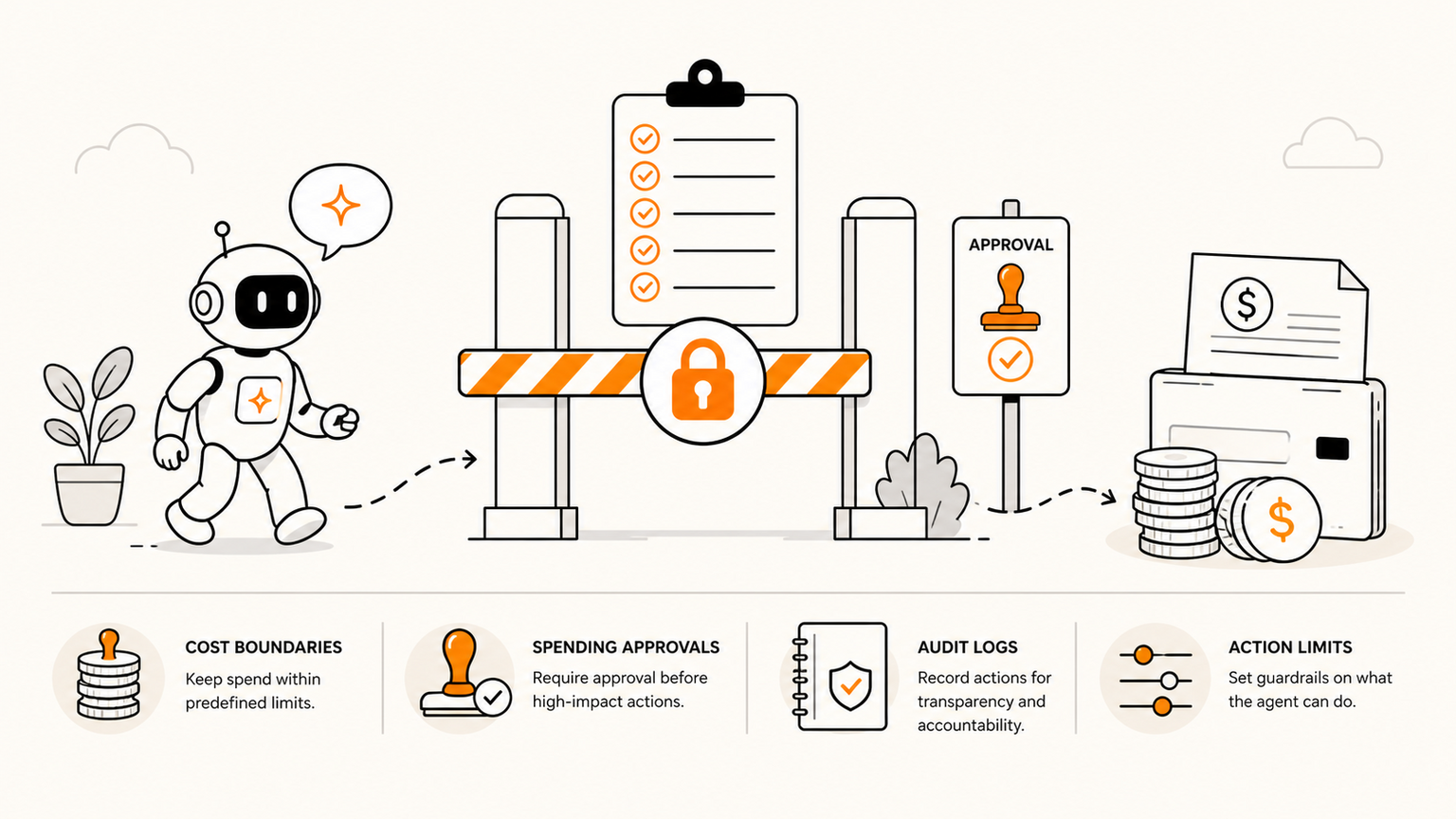
For GOFTUS, the evergreen keyword is ai agents. The practical issue is not whether Claude, ChatGPT, Gemini, or another model is smartest this week. It is whether the workflow around the agent has a named owner, a spending limit, a permission boundary, and a record of every proposed action. If an agent can prepare a quote, reconcile a payment, draft a refund, update a CRM record, or submit through a browser, the business needs a controlled lane before it acts.
The first workflow is an approval queue. Green steps can run automatically, such as summarising a ticket or finding missing fields. Amber steps need a human tap, such as sending a customer reply, changing a deal stage, or triggering a supplier order. Red steps are blocked until a manager reviews them, especially payments, cancellations, access changes, and anything that touches regulated data. Every lane should write to an audit log so the team can see what happened later.
What competitors are missing
This is where SaaS tools and consultants are useful but incomplete. A tool may offer a button called approval, and a consultant may produce a policy. GOFTUS focuses on the living workflow: triggers, integrations, review screens, exception routing, logs, fallback model choices, and monthly improvement. The outcome is not blind autonomy. It is fewer manual chases, faster preparation, and fewer risky clicks made without context.
Workflow GOFTUS would implement
ROI should be measured by avoided rework and faster throughput, not by vague AI excitement. Track how many agent proposals were approved, rejected, edited, or escalated. Track how long approvals took and which exceptions repeat. If a finance, support, or sales workflow repeatedly hits the red lane, that tells the business where clearer rules or better data are needed. That is how ai agents become operational capacity rather than another risky subscription.
AI agent action control checklist
For this workflow, GOFTUS would begin with a short discovery session: what systems the agent can read, what systems it can change, which actions cost money, and who is accountable when something unexpected happens. The build would then separate preparation from execution. The agent can collect context, draft options, and explain its recommendation. Execution waits for a human when the action touches spend, customer commitments, access, or a public system. A second layer records the prompt, source data, approval, result, and any rollback step. This is also where cost governance belongs. If a model route becomes expensive or unreliable, the workflow should have a cheaper fallback lane, a usage ceiling, and a reason code when staff override it. That gives SMEs practical AI agents without pretending every action deserves full autonomy. The business can then review weekly exceptions and decide which rules can be tightened, relaxed, or turned into training material.
Rollout plan
A safe rollout should move in four short phases. First, observe the existing process for a week and capture the real inputs, rework, waiting time, and exceptions. Second, prepare the automation in a limited lane where AI can draft, classify, summarise, or route but cannot make irreversible changes. Third, approve the risky steps with named owners and simple review screens. Fourth, review the log and improve the workflow every month. This is deliberately less dramatic than buying a large platform and hoping staff adapt. It is also more reliable for SMEs because it respects the tools, habits, and constraints already inside the business.
The first version should be narrow enough that one manager can explain it in plain English. If staff cannot say when the workflow starts, where the output goes, who approves exceptions, and how to stop it, the automation is not ready. GOFTUS would rather ship a controlled lane that saves a few hours every week than an impressive demo nobody trusts. Once the log proves the workflow is safe, the business can widen the scope with confidence.
Summery for SMEs
The Reddit signal points to a practical operating lesson: AI agents with spending, cost, and action approval gates for SMEs. GOFTUS would turn that into a controlled workflow with a named owner, clear inputs, approval gates for risky actions, logs for review, and a monthly improvement loop. The internal path for this topic is /agents, with supporting Q&A on /questions.
FAQ
What should an SME do first? Start with one workflow that already creates delays or risk, then define the trigger, owner, allowed AI step, review gate, and log before adding more tools.
Where does GOFTUS fit? GOFTUS designs and manages the workflow around the tool: integrations, approval screens, exception routing, audit logs, and improvement after staff use it.
Sources and signal
Reddit/social signal: r/ClaudeAI posts discussed Claude handling money, subagent mistakes, usage limits, and model confusion. Reddit is treated as social heat, not verified fact.
News/source cross-check: Google News RSS returned headline-level context including Startup Fortune on AI agent approval queues, TIME on Claude managing workers, and agent automation coverage.
Source note: Reddit is used as operator sentiment and social heat only. Google News RSS results are cited at headline level where direct article retrieval was not available during the unattended run.