Accenture Breach Reports Show Why SMEs Need Workflow Security Controls
Accenture breach reports show why SMEs need access controls, audit logs, approvals, and incident workflows around AI automation.
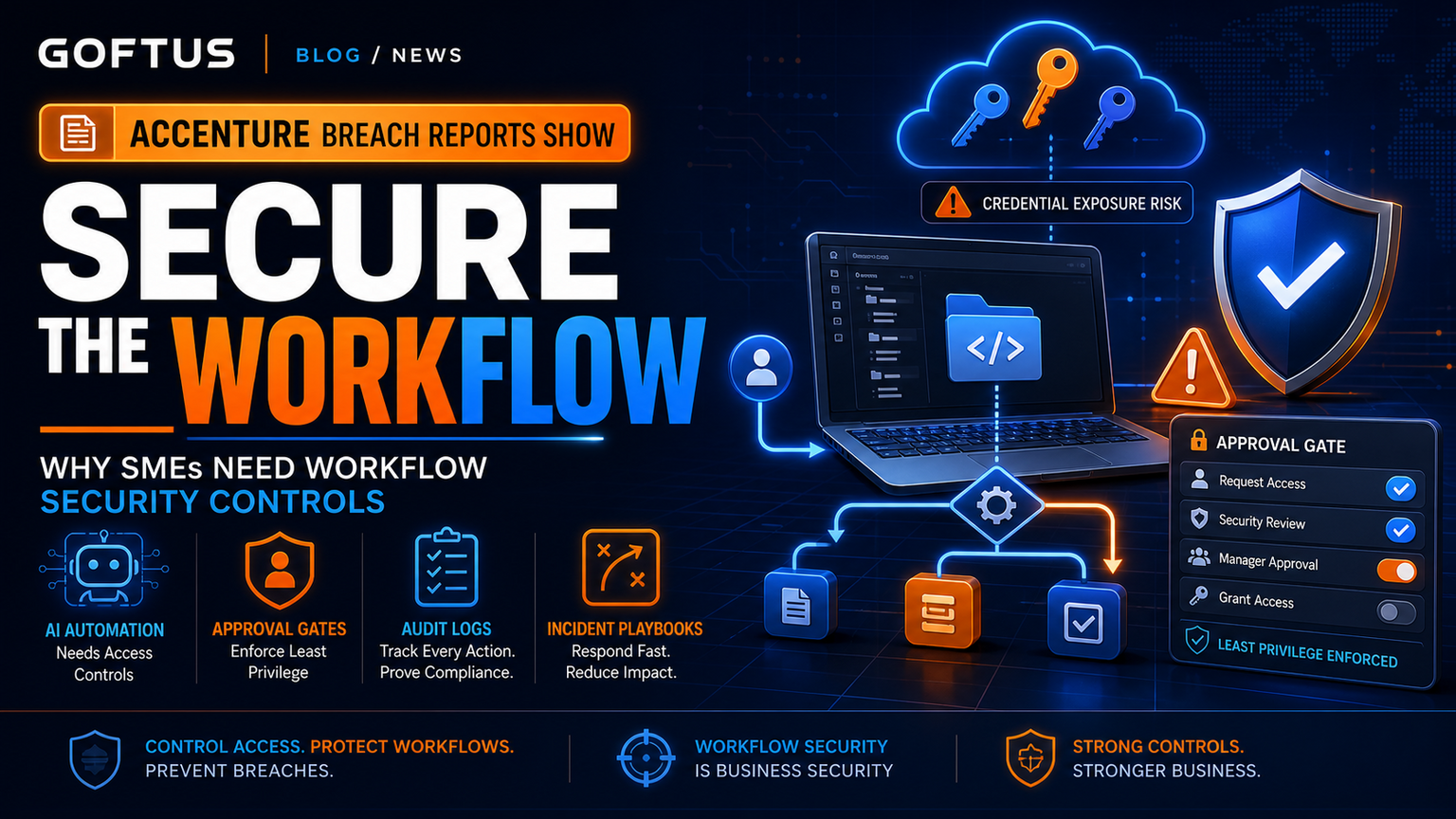
# Accenture Breach Reports Show Why SMEs Need Workflow Security Controls Meta description: Accenture breach reports show why SMEs using AI automation need access controls, audit logs, approvals, and incident workflows b
Accenture Breach Reports Show Why SMEs Need Workflow Security Controls
Meta description: Accenture breach reports show why SMEs using AI automation need access controls, audit logs, approvals, and incident workflows before tools scale risk.
Quick answer
Reports of an Accenture security incident should matter to UK, US, and EU SMEs because the lesson is not limited to large consultancies. When source code, cloud keys, credentials, or client delivery systems are discussed in a breach story, the practical question for smaller firms is simple: who can access business-critical workflows, what can they change, and how quickly can the team prove what happened?
The main source signal for this post is a live cybersecurity news cycle. Reuters and some direct pages were not fully accessible from this unattended run, so this article treats the incident as a reported and cross-checked security-news signal rather than adding unverified details.
Bharatvaj's view: the SME lesson is not to copy enterprise security theatre. It is to put practical controls around the everyday workflows that now include AI tools, SaaS integrations, CRM automations, document processing, and agentic assistants. GOFTUS helps businesses design those controls into the workflow itself, from AI automation services to agentic workflow systems, instead of leaving security as a quarterly checklist.
Why this breach story matters for operators
Most SMEs will not have the same infrastructure footprint as Accenture. They may not run huge global delivery platforms, complex cloud environments, or thousands of developer accounts. But they increasingly share one risk pattern with larger companies: important business work is spread across SaaS tools, code repositories, shared drives, CRMs, support inboxes, spreadsheets, automation builders, and AI assistants.
That spread creates a control problem. A workflow that starts in a form may update a CRM, trigger a follow-up email, attach a document, call an AI model, create a task, and notify a sales or support team. If the wrong account has too much access, or if no one reviews the automation path, one compromised credential can touch more systems than expected.
For SMEs, the right response is not panic. It is workflow mapping. Which steps are automated? Which accounts own the integrations? Which API keys exist? Which actions require human approval? Which logs would prove whether a customer record, document, or payment workflow changed? Those questions are operational, not abstract.
What this means for SMEs
The security news cycle is a reminder that automation should not be separated from governance. A business can use Zapier, n8n, Make, Bardeen, Gumloop, Lindy, Relevance AI, Stack AI, or custom scripts safely, but only if the workflow has guardrails.
A practical SME setup should include least-privilege access for automation accounts, named owners for each workflow, approval gates for sensitive actions, error alerts, monthly permission reviews, and a short incident playbook. If an AI agent can draft a reply, update a CRM field, read uploaded documents, or call an external tool, the business should know exactly where human review sits.
The same logic applies to internal knowledge assistants and document automation. AI should help teams move faster, but it should not quietly widen access to contracts, HR files, customer data, invoices, or credentials. The best automation systems reduce manual effort while making accountability clearer.
Competitor lens
Faculty AI, Deeper Insights, Waracle, and Brainpool AI in the UK can support serious AI programmes. LeewayHertz, Markovate, SoluLab, and BairesDev in the US can build custom systems. Addepto, STX Next, Netguru, and 10Clouds in Europe can deliver capable engineering. SaaS tools such as Zapier, n8n, Relevance AI, Lindy, Gumloop, Bardeen, Make, and Stack AI are useful for fast automation.
What competitors are often missing for SMEs is the operating layer around the automation. Tools automate tasks. GOFTUS automates the workflow around the task. That means the form, routing logic, approval step, CRM update, exception queue, audit log, support handoff, reporting dashboard, and monthly improvement loop are designed together.
This matters after a breach story because the weak point is rarely just one tool. It is usually the join between tools, people, permissions, and monitoring. GOFTUS counter-positions on that join. We help SMEs build AI automation with control points that owners can understand and staff can actually follow.
What SMEs should do next
First, list the workflows where automation or AI can touch customer data, financial data, operational decisions, or credentials. Do not start with every tool in the company. Start with five workflows that would hurt if they changed without approval.
Second, identify the automation account behind each workflow. If a shared admin login owns everything, separate it. If an API key has broad access, reduce it. If a chatbot or AI agent can take action, define what it can only suggest and what it can execute.
Third, add proof. Every sensitive workflow should leave a useful trail: who requested the action, what changed, which automation ran, whether a human approved it, and where exceptions go. Logs are not just for forensic teams. They are how business owners stay calm when something looks wrong.
Fourth, test the incident path. If a staff member reports a suspicious CRM update or an unexpected file share, who pauses the automation? Who rotates the key? Who checks the log? Who contacts customers if needed? A one-page playbook beats a large policy that no one uses.
If you want a practical starting point, GOFTUS can review your current automations and design a safer first control layer through our workflow automation services or an AI agents consultation.
Summery for SMEs
The Accenture breach reports are a useful warning for smaller businesses because modern operations are now connected by automation, SaaS tools, and AI assistants. SMEs do not need enterprise complexity, but they do need clear workflow security controls.
Start with access, approvals, logs, and incident playbooks around the workflows that matter most. Then expand automation with confidence. GOFTUS helps teams move from scattered tools to measurable, monitored, and human-approved workflow systems.
FAQ
Does a large-company breach matter to a small business?
Yes, if the small business uses connected SaaS tools, shared credentials, AI assistants, or automation accounts. The scale is different, but the workflow risk is similar. A compromised account can still update records, send messages, expose files, or break a customer process.
Should SMEs stop using automation after breach reports?
No. The better response is controlled automation. Keep the time savings, but add least-privilege access, named workflow owners, approval gates, audit logs, and clear exception handling. Automation becomes safer when the workflow is designed intentionally.
How can GOFTUS help with workflow security?
GOFTUS maps the workflow before automating it. We define the data touched, the systems involved, the human approval points, the logging requirements, and the incident response path. That gives SMEs practical security controls without slowing every task.
Source notes
Reddit cybersecurity feeds returned rate limits after the first Reddit source pass, so no direct Reddit claim is made for this topic.